The La Brea Tar Pits are a cluster of natural asphalt seeps located in Hancock Park, Los Angeles. For tens of thousands of years, crude oil has seeped to the surface, creating sticky asphalt traps that ensnared prehistoric animals, insects, and plants. The preservation of these specimens in the asphalt has provided scientists with an unparalleled record of the late Pleistocene epoch in North America.
The site remains an active paleontological research facility. The George C. Page Museum, located on the grounds, houses a vast collection of fossils recovered from the pits, including remains of mammoths, saber-toothed cats, and dire wolves. Ongoing excavations continue to yield new discoveries, offering insights into the environmental changes and extinction events of the last 50,000 years.
Key Facts
- Materials
- Asphalt, Natural gas, Sedimentary rock
- Civilization
- Natural geological formation
- Accessibility
- Fully wheelchair accessible
- Date(s)
- 50,000 years ago - present
- Condition
- Active research site and public museum
- Original Function
- Natural asphalt seep and animal trap
- Key Figures
- John C. Merriam, George C. Page
Geological Formation
PleistoceneThe asphalt seeps formed due to the movement of crude oil from the Salt Lake Oil Field through fissures in the local sedimentary rock. As the lighter components of the oil evaporated, a thick, sticky asphalt remained, creating natural traps that have been active for approximately 50,000 years.
Indigenous Use
Pre-colonialThe Chumash and Tongva peoples utilized the naturally occurring asphalt for thousands of years. They employed the material as a waterproof sealant for canoes, baskets, and housing, as well as an adhesive for tools and ceremonial items.
Scientific Discovery
1901-1915While the presence of bones had been noted by early settlers, it was not until 1901 that geologist W.W. Orcutt recognized the scientific significance of the fossils. Systematic excavations led by John C. Merriam of the University of California, Berkeley, began in 1905, revealing a massive concentration of extinct megafauna.
Modern Research and Preservation
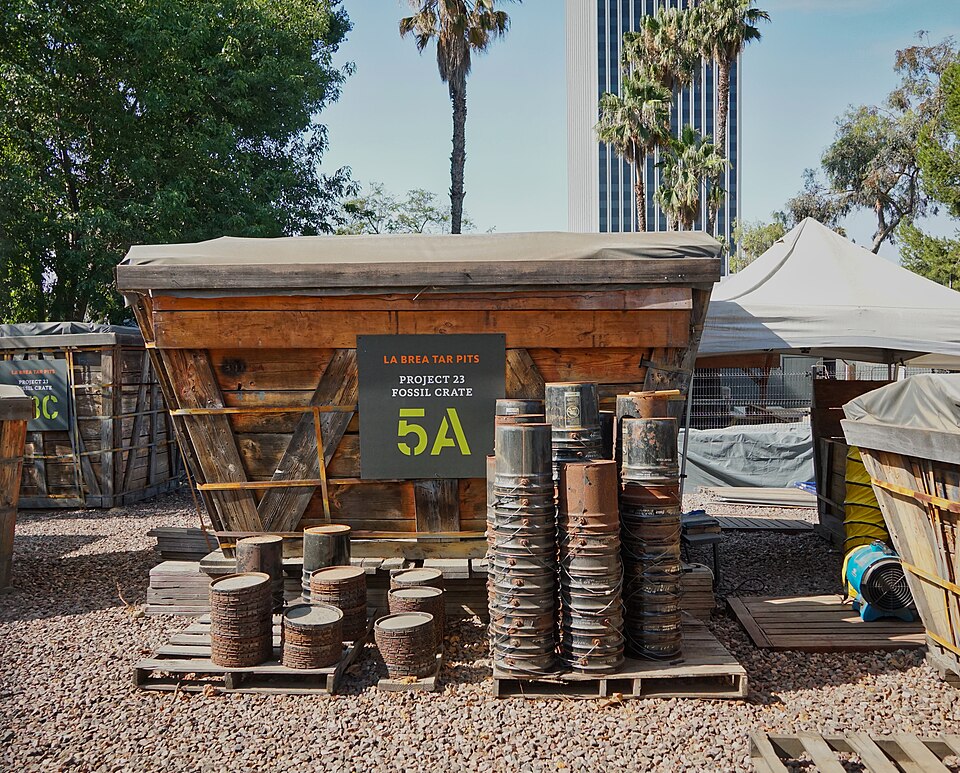
1977-presentThe George C. Page Museum opened in 1977 to house the growing collection of fossils. Today, the site is managed by the Natural History Museum of Los Angeles County. Researchers continue to excavate active pits, such as Project 23, which was discovered during the construction of an underground parking garage.
Cultural Significance
The La Brea Tar Pits serve as a unique intersection of urban development and deep-time history. They are a cornerstone of Los Angeles' scientific identity, providing a rare window into the prehistoric ecosystem of the Los Angeles Basin. The site is a major educational resource, bridging the gap between public interest in paleontology and rigorous academic research.
Beyond its scientific value, the site is a landmark of local heritage, representing the long history of human interaction with the land, from the indigenous use of asphalt to the modern preservation of fossilized remains.
Interpretive Notes
Scholarly debates and areas of uncertainty
There is ongoing discussion regarding the 'predator trap' hypothesis, which seeks to explain the disproportionately high number of carnivores found in the pits compared to herbivores. While the theory suggests that predators were lured to the pits by the distress calls of trapped prey, some researchers argue that the dynamics of entrapment were more complex and influenced by seasonal environmental factors.
Visiting Information
Entry Rules
Open daily. Admission is required for the museum, while the surrounding park grounds are accessible to the public. Visitors should follow posted safety signage near active pits and construction areas.
Best Times to Visit
Weekdays during the school year to avoid peak weekend crowds. Early morning visits allow for cooler temperatures when exploring the outdoor park area.
Photography
Personal photography is permitted throughout the park and museum. Commercial photography and filming require prior authorization from the museum administration.
Preservation Notes
Stay on marked paths and behind safety barriers. The asphalt is sticky and can be difficult to remove from clothing or shoes. Do not attempt to touch or collect samples from the active seeps.
Nearby POIs
11 shown- George C. Page Museum0.1 km
- Los Angeles County Museum of Art0.3 km
- Academy Museum of Motion Pictures0.4 km
- Petersen Automotive Museum0.5 km
- Hollywood Walk of Fame4.5 km
- Hollywood Museum4.5 km
- Hollywood Wax Museum4.5 km
- Griffith Observatory7.9 km
- Natural History Museum of Los Angeles County8.1 km
- Hammer Museum8.1 km
- California Science Center8.3 km
Key Facts
- Materials
- Asphalt, Natural gas, Sedimentary rock
- Civilization
- Natural geological formation
- Accessibility
- Fully wheelchair accessible
- Date(s)
- 50,000 years ago - present
- Condition
- Active research site and public museum
- Original Function
- Natural asphalt seep and animal trap
- Key Figures
- John C. Merriam, George C. Page
Nearby POIs
11 shown- George C. Page Museum0.1 km
- Los Angeles County Museum of Art0.3 km
- Academy Museum of Motion Pictures0.4 km
- Petersen Automotive Museum0.5 km
- Hollywood Walk of Fame4.5 km
- Hollywood Museum4.5 km
- Hollywood Wax Museum4.5 km
- Griffith Observatory7.9 km
- Natural History Museum of Los Angeles County8.1 km
- Hammer Museum8.1 km
- California Science Center8.3 km