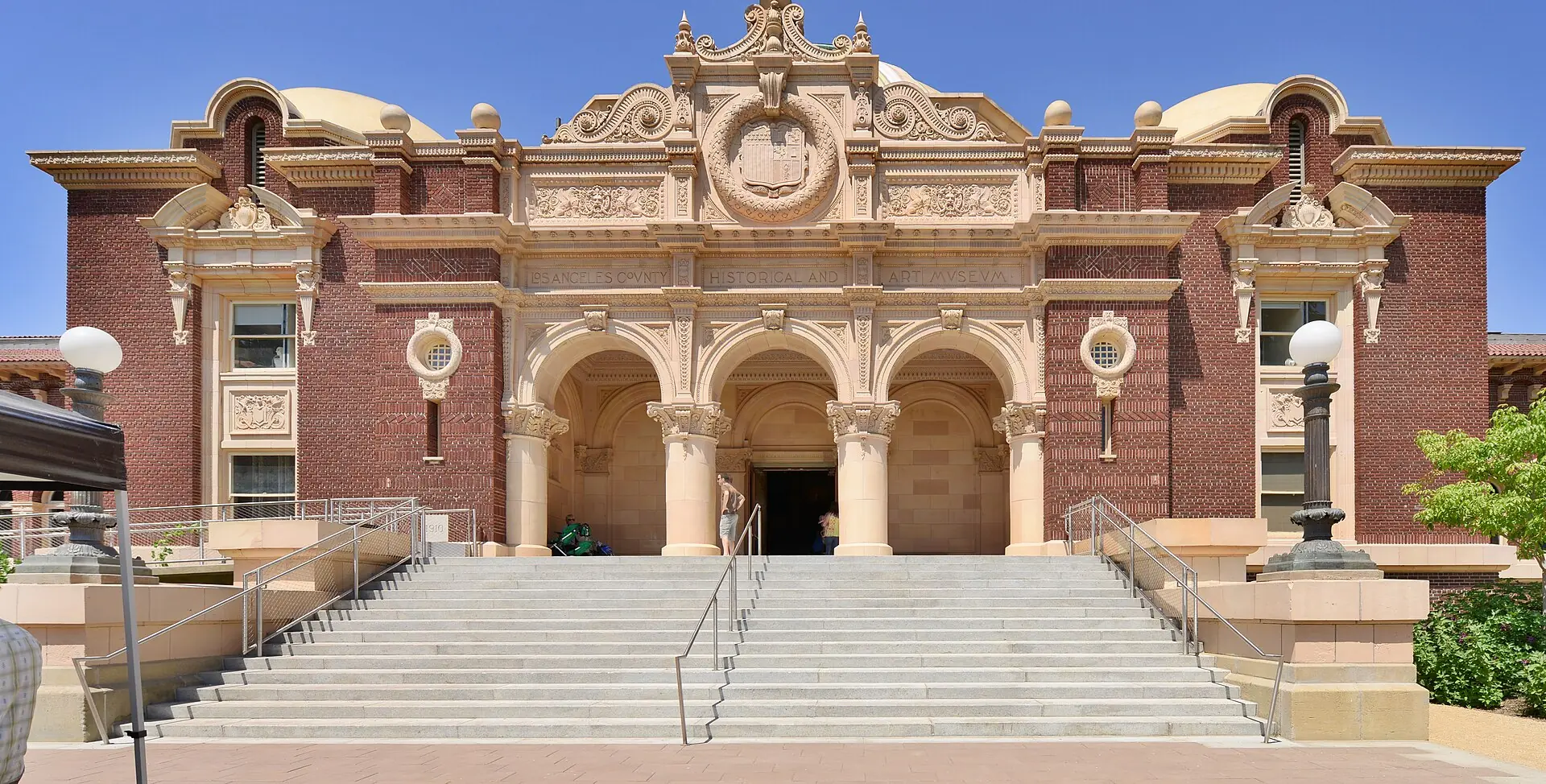
The Natural History Museum of Los Angeles County (NHM) is the largest natural and historical museum in the Western United States. Located in Exposition Park, it serves as a major research institution and public center for the study of natural and cultural history, housing a collection of nearly 35 million specimens and artifacts that span 4.5 billion years of history.
The museum's original 1913 building, a Beaux-Arts structure listed on the National Register of Historic Places, serves as the anchor for an expansive campus. Its collections are particularly noted for their extensive holdings in paleontology, mineralogy, and malacology, as well as significant cultural artifacts documenting the history of Southern California.
Key Facts
- Materials
- Concrete, Steel, Stone
- Civilization
- United States
- Accessibility
- Fully ADA compliant
- Date(s)
- 1913
- Condition
- Active, well-maintained
- Original Function
- Museum of History, Science, and Art
- Key Figures
- William M. Bowen, Frank D. Hudson
Founding and Early Years
1910-1913The museum was established in 1913 as the Museum of History, Science, and Art. The original rotunda building was designed by architects Frank D. Hudson and William A. Munsell, reflecting the civic growth of Los Angeles during the early 20th century.
Institutional Evolution
1961-2000In 1961, the institution was renamed the Natural History Museum of Los Angeles County, reflecting its specialized focus. Over the following decades, the museum expanded its research facilities and public exhibition spaces to accommodate its growing collection of natural specimens.
Modern Expansion
2000-PresentThe museum underwent significant renovations in the 21st century, including the opening of the Dinosaur Hall in 2011 and the Nature Gardens in 2013. These projects integrated modern exhibition design with the historic architecture of the original campus.
Cultural Significance
The museum acts as a critical repository for the biological and cultural heritage of the Pacific Rim and Southern California. It plays a vital role in public education and scientific research, bridging the gap between academic paleontology and community engagement through its extensive outreach programs and public exhibits.
Interpretive Notes
Scholarly debates and areas of uncertainty
Discussions within the institution often center on the balance between maintaining historic architectural integrity and the necessity of modernizing exhibition spaces to accommodate large-scale paleontological displays.
Visiting Information
Entry Rules
Open daily. Tickets are required for entry; residents of Los Angeles County receive free general admission during specific weekday hours with valid identification.
Best Times to Visit
Weekday mornings are recommended to avoid weekend crowds. The Nature Gardens are best visited during spring and early summer when local flora is in bloom.
Photography
Personal photography is permitted for non-commercial use. Flash and tripods are prohibited in exhibition galleries.
Preservation Notes
Visitors are requested not to touch display cases or artifacts. Food and drink are restricted to designated areas outside of the galleries.
Nearby POIs
11 shown- California Science Center0.3 km
- Grammy Museum3.8 km
- The Broad5.4 km
- Japanese American National Museum5.9 km
- George C. Page Museum8 km
- La Brea Tar Pits8.1 km
- Petersen Automotive Museum8.4 km
- Los Angeles County Museum of Art8.4 km
- Academy Museum of Motion Pictures8.4 km
- Watts Towers Arts Center9.6 km
- Hollywood Museum10.4 km
Sources & Further Reading
- [1]Natural History Museum of Los Angeles County: A Century of Discovery — William R. F. Phillips. Natural History Museum Press (2013)View
- [2]The Architecture of Exposition Park — James J. Miller. Journal of California History (2018)
Key Facts
- Materials
- Concrete, Steel, Stone
- Civilization
- United States
- Accessibility
- Fully ADA compliant
- Date(s)
- 1913
- Condition
- Active, well-maintained
- Original Function
- Museum of History, Science, and Art
- Key Figures
- William M. Bowen, Frank D. Hudson
Nearby POIs
11 shown- California Science Center0.3 km
- Grammy Museum3.8 km
- The Broad5.4 km
- Japanese American National Museum5.9 km
- George C. Page Museum8 km
- La Brea Tar Pits8.1 km
- Petersen Automotive Museum8.4 km
- Los Angeles County Museum of Art8.4 km
- Academy Museum of Motion Pictures8.4 km
- Watts Towers Arts Center9.6 km
- Hollywood Museum10.4 km