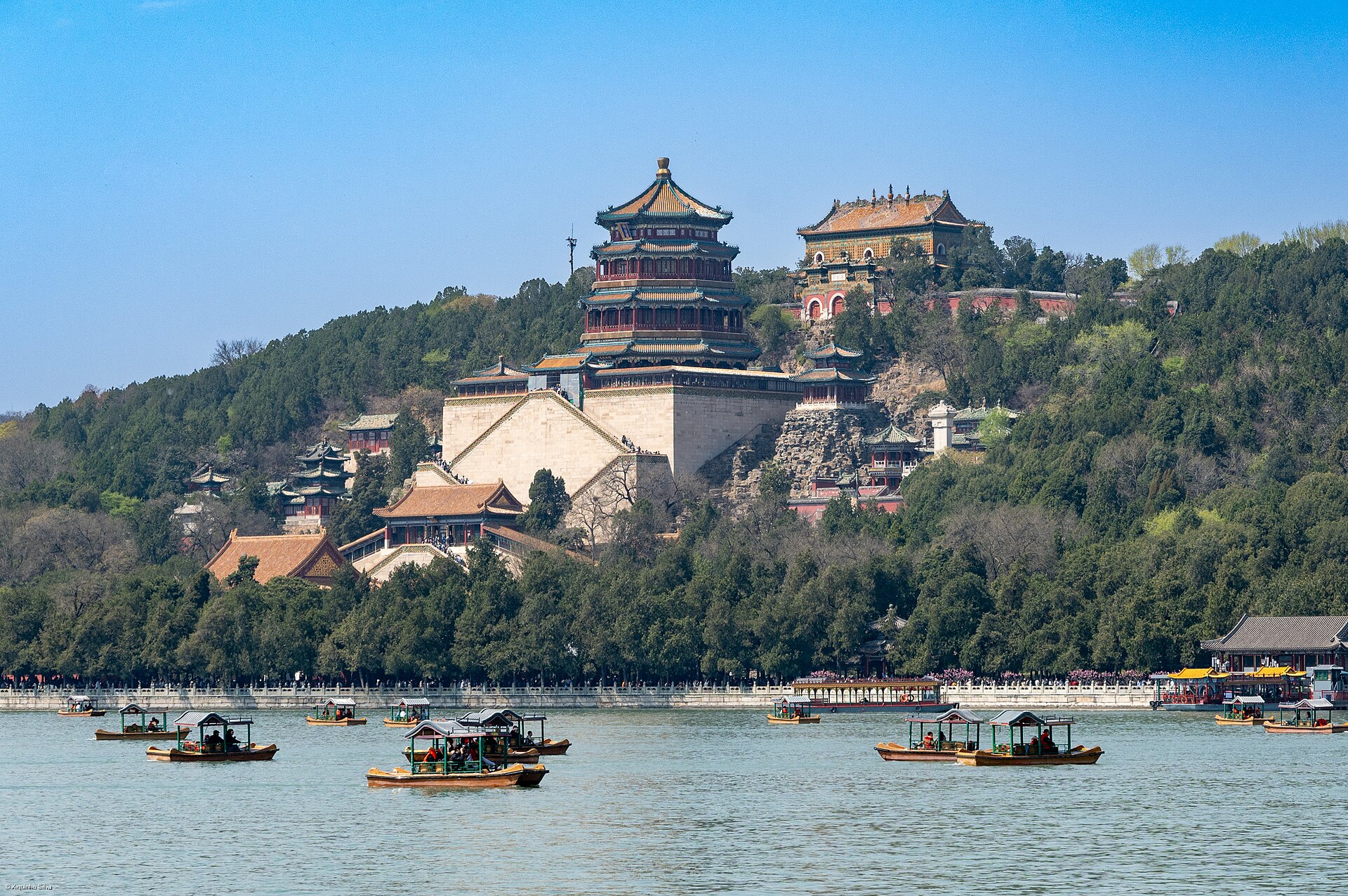
The Summer Palace in Beijing is a vast ensemble of lakes, gardens, and palaces that served as the primary retreat for the Qing Dynasty emperors. Spanning over 290 hectares, the site is dominated by Longevity Hill and Kunming Lake, which were extensively landscaped to reflect traditional Chinese garden design principles, emphasizing harmony between human-made structures and the natural environment.
The complex contains over 3,000 ancient buildings, including pavilions, temples, and bridges, housing a collection of more than 40,000 historical relics. It stands as a masterpiece of Chinese landscape garden design, integrating political, administrative, and residential functions within a highly aestheticized imperial setting.
Key Facts
- Materials
- Wood, Stone, Glazed tile, Brick
- Civilization
- Qing Dynasty
- Accessibility
- Partially accessible; some steep paths and stairs on Longevity Hill
- Date(s)
- 1750 (major expansion)
- Condition
- Well-preserved, public park and museum
- Original Function
- Imperial garden and summer retreat
- Key Figures
- Emperor Qianlong, Empress Dowager Cixi
Origins and Expansion
1750-1764The site was significantly expanded by Emperor Qianlong, who ordered the dredging of Kunming Lake and the use of the excavated earth to enlarge Longevity Hill. This project aimed to create a grand garden for his mother's birthday, establishing the core layout seen today.
Destruction and Reconstruction
1860-1886During the Second Opium War in 1860, Anglo-French forces destroyed much of the original garden structures. In 1886, Empress Dowager Cixi diverted funds intended for the navy to reconstruct the palace, using it as her primary residence and center for political activity.
Modern Era
1924-PresentFollowing the end of the Qing Dynasty, the Summer Palace was opened to the public as a park in 1924. It was designated a UNESCO World Heritage Site in 1998, recognized for its exceptional preservation of imperial garden architecture.
Cultural Significance
The Summer Palace represents the pinnacle of Chinese imperial garden design, embodying the philosophical concept of 'man and nature in one.' It served as a critical site for imperial governance during the late Qing period, particularly under Empress Dowager Cixi, who managed state affairs from the palace.
Today, it is a symbol of Chinese cultural heritage and a major site for public recreation. It reflects the transition of imperial spaces from exclusive royal retreats to public national monuments, serving as a focal point for historical education and tourism in Beijing.
Interpretive Notes
Scholarly debates and areas of uncertainty
There is ongoing academic discussion regarding the ethics of the reconstruction funded by Empress Dowager Cixi, specifically the diversion of naval funds during a period of national vulnerability. Scholars debate whether this decision significantly contributed to the decline of the Qing military and the subsequent geopolitical failures of the late 19th century.
Visiting Information
Entry Rules
Open daily. Tickets are required for entry to the park and specific internal attractions. Visitors must present valid identification (passport for foreigners) at the entrance.
Best Times to Visit
Early morning (before 9:00) to avoid large tour groups. Spring and autumn offer the most temperate weather for walking the extensive grounds.
Photography
Personal photography is permitted. Commercial photography and drone usage require prior authorization from the park administration.
Preservation Notes
Stay on designated paths to protect the landscape. Do not touch or climb on historical structures or artifacts. The site is subject to strict environmental protection regulations.
Nearby POIs
11 shown- China Science and Technology Museum10.6 km
- Military Museum of the Chinese People's Revolution10.9 km
- Prince Gong's Mansion11.9 km
- Capital Museum11.9 km
- Drum Tower and Bell Tower of Beijing12.2 km
- Beijing Temple of Confucius13.4 km
- Yonghe Temple13.6 km
- Forbidden City13.8 km
- National Art Museum of China14.2 km
- Chairman Mao Memorial Hall15.1 km
- National Museum of China15.2 km
Sources & Further Reading
- [1]Summer Palace: The Imperial Garden — Chen Congzhou. Foreign Languages Press (2005)
- [2]
Key Facts
- Materials
- Wood, Stone, Glazed tile, Brick
- Civilization
- Qing Dynasty
- Accessibility
- Partially accessible; some steep paths and stairs on Longevity Hill
- Date(s)
- 1750 (major expansion)
- Condition
- Well-preserved, public park and museum
- Original Function
- Imperial garden and summer retreat
- Key Figures
- Emperor Qianlong, Empress Dowager Cixi
Nearby POIs
11 shown- China Science and Technology Museum10.6 km
- Military Museum of the Chinese People's Revolution10.9 km
- Prince Gong's Mansion11.9 km
- Capital Museum11.9 km
- Drum Tower and Bell Tower of Beijing12.2 km
- Beijing Temple of Confucius13.4 km
- Yonghe Temple13.6 km
- Forbidden City13.8 km
- National Art Museum of China14.2 km
- Chairman Mao Memorial Hall15.1 km
- National Museum of China15.2 km