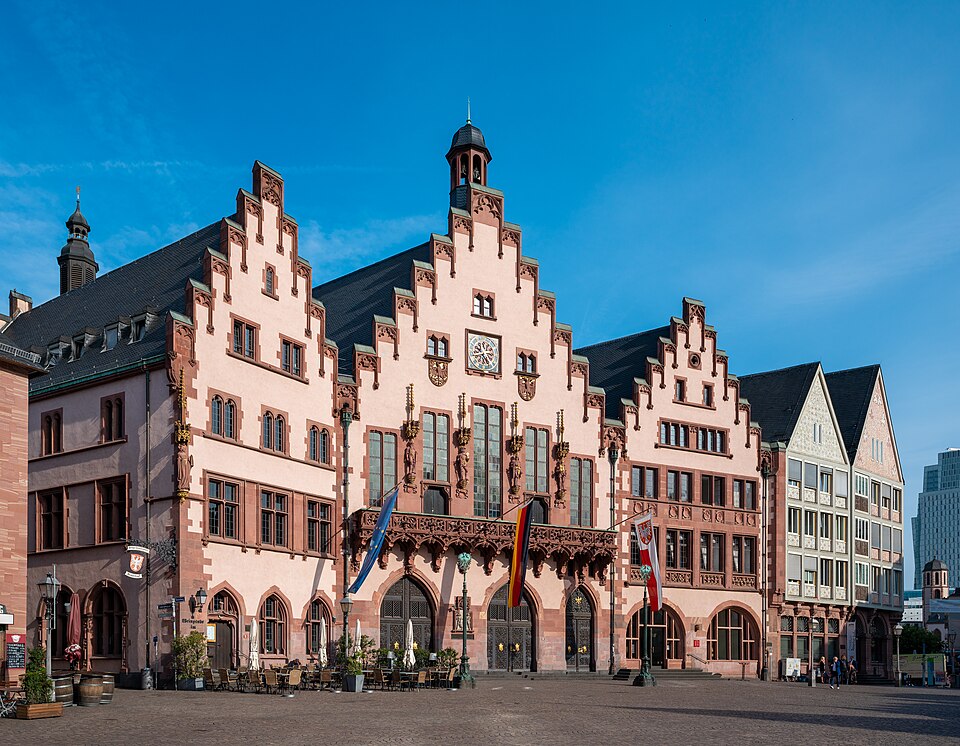
The Römer is a historic building complex in Frankfurt, Germany, which has served as the city's town hall for over 600 years. The structure is best known for its distinctive stepped-gable facade, which has become a primary architectural symbol of the city. Originally a collection of patrician houses, the central building was acquired by the city council in 1405 to function as the seat of municipal government.
Beyond its administrative role, the Römer holds significant historical importance as the site of coronation banquets for Holy Roman Emperors. Following the formal coronation ceremonies at the nearby Frankfurt Cathedral, the newly crowned monarchs would host elaborate feasts in the Kaisersaal (Emperor's Hall). Despite severe damage during World War II, the complex was meticulously reconstructed, maintaining its status as the heart of Frankfurt's civic life.
Key Facts
- Materials
- Sandstone, Timber framing
- Civilization
- Holy Roman Empire / German
- Accessibility
- Ground floor accessible; upper historical halls have limited access
- Date(s)
- 1405 (acquisition of core building)
- Condition
- Restored and active city hall
- Original Function
- Patrician residence and city hall
- Key Figures
- Maximilian II, Leopold II
Acquisition and Early Use
1405The city council purchased the 'Haus Römer' and the adjacent 'Haus Goldener Schwan' from the wealthy merchant family Römer. This acquisition consolidated the city's administrative functions into a single, prominent location.
Imperial Significance
1562-1792The Römer became the site of the coronation banquets for Holy Roman Emperors. The Kaisersaal was decorated with portraits of the emperors, serving as a stage for the political and social display of imperial power.
Destruction and Reconstruction
1944-1950sThe complex was largely destroyed by Allied bombing raids in March 1944. Post-war reconstruction began in 1947, with the city prioritizing the restoration of the iconic facade and the Kaisersaal to preserve the city's historical identity.
Cultural Significance
The Römer serves as the political and symbolic center of Frankfurt. It represents the city's long history as a free imperial city and its transition into a modern financial hub. The Kaisersaal remains a site of national importance, frequently used for state receptions and the celebration of major sporting victories by the German national football team.
Interpretive Notes
Scholarly debates and areas of uncertainty
Debates have historically centered on the authenticity of the post-war reconstruction. While some architectural historians argued for a modern interpretation of the site, the city's decision to replicate the medieval and Renaissance exterior remains a subject of study regarding the 'reconstruction of memory' in post-war Germany.
Visiting Information
Entry Rules
The Römerberg square is open to the public. The Kaisersaal is open for visitors when not in use for official city functions; check the official city website for daily availability.
Best Times to Visit
Weekdays during business hours for the best chance to view the interior halls. The square is most active during the Christmas market season.
Photography
Photography is permitted in public areas. Flash and tripods are prohibited inside the historical halls.
Preservation Notes
The building is an active administrative office; please respect designated quiet zones and staff-only areas.
Nearby POIs
10 shownSources & Further Reading
- [1]
- [2]The Holy Roman Empire: A Historical Encyclopedia — Jason Philip Coy. ABC-CLIO (2010)
Key Facts
- Materials
- Sandstone, Timber framing
- Civilization
- Holy Roman Empire / German
- Accessibility
- Ground floor accessible; upper historical halls have limited access
- Date(s)
- 1405 (acquisition of core building)
- Condition
- Restored and active city hall
- Original Function
- Patrician residence and city hall
- Key Figures
- Maximilian II, Leopold II