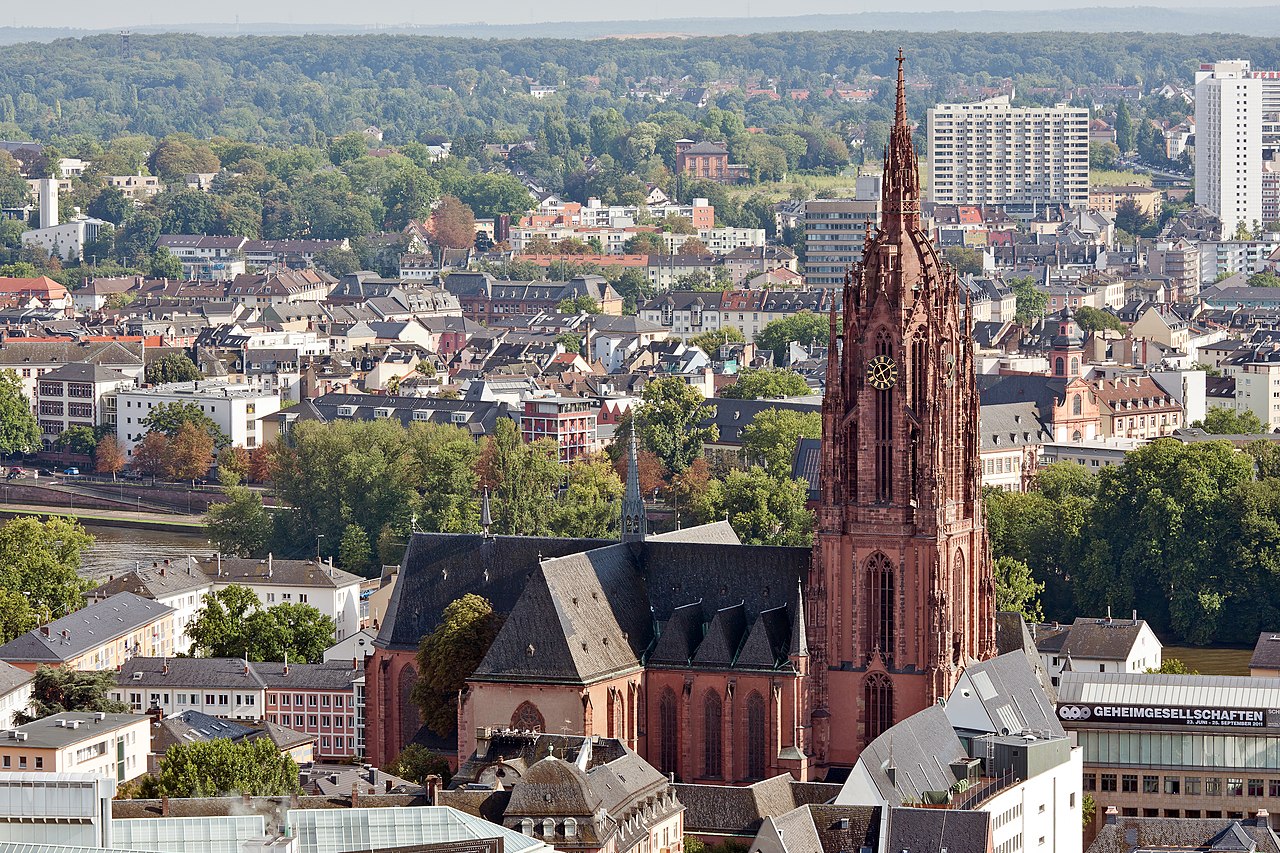
The Cathedral of Saint Bartholomew, commonly known as the Frankfurter Dom, is the largest religious building in Frankfurt am Main. Constructed primarily between the 14th and 15th centuries, the cathedral is a prominent example of Gothic architecture, characterized by its distinctive red sandstone masonry and a 95-meter-high tower that dominates the city skyline.
Beyond its religious function, the cathedral served as a critical site for the Holy Roman Empire. From 1356, it was the designated place for the election of kings, and from 1562 to 1792, it hosted the coronation ceremonies of ten Holy Roman Emperors. Despite suffering severe damage during World War II, the structure was meticulously reconstructed in the 1950s to preserve its historical significance.
Key Facts
- Materials
- Red sandstone
- Civilization
- Holy Roman Empire
- Accessibility
- Wheelchair accessible via side entrance
- Date(s)
- 1315–1514
- Condition
- Restored, active place of worship
- Original Function
- Collegiate church
- Key Figures
- Maximilian II, Leopold II
Early Foundations
7th–13th centuryThe site has hosted religious structures since the Merovingian period. A Carolingian palatine chapel was established here in the 8th century, which was later replaced by a Romanesque church dedicated to Saint Bartholomew in the 13th century.
Gothic Expansion
14th–15th centuryThe current Gothic structure was commissioned to replace the smaller Romanesque building. The choir was consecrated in 1315, and the nave was completed by the mid-15th century. The iconic tower was begun in 1415 by Madern Gerthener but remained unfinished for centuries.
Imperial Significance
1562–1792The cathedral gained immense political importance as the site for the election and coronation of Holy Roman Emperors. This era solidified its status as a national monument rather than just a local parish church.
Destruction and Reconstruction
1944–1953During the Allied bombing raids of 1944, the cathedral was severely damaged by fire, resulting in the loss of most interior furnishings. Reconstruction efforts began shortly after the war, with the tower being restored to its original design by 1953.
Cultural Significance
The Frankfurter Dom is a symbol of German national history, representing the intersection of ecclesiastical power and imperial governance. Its role in the coronation of emperors links the city of Frankfurt directly to the political legacy of the Holy Roman Empire.
Today, it serves as a center for the Catholic community in Frankfurt and remains a primary tourist destination. The cathedral museum, located in the cloister, houses significant liturgical artifacts that document the site's long history as a center of pilgrimage and political ceremony.
Interpretive Notes
Scholarly debates and areas of uncertainty
There is ongoing discussion regarding the extent to which the 1950s reconstruction accurately reflects the original medieval interior layout, as much of the original decorative program was lost to fire and subsequent modernization efforts.
Visiting Information
Entry Rules
Open daily. Entry to the cathedral is free. The tower is accessible for a small fee during seasonal operating hours. Modest dress is requested as it is an active place of worship.
Best Times to Visit
Weekday mornings to avoid weekend tourist crowds. The tower offers the best views of the city skyline during clear weather.
Photography
Photography is permitted for personal use without flash. Tripods and commercial equipment require prior authorization from the cathedral administration.
Preservation Notes
The red sandstone is susceptible to environmental erosion; ongoing maintenance is required to stabilize the exterior masonry. Visitors are asked to remain in designated areas.
Nearby POIs
10 shownSources & Further Reading
- [1]The Frankfurt Cathedral: History and Architecture — Friedrich Bothe. Frankfurt Historical Society (1998)
- [2]Coronations and the Holy Roman Empire — Peter H. Wilson. Oxford University Press (2016)
Key Facts
- Materials
- Red sandstone
- Civilization
- Holy Roman Empire
- Accessibility
- Wheelchair accessible via side entrance
- Date(s)
- 1315–1514
- Condition
- Restored, active place of worship
- Original Function
- Collegiate church
- Key Figures
- Maximilian II, Leopold II