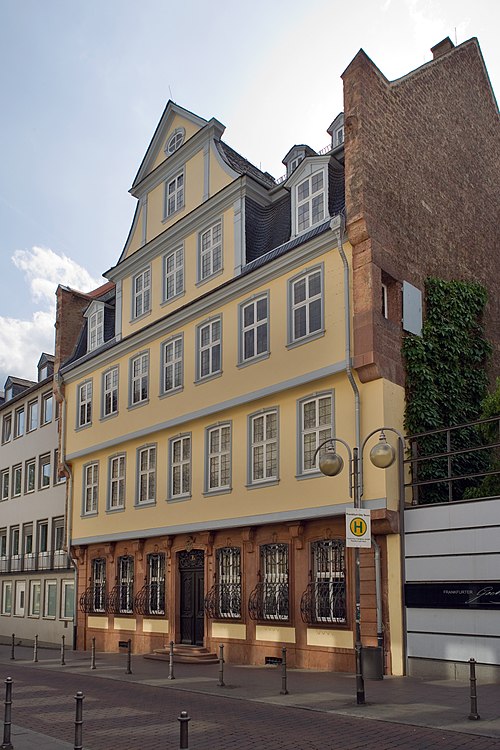
The Goethe House in Frankfurt is the birthplace and childhood home of the German writer and statesman Johann Wolfgang von Goethe. The original structure, a typical 18th-century bourgeois residence, was purchased by Goethe's grandmother in 1733 and served as the family home until 1795. It provides a detailed look into the domestic life, educational environment, and social status of a wealthy Frankfurt family during the Enlightenment.
Although the building was destroyed during Allied bombing raids in 1944, it was meticulously reconstructed in the post-war period using original furnishings, paintings, and library collections that had been evacuated for safekeeping. Today, the house functions as a museum and research center, preserving the atmosphere of the era in which Goethe spent his formative years.
Key Facts
- Materials
- Timber framing, Stone, Plaster
- Civilization
- German
- Accessibility
- Partially accessible; historic stairs limit access to upper floors
- Date(s)
- 1733-1755
- Condition
- Reconstructed and well-preserved museum
- Original Function
- Residential home
- Key Figures
- Johann Wolfgang von Goethe, Johann Caspar Goethe, Catharina Elisabeth Goethe
Family Residence
1733-1795The house was formed by merging two older half-timbered buildings. It served as the primary residence for the Goethe family, where Johann Wolfgang was born in 1749 and lived until he moved to Weimar in 1775.
Destruction and Reconstruction
1944-1951During the air raids of World War II in 1944, the house was severely damaged. Following the war, the city of Frankfurt undertook a faithful reconstruction, completed in 1951, to restore the site as a cultural monument.
Modern Museum
1951-PresentThe site now operates as part of the Goethe House and Museum complex, housing the original family library and serving as a center for the study of Goethe's life and works.
Cultural Significance
The Goethe House is a primary site for understanding the intellectual development of Germany's most celebrated writer. It illustrates the transition from the late Baroque period to the Enlightenment in German domestic architecture and social customs.
Beyond its architectural value, the house serves as a symbol of cultural continuity in Frankfurt. Its reconstruction after the war remains a significant example of German efforts to reclaim and preserve national heritage following the destruction of the 20th century.
Interpretive Notes
Scholarly debates and areas of uncertainty
Debates exist regarding the extent to which the post-war reconstruction accurately reflects the original 18th-century interior layout versus the aesthetic preferences of the 1950s restoration architects.
Visiting Information
Entry Rules
Open daily. Tickets can be purchased on-site or online. Guided tours are available for groups by appointment.
Best Times to Visit
Weekday mornings to avoid weekend tourist groups. The museum is particularly relevant during the annual Frankfurt Book Fair.
Photography
Non-commercial photography permitted without flash or tripods.
Preservation Notes
Visitors are required to leave large bags in lockers. Touching of furniture and artifacts is strictly prohibited.
Nearby POIs
10 shownSources & Further Reading
- [1]
- [2]Goethe's Life in Frankfurt — Nicholas Boyle. Oxford University Press (1991)
Key Facts
- Materials
- Timber framing, Stone, Plaster
- Civilization
- German
- Accessibility
- Partially accessible; historic stairs limit access to upper floors
- Date(s)
- 1733-1755
- Condition
- Reconstructed and well-preserved museum
- Original Function
- Residential home
- Key Figures
- Johann Wolfgang von Goethe, Johann Caspar Goethe, Catharina Elisabeth Goethe