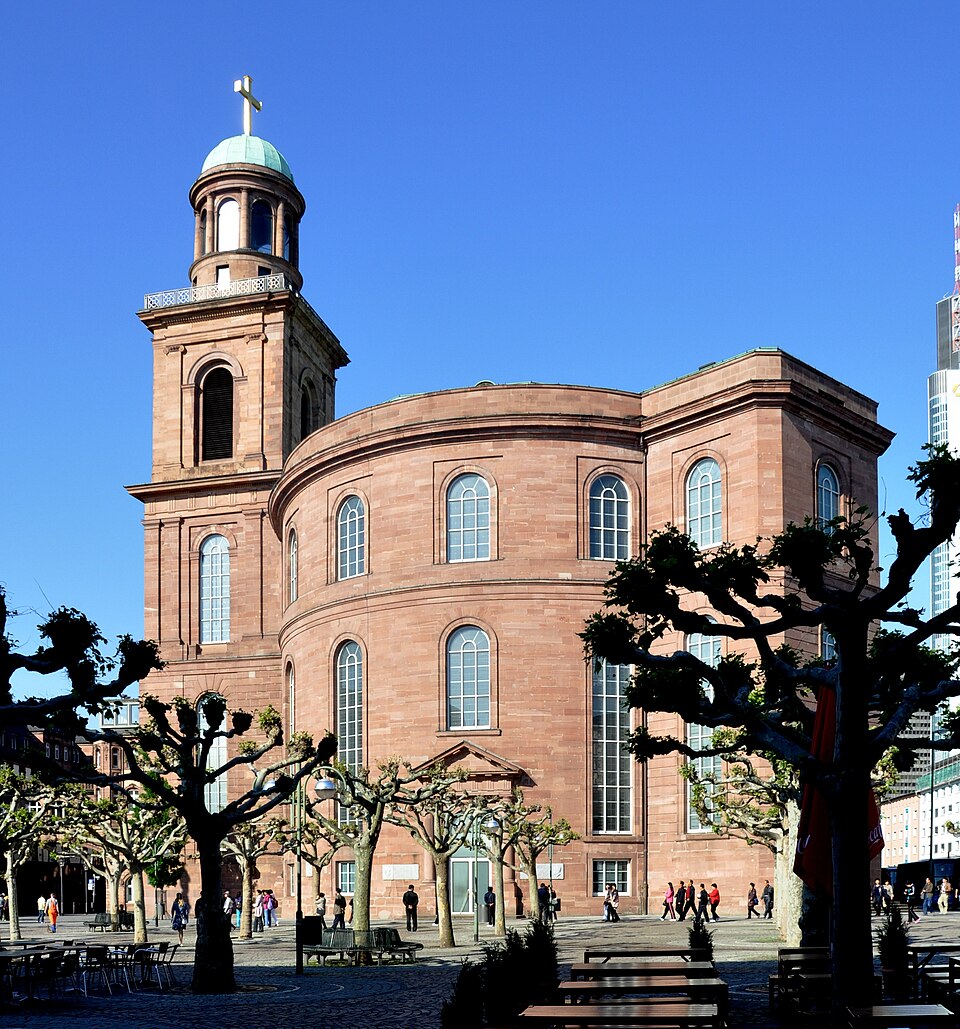
The Paulskirche (St. Paul's Church) is a prominent Neoclassical building in Frankfurt am Main, Germany. Originally constructed as a Lutheran church between 1789 and 1833, it is primarily recognized today as the site of the Frankfurt Parliament of 1848, the first freely elected legislative body for all of Germany. This event established the church as a foundational symbol of German democracy and national unity.
Following its near-total destruction during World War II, the interior was rebuilt in a simplified, modern style rather than its original historicist form. Today, the building no longer functions as a church but serves as a national memorial and a venue for prestigious public events, most notably the presentation of the Peace Prize of the German Book Trade.
Key Facts
- Materials
- Sandstone, Concrete
- Civilization
- German
- Accessibility
- Wheelchair accessible
- Date(s)
- 1789-1833
- Condition
- Restored as a memorial and event space
- Original Function
- Protestant Church
- Key Figures
- Heinrich von Gagern, Johann Friedrich Christian Hess
Construction and Early Years
1789-1833The church was built on the site of a medieval Franciscan church that had fallen into disrepair. Designed by Johann Friedrich Christian Hess, the structure was completed in 1833 and served the local Lutheran congregation for over a century.
The Frankfurt Parliament
1848-1849During the revolutions of 1848, the church was chosen as the meeting place for the Frankfurt Parliament. The assembly drafted the Paulskirche Constitution, which proposed a unified German state with a constitutional monarchy, though the movement was ultimately suppressed by Prussian and Austrian forces.
Destruction and Reconstruction
1944-1948The church was gutted by Allied bombing raids in March 1944. Following the war, it was the first building in Frankfurt to be reconstructed. The interior was redesigned by Rudolf Schwarz, prioritizing a functional, austere aesthetic that emphasized its role as a democratic monument.
Cultural Significance
The Paulskirche is widely regarded as the 'cradle of German democracy.' It represents the transition from fragmented feudal states to a unified, democratic nation-state. The annual awarding of the Peace Prize of the German Book Trade within its walls reinforces its status as a site dedicated to intellectual freedom and international reconciliation.
Interpretive Notes
Scholarly debates and areas of uncertainty
There is ongoing academic discussion regarding the 'reconstruction vs. restoration' of the interior. Some historians argue that the 1948 modernist redesign obscured the original architectural intent, while others maintain that the current state serves as a more honest reflection of Germany's post-war commitment to democratic renewal.
Visiting Information
Entry Rules
Open daily to the public. Admission is free. Security checks may be in place for high-profile events.
Best Times to Visit
Weekdays during business hours. Avoid dates when the building is reserved for official state ceremonies or the Peace Prize award.
Photography
Personal photography is permitted. Tripods and professional equipment require prior authorization from the city administration.
Preservation Notes
The building is a protected historical monument. Visitors are expected to maintain a respectful demeanor given its status as a national memorial.
Nearby POIs
10 shownSources & Further Reading
- [1]The Frankfurt Parliament 1848-1849 — Frank Eyck. St. Martin's Press (1968)
- [2]Die Paulskirche: Symbol demokratischer Freiheit — Lothar Gall. Frankfurter Societäts-Druckerei (1998)
Key Facts
- Materials
- Sandstone, Concrete
- Civilization
- German
- Accessibility
- Wheelchair accessible
- Date(s)
- 1789-1833
- Condition
- Restored as a memorial and event space
- Original Function
- Protestant Church
- Key Figures
- Heinrich von Gagern, Johann Friedrich Christian Hess