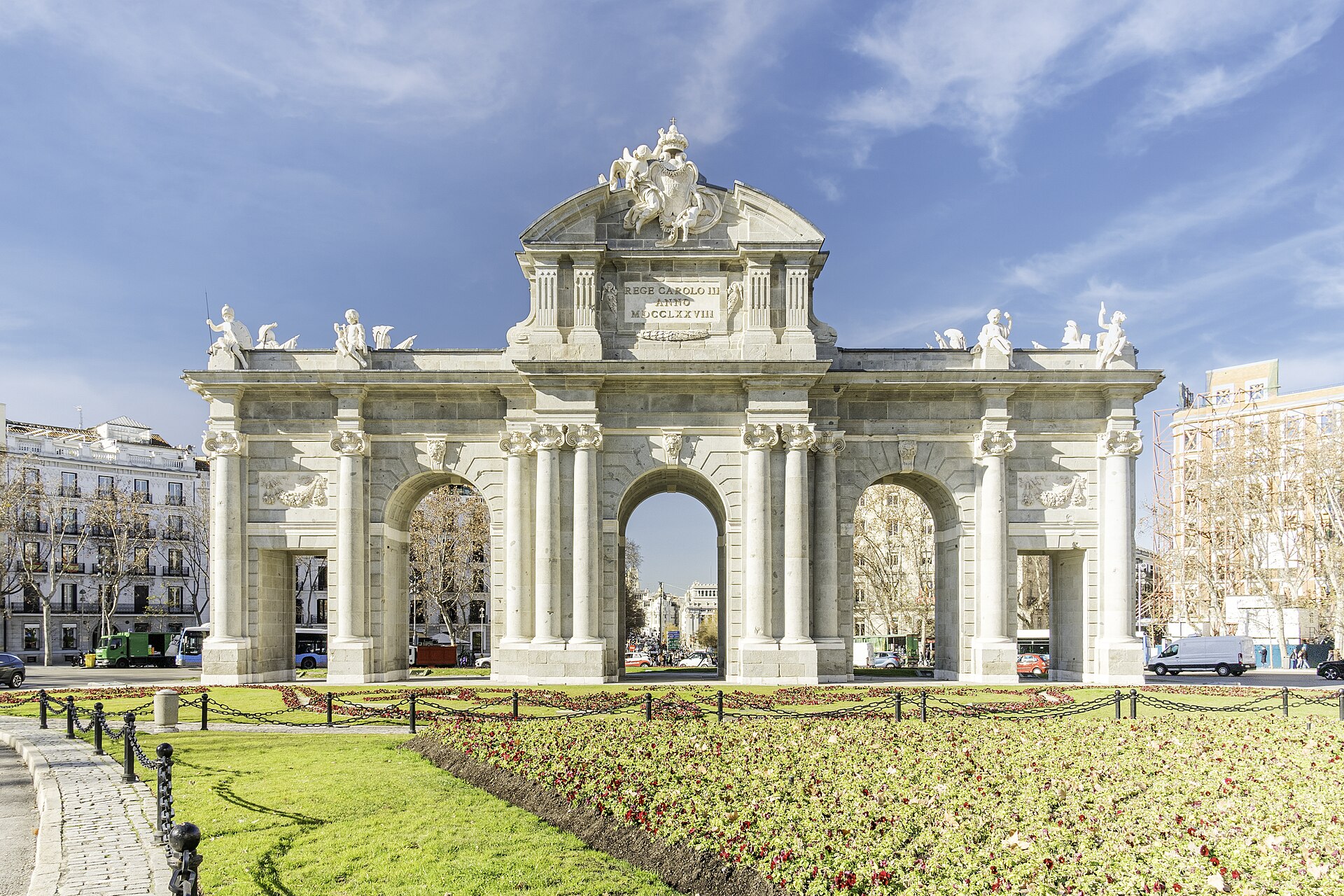
The Puerta de Alcalá is a monumental neoclassical triumphal arch located in the Plaza de la Independencia in Madrid. Commissioned by King Charles III to replace an older, smaller gate, it served as the grand entrance to the city for travelers arriving from France and Aragon. It was designed by the Italian architect Francesco Sabatini and inaugurated in 1778.
The structure is composed of five bays, featuring three central arches and two rectangular side gates. Its design incorporates a mix of Doric and Ionic orders, adorned with sculptural elements by Francisco Gutiérrez and Roberto Michel. These sculptures represent the four cardinal virtues—Prudence, Justice, Temperance, and Fortitude—alongside royal heraldry and military trophies, reflecting the Enlightenment-era aspirations of the Spanish monarchy.
Key Facts
- Materials
- Granite, White Colmenar limestone
- Civilization
- Spanish
- Accessibility
- Public plaza, fully accessible
- Date(s)
- 1769-1778
- Condition
- Well-preserved, urban landmark
- Original Function
- City gate and triumphal arch
- Key Figures
- Charles III of Spain, Francesco Sabatini, Francisco Gutiérrez
Origins and Commission
1769King Charles III ordered the construction of a new gate to replace the existing 16th-century structure, which was considered insufficient for the city's modernization efforts. Francesco Sabatini was selected to design the new monument.
Construction and Inauguration
1774-1778Construction spanned several years, utilizing granite for the base and limestone for the decorative elements. The arch was officially inaugurated in 1778, serving as a symbolic threshold to the capital.
Modern Preservation
20th century - presentThe gate has undergone several restoration campaigns to address environmental degradation caused by urban traffic. It remains one of the most iconic symbols of Madrid and was declared a National Monument in 1976.
Cultural Significance
The Puerta de Alcalá stands as a symbol of the Enlightenment in Spain, representing the urban planning reforms initiated by Charles III. It marks the transition from the medieval walled city to the modern capital, serving as a focal point for civic life and public celebrations in Madrid.
Beyond its architectural role, the gate is deeply embedded in Spanish popular culture, famously immortalized in the 1986 song 'La Puerta de Alcalá' by Ana Belén and Víctor Manuel, which solidified its status as a beloved national icon.
Interpretive Notes
Scholarly debates and areas of uncertainty
There is minor scholarly discussion regarding the influence of Roman triumphal arches versus the specific Italian baroque-neoclassical hybrid style favored by Sabatini. Additionally, the exact interpretation of the sculptural program's political messaging during the reign of Charles III remains a subject of study for historians of 18th-century Spanish art.
Visiting Information
Entry Rules
The monument is located in the center of a public traffic circle and is not an enclosed building; it is viewable at all times from the surrounding plaza.
Best Times to Visit
Early morning or late evening to avoid heavy traffic and to see the monument illuminated at night.
Photography
None; the site is a public landmark.
Preservation Notes
The monument is protected as a heritage site. Pedestrians should remain on designated sidewalks and avoid climbing on the base of the structure.
Nearby POIs
11 shown- Cybele Palace0.3 km
- Museo Arqueologico Nacional0.4 km
- Naval Museum of Madrid0.4 km
- Thyssen-Bornemisza Museum0.7 km
- Museo del Prado0.7 km
- Palacio de Cristal del Retiro0.9 km
- Museo del Romanticismo1.1 km
- Museo Nacional Centro de Arte Reina Sofia1.4 km
- Sorolla Museum1.7 km
- Lazaro Galdiano Museum1.9 km
- Monument to Miguel de Cervantes2.1 km
Sources & Further Reading
- [1]La Puerta de Alcalá: Historia y Arquitectura — Pedro Navascués Palacio. Ayuntamiento de Madrid (1988)
- [2]Sabatini y la arquitectura neoclásica en España — Delfín Rodríguez Ruiz. Cátedra (1993)
Key Facts
- Materials
- Granite, White Colmenar limestone
- Civilization
- Spanish
- Accessibility
- Public plaza, fully accessible
- Date(s)
- 1769-1778
- Condition
- Well-preserved, urban landmark
- Original Function
- City gate and triumphal arch
- Key Figures
- Charles III of Spain, Francesco Sabatini, Francisco Gutiérrez
Nearby POIs
11 shown- Cybele Palace0.3 km
- Museo Arqueologico Nacional0.4 km
- Naval Museum of Madrid0.4 km
- Thyssen-Bornemisza Museum0.7 km
- Museo del Prado0.7 km
- Palacio de Cristal del Retiro0.9 km
- Museo del Romanticismo1.1 km
- Museo Nacional Centro de Arte Reina Sofia1.4 km
- Sorolla Museum1.7 km
- Lazaro Galdiano Museum1.9 km
- Monument to Miguel de Cervantes2.1 km