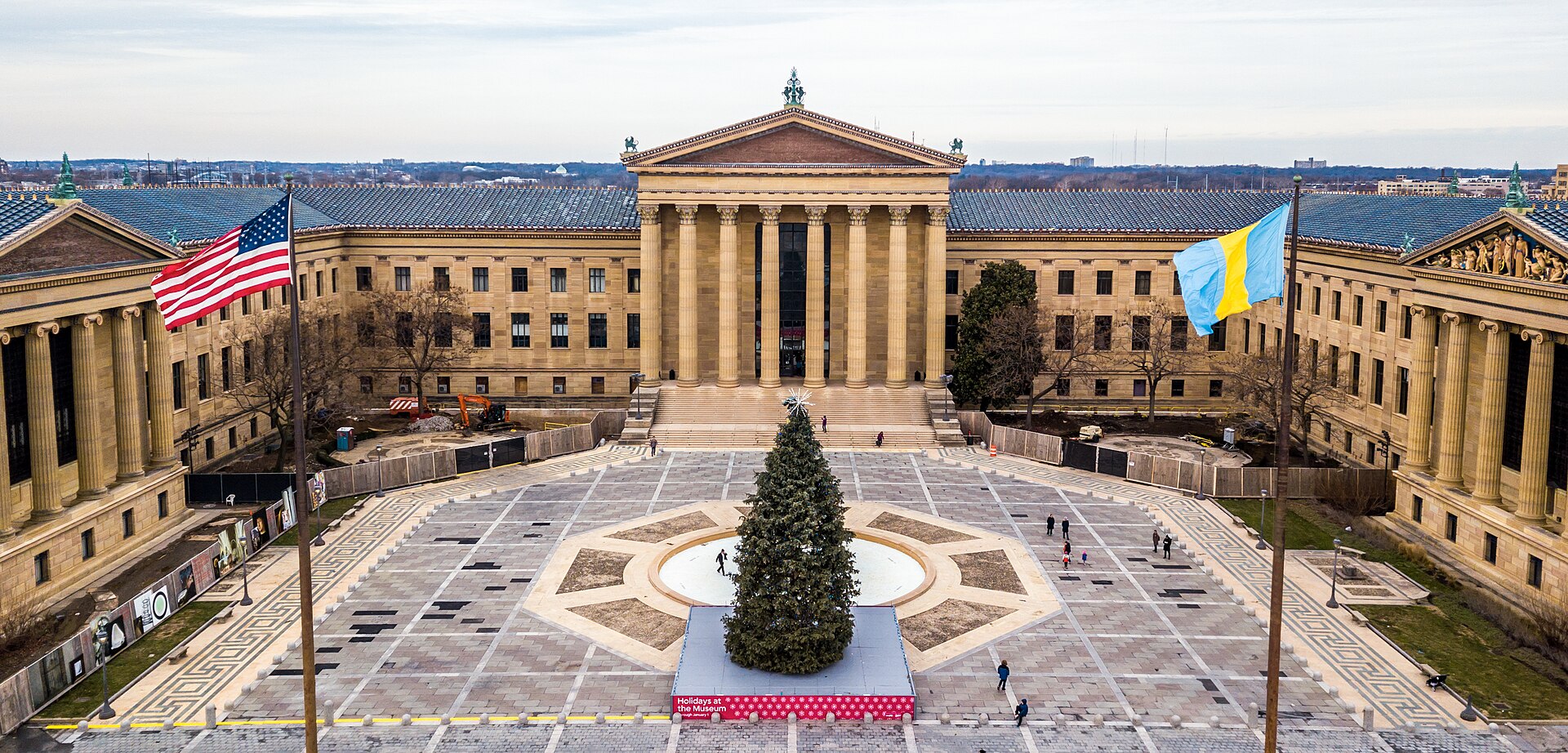
The Philadelphia Museum of Art is one of the largest and most prominent art museums in the United States. Located at the western end of the Benjamin Franklin Parkway, the main building is a monumental structure designed in the Greek Revival style, completed in 1928. It houses a vast collection of over 240,000 objects spanning 2,000 years, including significant holdings of European, American, and Asian art.
The museum is widely recognized for its iconic 'Rocky Steps,' made famous by the 1976 film Rocky. Beyond its cinematic fame, the institution serves as a major cultural anchor for Philadelphia, featuring extensive galleries of Renaissance, Impressionist, and contemporary works, as well as period rooms and architectural installations salvaged from around the world.
Key Facts
- Materials
- Minnesota dolomite, Terra cotta, Steel frame
- Civilization
- American
- Accessibility
- Fully wheelchair accessible with elevators and ramps
- Date(s)
- 1919-1928
- Condition
- Active, fully operational
- Original Function
- Public Art Museum
- Key Figures
- Julian Abele, Horace Trumbauer, Charles C. Harrison
Founding and Centennial
1876The museum was chartered in 1876 as part of the Centennial Exposition held in Philadelphia. It was originally housed in Memorial Hall, which served as the art gallery for the world's fair.
Construction of the Main Building
1919-1928Due to the rapid growth of the collection, a new, larger facility was commissioned. The design was led by the architectural firm Horace Trumbauer & Associates, with significant contributions from Julian Abele, the first African American graduate of the University of Pennsylvania's Department of Architecture.
Modern Expansion
2017-2021The museum underwent a major renovation project led by architect Frank Gehry. This project, known as the Core Project, focused on internal infrastructure, the creation of new gallery spaces, and the restoration of the historic vaulted walkway.
Cultural Significance
The museum is a cornerstone of Philadelphia's cultural identity, representing the city's commitment to civic education and the arts. Its architecture, inspired by ancient Greek temples, reflects the 'City Beautiful' movement of the early 20th century, which sought to elevate urban life through monumental design.
In popular culture, the museum's exterior stairs have become a global symbol of perseverance and triumph. This association has transformed the site into a pilgrimage destination for tourists, bridging the gap between high art and mass-market cultural phenomena.
Interpretive Notes
Scholarly debates and areas of uncertainty
There is ongoing scholarly discussion regarding the attribution of the museum's design. While Horace Trumbauer was the lead architect, historians have increasingly highlighted the pivotal role of Julian Abele, whose contributions were historically marginalized due to racial prejudice in the early 20th century.
Visiting Information
Entry Rules
Open Wednesday through Monday. Tickets are required for entry. Visitors must pass through security screening. Large bags and backpacks are not permitted in the galleries.
Best Times to Visit
Weekday mornings are generally less crowded. The museum is busiest on weekends and during major temporary exhibitions.
Photography
Personal photography is permitted in most galleries without flash or tripods. Some special exhibitions may prohibit photography entirely.
Preservation Notes
Do not touch artwork or display cases. Maintain a respectful distance from all exhibits. Food and drink are prohibited inside the galleries.
Nearby POIs
8 shownSources & Further Reading
- [1]The Philadelphia Museum of Art: A History — David B. Brownlee. Philadelphia Museum of Art Publications (2001)
- [2]Julian Abele: Architect and the Beaux Arts — Dreck Spurlock Wilson. Routledge (2004)
Key Facts
- Materials
- Minnesota dolomite, Terra cotta, Steel frame
- Civilization
- American
- Accessibility
- Fully wheelchair accessible with elevators and ramps
- Date(s)
- 1919-1928
- Condition
- Active, fully operational
- Original Function
- Public Art Museum
- Key Figures
- Julian Abele, Horace Trumbauer, Charles C. Harrison