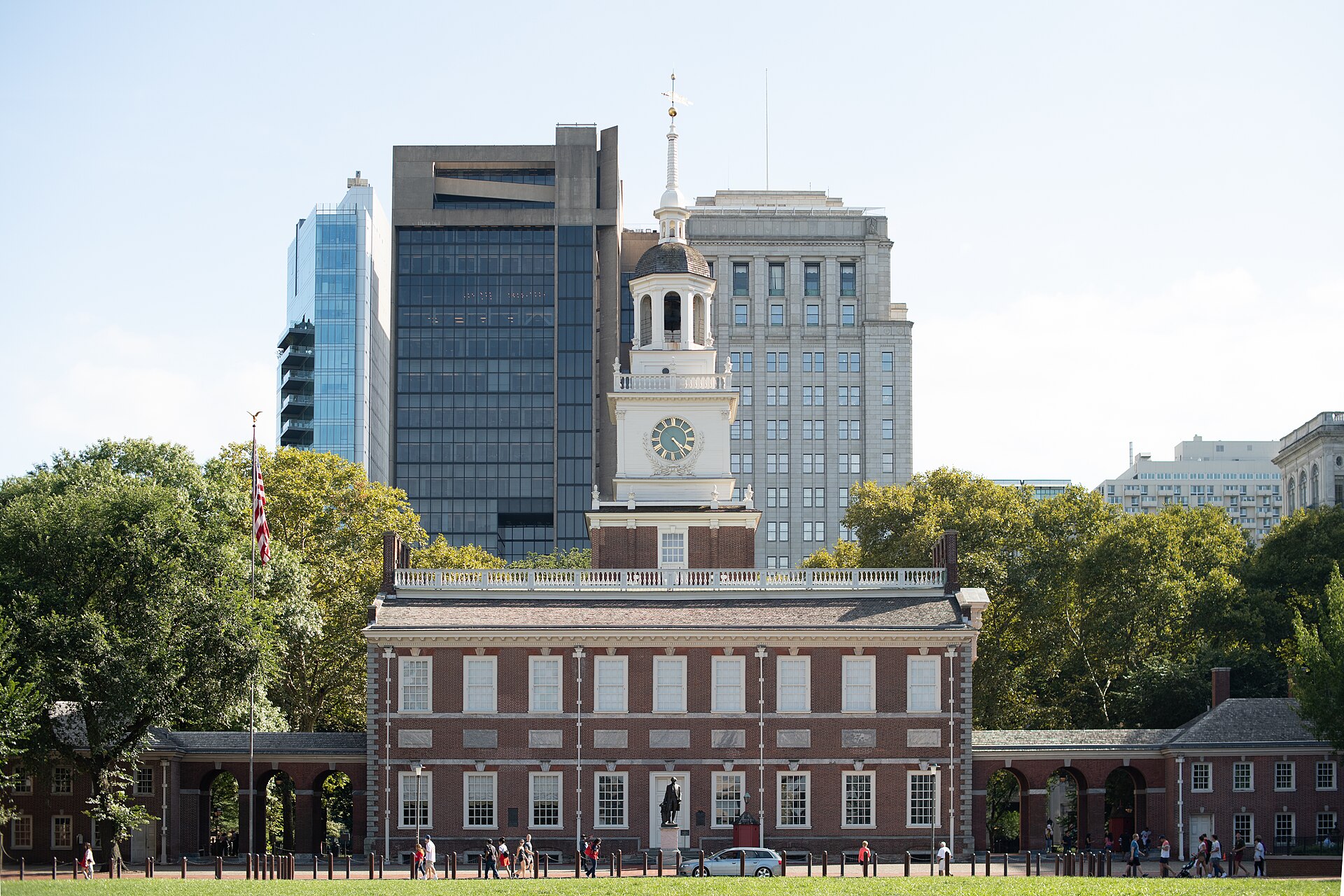
Independence Hall, originally the Pennsylvania State House, served as the principal meeting place of the Second Continental Congress. It is the site where the Declaration of Independence was debated and adopted in 1776, and where the United States Constitution was drafted and signed in 1787.
Designed by Edmund Woolley and Andrew Hamilton, the building is a prime example of Georgian architecture. Its Assembly Room remains the most historically significant space, having hosted the foundational debates that defined the American political system. The structure is now the centerpiece of Independence National Historical Park.
Key Facts
- Materials
- Red brick, Marble, Wood
- Civilization
- American
- Accessibility
- Fully accessible with elevator access to the second floor
- Date(s)
- 1732-1753
- Condition
- Well-preserved, managed by the National Park Service
- Original Function
- Pennsylvania State House
- Key Figures
- George Washington, Benjamin Franklin, Thomas Jefferson, James Madison
Construction and Colonial Use
1732-1753The building was commissioned by the Pennsylvania Colonial Assembly to serve as the provincial state house. Construction began in 1732 under the supervision of Andrew Hamilton and master builder Edmund Woolley, with the tower and steeple completed by 1753.
Revolutionary Era
1775-1783The Assembly Room served as the meeting place for the Second Continental Congress. It was here that the delegates signed the Declaration of Independence in 1776 and later organized the Continental Army under the command of George Washington.
Constitutional Convention
1787During the summer of 1787, delegates from twelve states gathered in the Assembly Room to address the weaknesses of the Articles of Confederation. The resulting United States Constitution was signed on September 17, 1787, establishing the framework for the federal government.
Preservation and Modern Status
19th century - presentFollowing the relocation of the state capital, the building faced potential demolition but was purchased by the City of Philadelphia in 1816. It was designated a National Historical Park in 1948 and inscribed as a UNESCO World Heritage Site in 1979.
Cultural Significance
Independence Hall is regarded as the birthplace of the United States. It symbolizes the democratic ideals of self-governance and the rule of law. The site is a focal point for American civic identity, representing the transition from British colonial rule to an independent republic.
Beyond its national importance, the building serves as a global icon for constitutional democracy. Its preservation reflects the ongoing American commitment to interpreting and honoring the legacy of the Founding Fathers.
Interpretive Notes
Scholarly debates and areas of uncertainty
Debates often center on the extent of the building's original 18th-century fabric versus later 19th and 20th-century restorations. Scholars also discuss the degree to which the physical layout of the Assembly Room influenced the interpersonal dynamics and compromises reached during the Constitutional Convention.
Visiting Information
Entry Rules
Entry is by timed ticket only. Tickets are available for a small service fee online or at the Independence Visitor Center. Security screening is mandatory for all visitors. The site is open daily, though hours vary by season.
Best Times to Visit
Early morning or late afternoon on weekdays to avoid peak tourist traffic. Spring and autumn offer the most comfortable weather for walking through the surrounding historical park.
Photography
Personal photography is permitted throughout the building. Tripods and professional lighting equipment require a special use permit.
Preservation Notes
Visitors are required to stay with their guided tour group at all times. Touching the historic furniture or walls is strictly prohibited to prevent degradation of the original materials.
Nearby POIs
8 shownSources & Further Reading
- [1]Independence: A Guide to Independence National Historical Park — National Park Service. U.S. Department of the Interior (2020)View
- [2]The Constitutional Convention of 1787 — John P. Kaminski. Center for the Study of the American Constitution (2005)
Key Facts
- Materials
- Red brick, Marble, Wood
- Civilization
- American
- Accessibility
- Fully accessible with elevator access to the second floor
- Date(s)
- 1732-1753
- Condition
- Well-preserved, managed by the National Park Service
- Original Function
- Pennsylvania State House
- Key Figures
- George Washington, Benjamin Franklin, Thomas Jefferson, James Madison