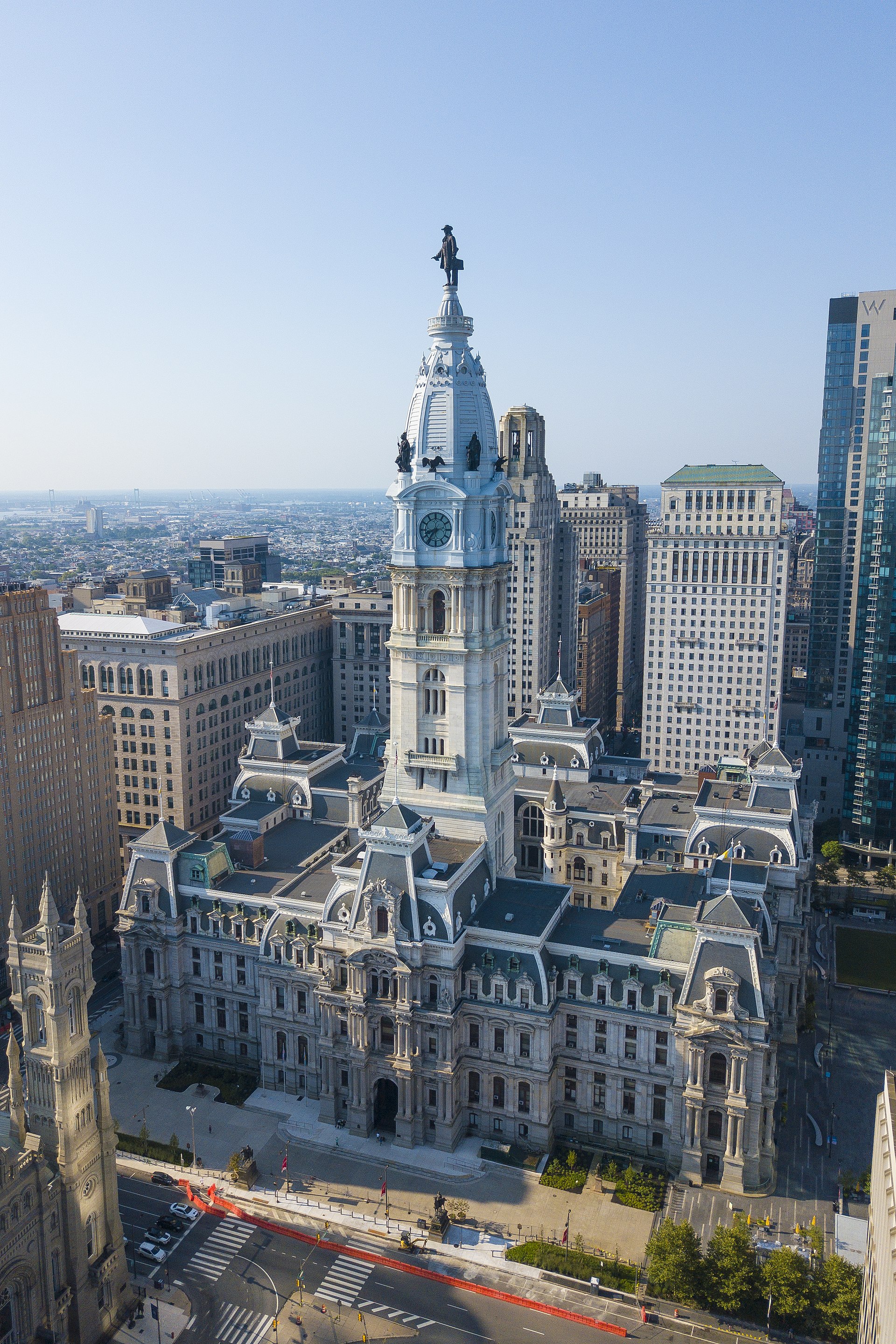
Philadelphia City Hall is the seat of government for the City of Philadelphia and serves as the courthouse for the First Judicial District of Pennsylvania. Designed by architect John McArthur Jr. in the Second Empire style, the structure is the world's largest free-standing masonry building, constructed without a steel frame. Its massive granite and marble walls reach a height of 548 feet, including the iconic bronze statue of city founder William Penn atop the tower.
Construction spanned thirty years, from 1871 to 1901, reflecting the city's rapid industrial growth during the late 19th century. The building features an elaborate sculptural program directed by Alexander Milne Calder, comprising over 250 individual sculptures that celebrate the history and cultural identity of the region.
Key Facts
- Materials
- Granite, Marble, Limestone, Bronze
- Civilization
- American
- Accessibility
- Wheelchair accessible via designated entrances
- Date(s)
- 1871-1901
- Condition
- Active government building, well-preserved
- Original Function
- Municipal government and courthouse
- Key Figures
- John McArthur Jr., Alexander Milne Calder, William Penn
Planning and Design
1860sFollowing the consolidation of Philadelphia, the city required a centralized administrative hub. A design competition was held in 1869, resulting in the selection of John McArthur Jr.'s Second Empire proposal, which was heavily influenced by the Louvre in Paris.
Construction Phase
1871-1901Construction began in 1871. Due to the massive scale and the decision to use load-bearing masonry rather than a steel frame, the project took three decades to complete. The tower was finished in 1894, and the final interior work concluded in 1901.
Modern Era and Preservation
20th century - presentThroughout the 20th century, the building faced threats of demolition due to maintenance costs. However, it was designated a National Historic Landmark in 1976. Extensive exterior cleaning and restoration projects in the 1990s and 2000s stabilized the masonry and restored the tower's clock and statue.
Cultural Significance
Philadelphia City Hall stands as a symbol of the city's 19th-century industrial might and civic ambition. For decades, a 'gentleman's agreement' prohibited the construction of any building in the city taller than the hat of the William Penn statue, a tradition that defined the Philadelphia skyline until 1987.
Beyond its administrative function, the building is a landmark of American architectural history, representing the transition from traditional masonry techniques to the modern era of skyscraper construction.
Interpretive Notes
Scholarly debates and areas of uncertainty
There is ongoing discussion regarding the structural integrity of the unreinforced masonry in the face of modern seismic standards. Additionally, architectural historians often debate the building's stylistic classification, as it blends elements of Second Empire, Beaux-Arts, and Victorian Gothic influences.
Visiting Information
Entry Rules
Open to the public for government business and guided tower tours. Visitors must pass through security screening. Business attire is recommended for those visiting courtrooms.
Best Times to Visit
Weekdays during business hours for full access to administrative offices. The observation deck is best visited on clear days for panoramic views of the city.
Photography
Personal photography is permitted in public areas. Photography is strictly prohibited inside courtrooms and security checkpoints.
Preservation Notes
The building is a historic landmark; visitors are requested to refrain from touching the exterior masonry or interior decorative carvings. Restoration work is ongoing; some facades may be obscured by scaffolding.
Nearby POIs
8 shownSources & Further Reading
- [1]Philadelphia City Hall: A History — James F. O'Gorman. University of Pennsylvania Press (2003)
- [2]The Architecture of Philadelphia — George E. Thomas. University of Pennsylvania Press (2000)
Key Facts
- Materials
- Granite, Marble, Limestone, Bronze
- Civilization
- American
- Accessibility
- Wheelchair accessible via designated entrances
- Date(s)
- 1871-1901
- Condition
- Active government building, well-preserved
- Original Function
- Municipal government and courthouse
- Key Figures
- John McArthur Jr., Alexander Milne Calder, William Penn