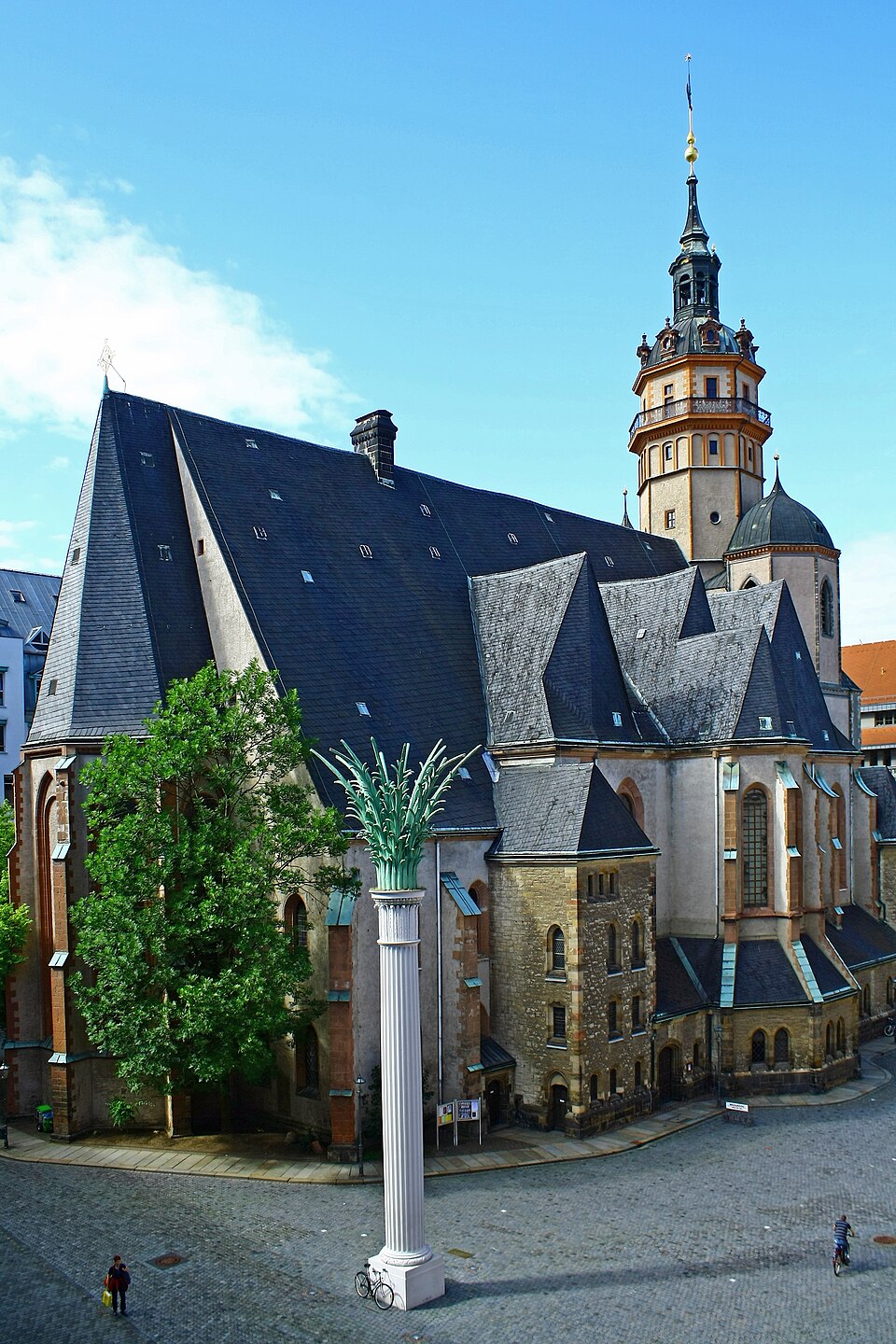
St. Nicholas Church (Nikolaikirche) is the oldest and largest church in Leipzig, Germany. Originally established in the 12th century as a Romanesque structure, it underwent significant Gothic expansions in the 16th century and a major Neoclassical interior redesign by Johann Carl Friedrich Dauthe in the late 18th century. The interior is noted for its distinctive palm-tree-like columns and pastel color palette.
Beyond its architectural history, the church gained international prominence as the starting point of the 1989 Monday Demonstrations. These peaceful protests, which began with prayers for peace, became a catalyst for the collapse of the East German government and the subsequent reunification of Germany.
Key Facts
- Materials
- Sandstone, Brick, Stucco
- Civilization
- German
- Accessibility
- Ground level accessible
- Date(s)
- 1165 - 18th century
- Condition
- Well-preserved, active place of worship
- Original Function
- Parish church
- Key Figures
- Johann Sebastian Bach, Christian Führer
Founding and Medieval Growth
12th - 15th centuryFounded around 1165 at the intersection of two major trade routes, the church began as a Romanesque structure. It was significantly expanded in the early 16th century into a late Gothic hall church to accommodate the growing population of the merchant city.
Reformation and Baroque Era
16th - 18th centuryThe church became a center of the Protestant Reformation in Leipzig. From 1723 to 1750, Johann Sebastian Bach served as the music director for the city's main churches, including St. Nicholas, where several of his works premiered.
Neoclassical Transformation
1784 - 1797Architect Johann Carl Friedrich Dauthe redesigned the interior in the Neoclassical style. This renovation introduced the iconic palm-leaf columns and a lighter, more airy aesthetic that departed from the previous Gothic interior.
The Peaceful Revolution
1989Under the leadership of Pastor Christian Führer, the church hosted 'Prayers for Peace' starting in 1982. By 1989, these gatherings evolved into the Monday Demonstrations, where thousands marched peacefully against the GDR regime, playing a decisive role in the fall of the Berlin Wall.
Cultural Significance
The Nikolaikirche is a symbol of civil courage and non-violent resistance. It represents the intersection of religious life and political activism, serving as a permanent memorial to the events of 1989 that reshaped modern European history.
Interpretive Notes
Scholarly debates and areas of uncertainty
Debates exist regarding the extent to which the 18th-century Neoclassical interior compromised the original Gothic structural integrity, with some architectural historians arguing for a more faithful restoration of the medieval elements.
Visiting Information
Entry Rules
Open to the public daily. Visitors are requested to maintain silence as it is an active place of worship. Entry is free, though donations for maintenance are encouraged.
Best Times to Visit
Weekday mornings for a quiet atmosphere. October 9th is historically significant as the anniversary of the largest 1989 demonstration.
Photography
Photography is permitted for personal use without flash. Tripods and commercial equipment require prior authorization.
Preservation Notes
The interior stucco and palm columns are fragile; visitors should refrain from touching the architectural features. The church is maintained by the Evangelical-Lutheran Church of Saxony.
Nearby POIs
9 shownSources & Further Reading
- [1]The Monday Demonstrations in Leipzig — Christian Führer. Evangelische Verlagsanstalt (2009)
- [2]Leipzig: A History of the City — Enno Bünz. Leipziger Universitätsverlag (2015)
Key Facts
- Materials
- Sandstone, Brick, Stucco
- Civilization
- German
- Accessibility
- Ground level accessible
- Date(s)
- 1165 - 18th century
- Condition
- Well-preserved, active place of worship
- Original Function
- Parish church
- Key Figures
- Johann Sebastian Bach, Christian Führer