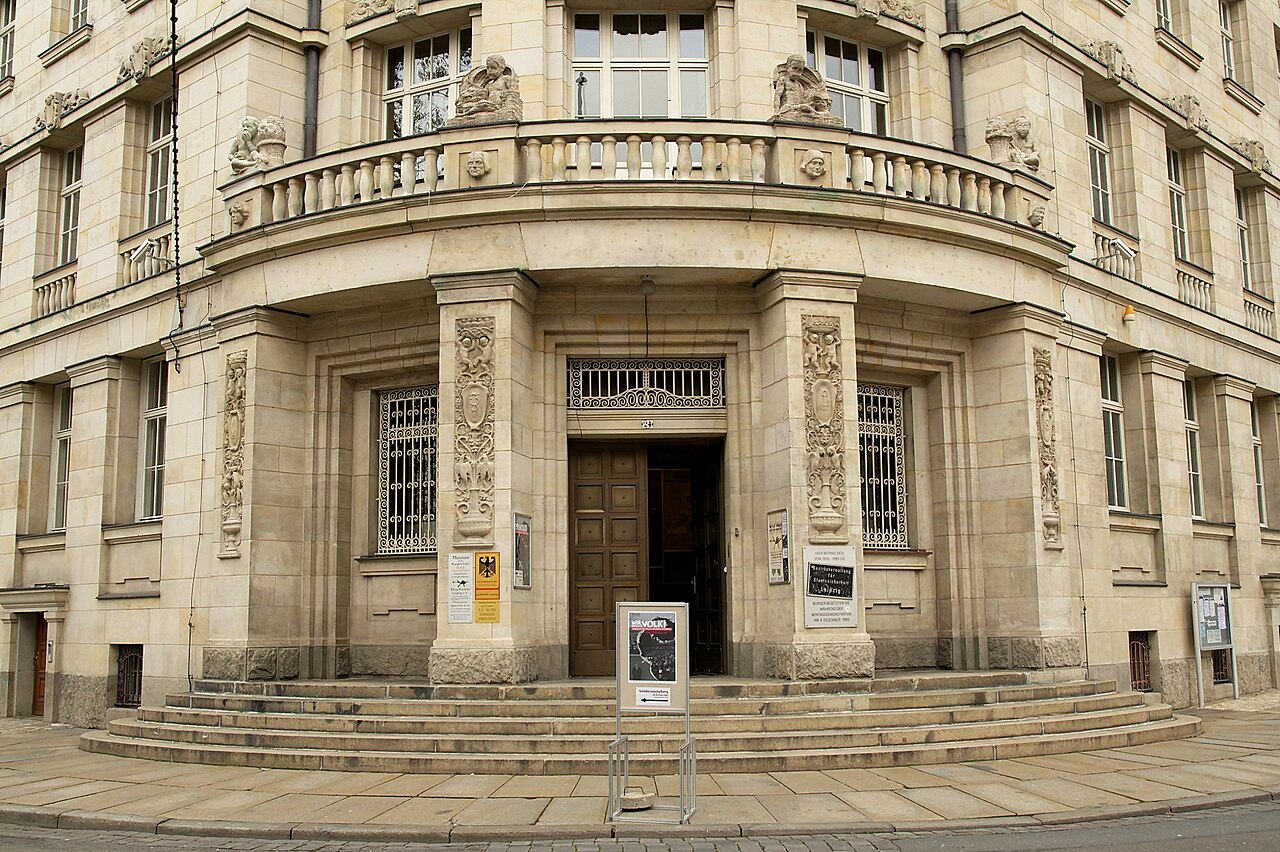
The Museum in der 'Runden Ecke' is located in the former district headquarters of the Ministry for State Security (Stasi) in Leipzig. The building served as the command center for the secret police in the Leipzig district from 1950 until the peaceful revolution of 1989, when it was occupied by demonstrators to prevent the destruction of sensitive files.
Today, the museum documents the history, structure, and operational methods of the Stasi. The permanent exhibition, titled 'Stasi - Power and Banality,' utilizes original documents, surveillance equipment, and artifacts to illustrate how the secret police monitored the East German population and suppressed political dissent.
Key Facts
- Materials
- Stone, Brick, Concrete
- Civilization
- East German
- Accessibility
- Limited; historic building with restricted elevator access
- Date(s)
- 1913
- Condition
- Preserved as a memorial museum
- Original Function
- District headquarters for the Ministry for State Security
- Key Figures
- Erich Mielke
Construction and Early Use
1913The building was originally constructed as the headquarters for the Leipzig police force, serving as a municipal administrative building for several decades.
Stasi Headquarters
1950-1989Following the division of Germany, the building became the district headquarters for the Ministry for State Security. It functioned as the nerve center for surveillance and repression in the Leipzig region.
The Peaceful Revolution
1989On December 4, 1989, citizens of Leipzig occupied the building to prevent the Stasi from destroying incriminating files, marking a pivotal moment in the collapse of the GDR regime.
Establishment of the Museum
1990-PresentThe Citizens' Committee of Leipzig took over the building shortly after the revolution. The museum was established to ensure the history of the Stasi's activities remained accessible to the public and to preserve the site as a place of remembrance.
Cultural Significance
The museum serves as a critical site for understanding the mechanisms of totalitarian control and the history of the Peaceful Revolution. It plays a vital role in German civic education, emphasizing the importance of transparency and the protection of civil rights against state overreach.
Interpretive Notes
Scholarly debates and areas of uncertainty
Discussions often center on the balance between preserving the site as an authentic 'perpetrator location' versus the challenges of maintaining a historic building that was not originally designed for public exhibition.
Visiting Information
Entry Rules
Open daily from 10:00 to 18:00. Admission is free, though donations are encouraged to support the Citizens' Committee.
Best Times to Visit
Weekdays are generally quieter. The museum is particularly significant on December 4th, the anniversary of the building's occupation.
Photography
Personal photography is permitted for non-commercial use. Flash photography is prohibited in certain exhibition rooms to protect sensitive documents.
Preservation Notes
The building is a protected historic monument. Visitors are asked to respect the integrity of the original office spaces and artifacts.
Nearby POIs
9 shownSources & Further Reading
- [1]The Stasi: Myth and Reality — John O. Koehler. Westview Press (1999)
- [2]
Key Facts
- Materials
- Stone, Brick, Concrete
- Civilization
- East German
- Accessibility
- Limited; historic building with restricted elevator access
- Date(s)
- 1913
- Condition
- Preserved as a memorial museum
- Original Function
- District headquarters for the Ministry for State Security
- Key Figures
- Erich Mielke