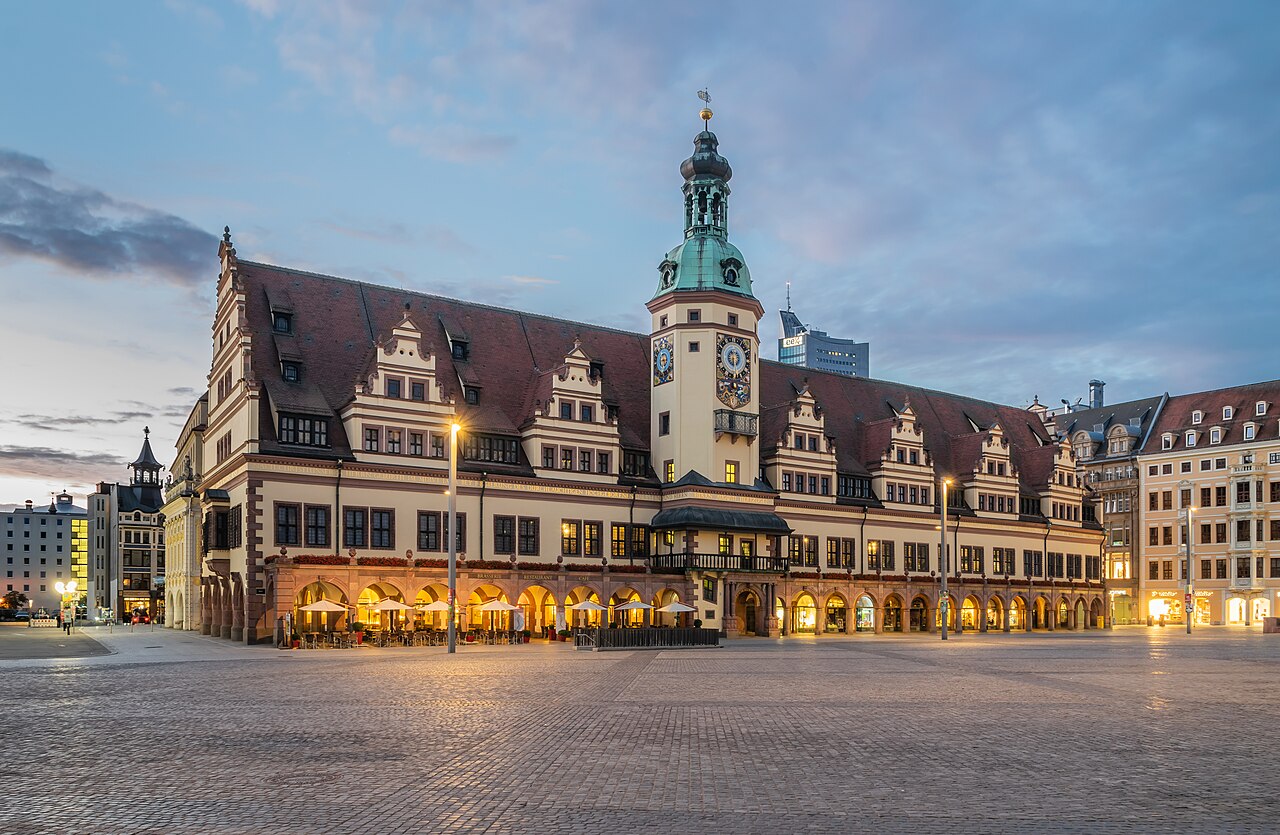
The Altes Rathaus (Old Town Hall) in Leipzig is a prominent example of German Renaissance architecture, located on the city's market square. Commissioned by Mayor Hieronymus Lotter and constructed in 1556-1557, the building served as the administrative center of the city for nearly four centuries. Its design is noted for its asymmetrical tower, which was intentionally placed off-center to accommodate the existing market layout.
Following extensive damage during World War II, the building was meticulously reconstructed and now houses the Museum of City History. The interior features the Great Hall (Festsaal), one of the longest preserved ballroom halls in Germany, which serves as a testament to the city's historical wealth and civic importance during the Renaissance period.
Key Facts
- Materials
- Sandstone, Brick, Timber
- Civilization
- German
- Accessibility
- Partially accessible; elevator available for museum levels
- Date(s)
- 1556-1557
- Condition
- Restored; currently functions as a museum
- Original Function
- Administrative seat of the Leipzig city council
- Key Figures
- Hieronymus Lotter
Commission and Construction
1556-1557The building was commissioned by the Leipzig city council under the leadership of Mayor Hieronymus Lotter. It was completed in a remarkably short period of nine months, replacing an older medieval structure.
Baroque Modifications
18th centuryDuring the 18th century, the interior was updated to reflect Baroque aesthetic preferences, though the exterior Renaissance facade remained largely unchanged.
War Damage and Reconstruction
1943-1948The building suffered severe damage during Allied bombing raids in 1943. Post-war reconstruction efforts began in 1945, focusing on restoring the historic facade and the interior ballroom to their original state.
Museum Transformation
20th century - presentSince the mid-20th century, the building has served as the primary location for the Museum of City History, documenting Leipzig's development from the Middle Ages to the modern era.
Cultural Significance
The Altes Rathaus stands as a symbol of Leipzig's historical status as a major center of trade and commerce. Its architecture reflects the civic pride of the merchant class during the Renaissance, and it remains a focal point for public life in the city's market square.
Interpretive Notes
Scholarly debates and areas of uncertainty
The decision to place the tower asymmetrically is a subject of architectural study, with debates centering on whether it was a deliberate aesthetic choice by Lotter or a pragmatic necessity dictated by the pre-existing medieval street grid.
Visiting Information
Entry Rules
Open Tuesday to Sunday. Tickets are required for museum entry. No specific dress code is enforced, but respectful behavior is expected within the historical halls.
Best Times to Visit
Weekday mornings are generally quieter. The market square is particularly active during the annual Christmas market in December.
Photography
Personal photography is permitted without flash or tripods. Commercial photography requires prior authorization from the museum administration.
Preservation Notes
Visitors are requested to refrain from touching the historical wall surfaces and to adhere to the marked visitor paths to protect the original flooring.
Nearby POIs
9 shownSources & Further Reading
- [1]Leipzig: Eine Stadt im Wandel — Sebastian Ringel. Lehmstedt Verlag (2015)
- [2]The Renaissance in Germany — Henry Russell Hitchcock. Yale University Press (1981)
Key Facts
- Materials
- Sandstone, Brick, Timber
- Civilization
- German
- Accessibility
- Partially accessible; elevator available for museum levels
- Date(s)
- 1556-1557
- Condition
- Restored; currently functions as a museum
- Original Function
- Administrative seat of the Leipzig city council
- Key Figures
- Hieronymus Lotter