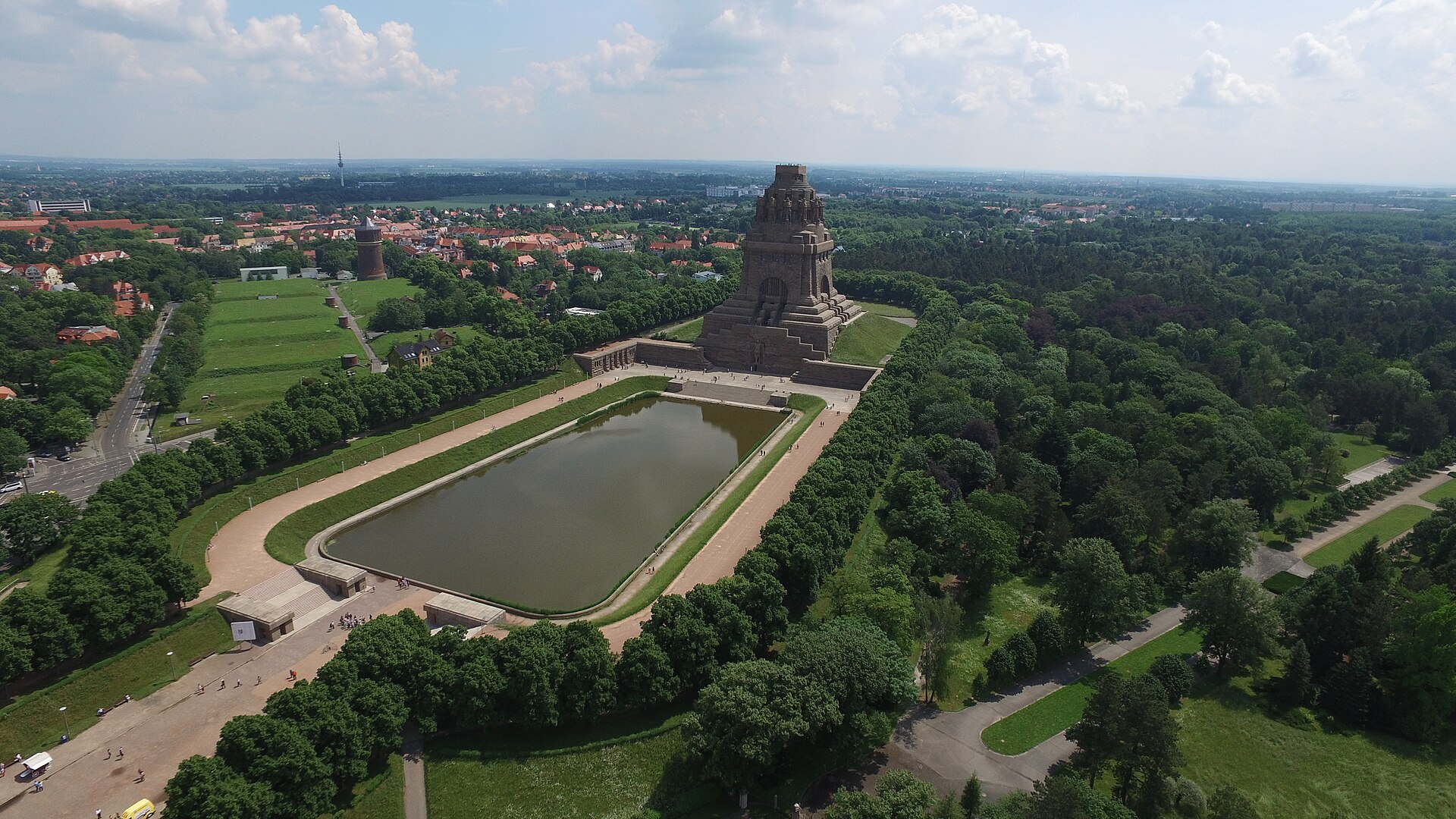
The Monument to the Battle of the Nations (Völkerschlachtdenkmal) is a massive memorial in Leipzig, Germany, commemorating the 1813 Battle of the Nations, where a coalition of European powers defeated Napoleon Bonaparte. Completed in 1913 to mark the centenary of the battle, the structure stands 91 meters tall and serves as a prominent example of Wilhelmine architecture, blending monumentalism with elements of Art Nouveau and Egyptian revival styles.
The interior features a vast Hall of Fame, characterized by colossal statues representing virtues such as faith, bravery, and sacrifice. The structure is built primarily of concrete faced with granite blocks, and its design was intended to evoke a sense of German national unity and historical continuity. Today, it functions as both a historical site and a museum, offering panoramic views of the surrounding battlefield from its observation platform.
Key Facts
- Materials
- Concrete, Granite
- Civilization
- German Empire
- Accessibility
- Elevator access to the first platform; stairs required for the summit
- Date(s)
- 1898-1913
- Condition
- Well-preserved, active museum and memorial
- Original Function
- National war memorial
- Key Figures
- Bruno Schmitz, Clemens Thieme, Wilhelm II
Conception and Planning
1894-1898Following the 75th anniversary of the battle, the German Patriotic Association for the Erection of a Monument to the Battle of the Nations was formed. Architect Bruno Schmitz was selected to design the structure after a national competition, emphasizing a design that reflected the scale of the historical event.
Construction
1898-1913Construction began in 1898 under the supervision of Clemens Thieme. The project faced significant financial challenges, requiring extensive public fundraising. The monument was officially inaugurated on October 18, 1913, exactly 100 years after the conclusion of the battle.
World Wars and GDR Era
1914-1989During the Nazi era, the monument was utilized for propaganda rallies. Following World War II, the site fell into disrepair under the German Democratic Republic (GDR), which viewed the nationalist symbolism with ambivalence, though it remained a landmark of the city.
Restoration and Modern Status
1990-presentAfter German reunification, a comprehensive, multi-year restoration project was launched to repair the concrete core and granite exterior. The site is now managed by the City of Leipzig and serves as a site of historical reflection and tourism.
Cultural Significance
The monument occupies a complex place in German cultural history. Originally intended to foster national identity and commemorate the liberation from Napoleonic rule, its heavy, imposing aesthetic has been interpreted in various ways throughout the 20th century. It remains a focal point for understanding the evolution of German nationalism and the architectural legacy of the Wilhelmine period.
Interpretive Notes
Scholarly debates and areas of uncertainty
Debate persists regarding the monument's ideological legacy and its appropriation by various political regimes. Scholars often discuss the tension between its role as a site of genuine historical commemoration and its function as a tool for nationalist myth-making.
Visiting Information
Entry Rules
Open daily. Tickets are required for entry to the interior and the observation platform. Visitors are advised to check the official website for seasonal opening hours and potential closures for events.
Best Times to Visit
Spring and autumn offer the best weather for climbing the stairs to the observation platform. Weekday mornings are generally less crowded than weekends.
Photography
Personal photography is permitted. Commercial photography and the use of tripods require prior authorization from the monument administration.
Preservation Notes
The structure is subject to ongoing maintenance due to its size and material composition. Visitors are requested to respect the solemn nature of the memorial and stay within designated visitor areas.
Nearby POIs
9 shownSources & Further Reading
- [1]The Monument to the Battle of the Nations: A History — Steffen Poser. Leipzig City Museum Press (2013)View
- [2]Nationalism and Architecture in the German Empire — Barbara Miller Lane. Yale University Press (1985)
Key Facts
- Materials
- Concrete, Granite
- Civilization
- German Empire
- Accessibility
- Elevator access to the first platform; stairs required for the summit
- Date(s)
- 1898-1913
- Condition
- Well-preserved, active museum and memorial
- Original Function
- National war memorial
- Key Figures
- Bruno Schmitz, Clemens Thieme, Wilhelm II