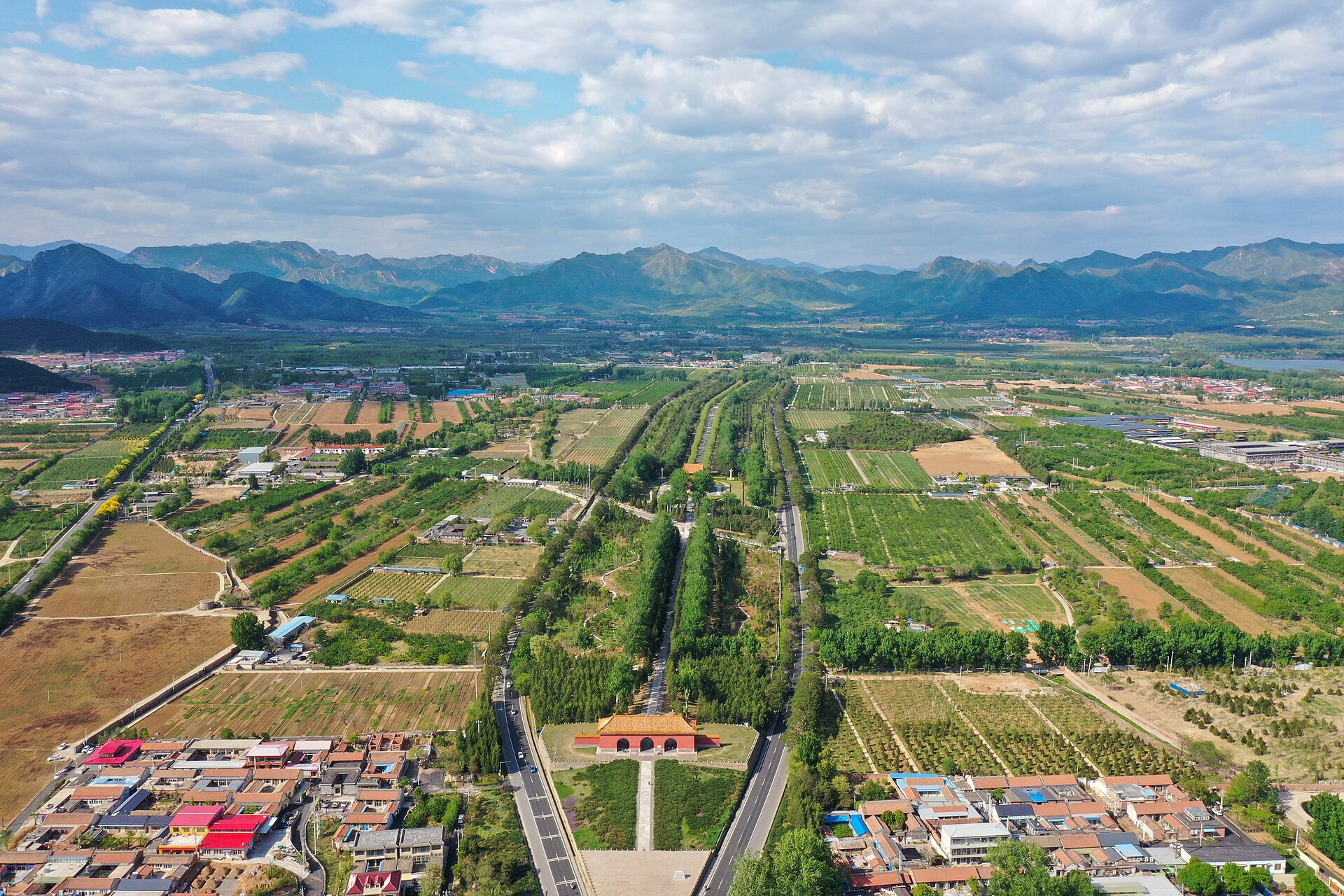
The Ming Tombs are a collection of mausoleums built by the emperors of the Ming dynasty of China. Located in the Changping District of Beijing, the site covers an area of over 40 square kilometers and contains the burial sites of thirteen Ming emperors, along with their empresses, concubines, and other imperial family members.
The site was selected for its geomantic properties, situated at the foot of the Tianshou Mountains to provide protection from northern winds and ensure favorable energy flow. The complex is characterized by its grand scale, symmetrical layout, and the integration of traditional Chinese architectural principles with the natural landscape.
Key Facts
- Materials
- Stone, Brick, Wood, Glazed tile
- Civilization
- Ming Dynasty
- Accessibility
- Partially accessible; some steep stairs at tomb entrances
- Date(s)
- 1409 - 1644 CE
- Condition
- Well-preserved, major tourist site
- Original Function
- Imperial burial complex
- Key Figures
- Yongle Emperor, Wanli Emperor
Establishment
1409 CEThe site was chosen by the Yongle Emperor, who moved the Ming capital from Nanjing to Beijing. He selected the location for his own tomb, Changling, which set the standard for the subsequent twelve imperial mausoleums built in the area.
Expansion
15th - 17th centuryOver the next two centuries, successive emperors constructed their own tombs within the valley. Each tomb was connected to the main entrance, the Great Red Gate, via a sacred path known as the Spirit Way, lined with stone statues of animals and officials.
Excavation and Modern Era
1956 - presentIn 1956, the Dingling tomb was excavated, revealing the underground palace of the Wanli Emperor. This remains the only tomb at the site to have been systematically opened. Today, the complex is a protected UNESCO World Heritage site and a major center for historical research.
Cultural Significance
The Ming Tombs represent the pinnacle of Chinese imperial funerary architecture and reflect the deep-seated influence of Feng Shui in state planning. The site serves as a physical manifestation of the Ming dynasty's cosmological view, where the emperor's final resting place was designed to maintain the harmony between the heavens, the earth, and the state.
Beyond their religious and architectural importance, the tombs are central to the study of Ming material culture. The artifacts recovered from the Dingling excavation have provided invaluable insights into the daily lives, craftsmanship, and burial customs of the imperial court.
Interpretive Notes
Scholarly debates and areas of uncertainty
There is ongoing academic debate regarding the ethics of excavating imperial tombs. The 1956 opening of the Dingling tomb resulted in the rapid deterioration of many silk and wooden artifacts due to exposure to the atmosphere, leading to a moratorium on further excavations of imperial burial sites in China.
Visiting Information
Entry Rules
Open daily. Tickets are required for entry to the main tomb areas and the Spirit Way. Modest dress is recommended. Security checks are mandatory at all entrances.
Best Times to Visit
Spring (April-May) and Autumn (September-October) offer the most temperate weather for walking the extensive grounds. Avoid major Chinese public holidays to minimize crowds.
Photography
Photography is permitted in outdoor areas. Flash photography is strictly prohibited inside the underground palaces and museum exhibition halls.
Preservation Notes
Stay on designated paths to protect the surrounding landscape and stone structures. Do not touch or climb on the stone statues along the Spirit Way. Some areas may be closed for ongoing maintenance.
Nearby POIs
11 shown- China Aviation Museum14.3 km
- Great Wall of China - Badaling Section21.1 km
- Summer Palace28.6 km
- China Science and Technology Museum31.4 km
- Great Wall of China - Jiankou Section34.4 km
- Great Wall of China - Mutianyu Section35.1 km
- Drum Tower and Bell Tower of Beijing37.7 km
- Beijing Temple of Confucius38 km
- Prince Gong's Mansion38 km
- Yonghe Temple38 km
- Military Museum of the Chinese People's Revolution39.3 km
Sources & Further Reading
- [1]
- [2]The Ming Tombs: Architecture and Symbolism — Ann Paludan. Oxford University Press (1991)
Key Facts
- Materials
- Stone, Brick, Wood, Glazed tile
- Civilization
- Ming Dynasty
- Accessibility
- Partially accessible; some steep stairs at tomb entrances
- Date(s)
- 1409 - 1644 CE
- Condition
- Well-preserved, major tourist site
- Original Function
- Imperial burial complex
- Key Figures
- Yongle Emperor, Wanli Emperor
Nearby POIs
11 shown- China Aviation Museum14.3 km
- Great Wall of China - Badaling Section21.1 km
- Summer Palace28.6 km
- China Science and Technology Museum31.4 km
- Great Wall of China - Jiankou Section34.4 km
- Great Wall of China - Mutianyu Section35.1 km
- Drum Tower and Bell Tower of Beijing37.7 km
- Beijing Temple of Confucius38 km
- Prince Gong's Mansion38 km
- Yonghe Temple38 km
- Military Museum of the Chinese People's Revolution39.3 km