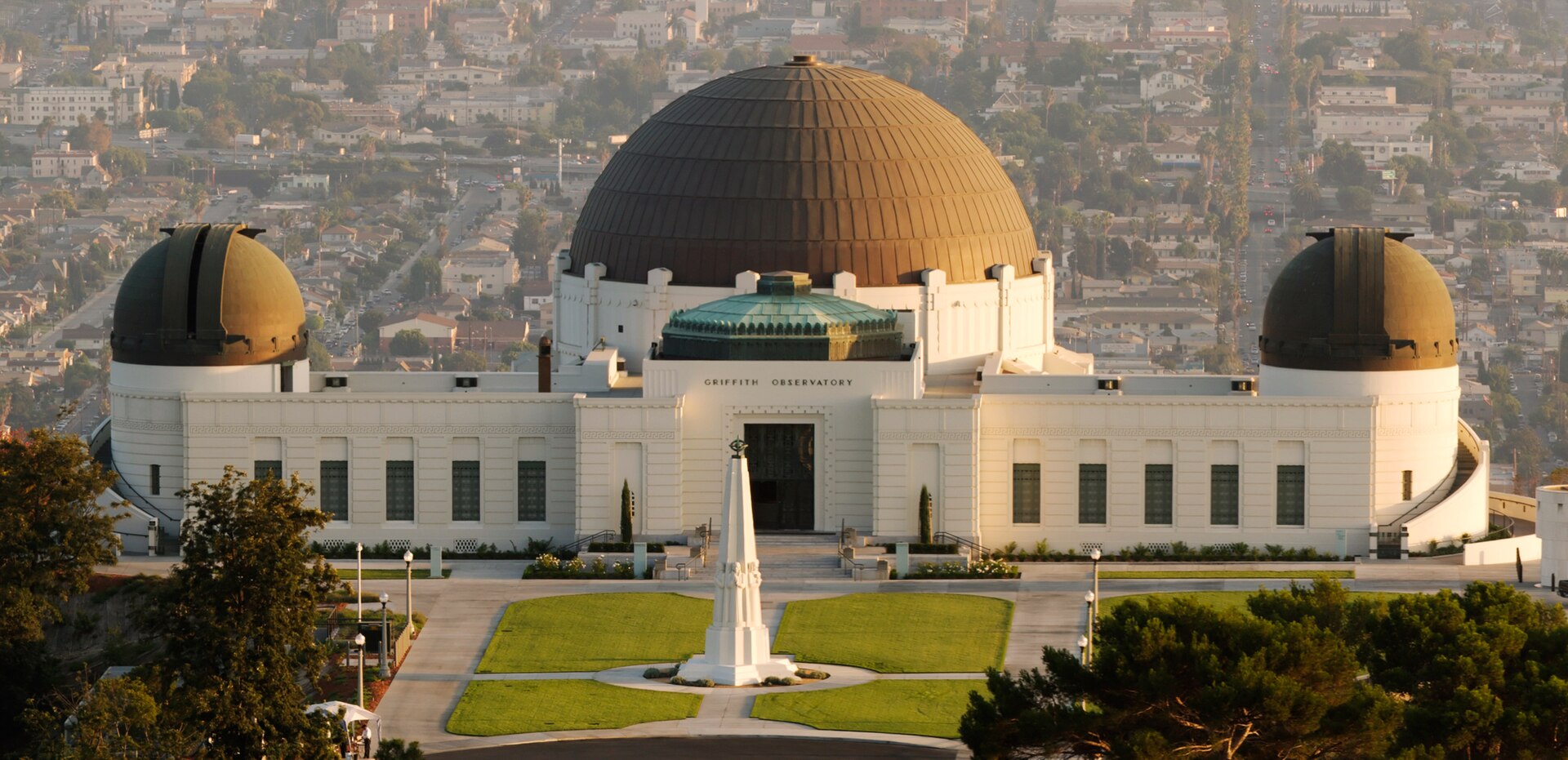
The Griffith Observatory is a public facility located on the southern slope of Mount Hollywood in Los Angeles' Griffith Park. Opened in 1935, it was designed by architects John C. Austin and Frederick M. Ashley, with the project funded by a bequest from Griffith J. Griffith. The building serves as a gateway to the cosmos, offering public access to telescopes, a planetarium, and extensive science exhibits.
Constructed in the Art Deco style, the observatory is characterized by its iconic copper domes and white concrete facade. It has served as a significant cultural landmark and a frequent filming location for Hollywood cinema, while remaining a primary site for public astronomical education and observation in Southern California.
Key Facts
- Materials
- Reinforced concrete, Copper, Steel
- Civilization
- United States
- Accessibility
- Wheelchair accessible with designated parking and shuttle service
- Date(s)
- 1933-1935
- Condition
- Fully operational and restored
- Original Function
- Public observatory and planetarium
- Key Figures
- Griffith J. Griffith, John C. Austin, Frederick M. Ashley
Conception and Funding
1919Upon his death in 1919, Griffith J. Griffith left a portion of his estate to the City of Los Angeles for the construction of an observatory and a planetarium in Griffith Park, aiming to make astronomy accessible to the general public.
Construction
1933-1935Construction began in 1933 under the Public Works Administration. The design team, led by John C. Austin and Frederick M. Ashley, integrated the building into the hillside, utilizing a distinctive Art Deco aesthetic that became synonymous with Los Angeles architecture.
World War II and Training
1940sDuring World War II, the planetarium theater was utilized to train pilots in celestial navigation, demonstrating the facility's utility beyond public education.
Renovation and Expansion
2002-2006The observatory closed in 2002 for a comprehensive four-year renovation and expansion project. This effort restored the original building, upgraded the planetarium with a state-of-the-art laser projection system, and added extensive underground exhibit space.
Cultural Significance
The Griffith Observatory is a symbol of Los Angeles' commitment to science and public education. It is deeply embedded in the city's cultural identity, frequently appearing in films such as 'Rebel Without a Cause' and 'La La Land,' which have cemented its status as a global icon of the American West.
Interpretive Notes
Scholarly debates and areas of uncertainty
Discussions regarding the observatory often center on the balance between preserving its historic Art Deco architecture and the necessity of modernizing its scientific equipment to remain relevant in contemporary astronomical research and public outreach.
Visiting Information
Entry Rules
Admission to the building and grounds is free. Parking is limited and paid. The facility is closed on Mondays.
Best Times to Visit
Weekday mornings or late evenings on weekdays to avoid peak weekend crowds. Clear nights are ideal for telescope viewing.
Photography
Personal photography is permitted. Commercial photography and filming require a permit from the City of Los Angeles Department of Recreation and Parks.
Preservation Notes
The building is a designated Los Angeles Historic-Cultural Monument. Visitors are requested to respect the historic architecture and keep to designated paths.
Nearby POIs
11 shown- Hollywood Wax Museum3.9 km
- Hollywood Museum4 km
- Hollywood Walk of Fame4.1 km
- George C. Page Museum7.9 km
- La Brea Tar Pits7.9 km
- Los Angeles County Museum of Art8.1 km
- Academy Museum of Motion Pictures8.2 km
- Petersen Automotive Museum8.4 km
- The Broad8.4 km
- Grammy Museum8.8 km
- Japanese American National Museum9.5 km
Key Facts
- Materials
- Reinforced concrete, Copper, Steel
- Civilization
- United States
- Accessibility
- Wheelchair accessible with designated parking and shuttle service
- Date(s)
- 1933-1935
- Condition
- Fully operational and restored
- Original Function
- Public observatory and planetarium
- Key Figures
- Griffith J. Griffith, John C. Austin, Frederick M. Ashley
Nearby POIs
11 shown- Hollywood Wax Museum3.9 km
- Hollywood Museum4 km
- Hollywood Walk of Fame4.1 km
- George C. Page Museum7.9 km
- La Brea Tar Pits7.9 km
- Los Angeles County Museum of Art8.1 km
- Academy Museum of Motion Pictures8.2 km
- Petersen Automotive Museum8.4 km
- The Broad8.4 km
- Grammy Museum8.8 km
- Japanese American National Museum9.5 km