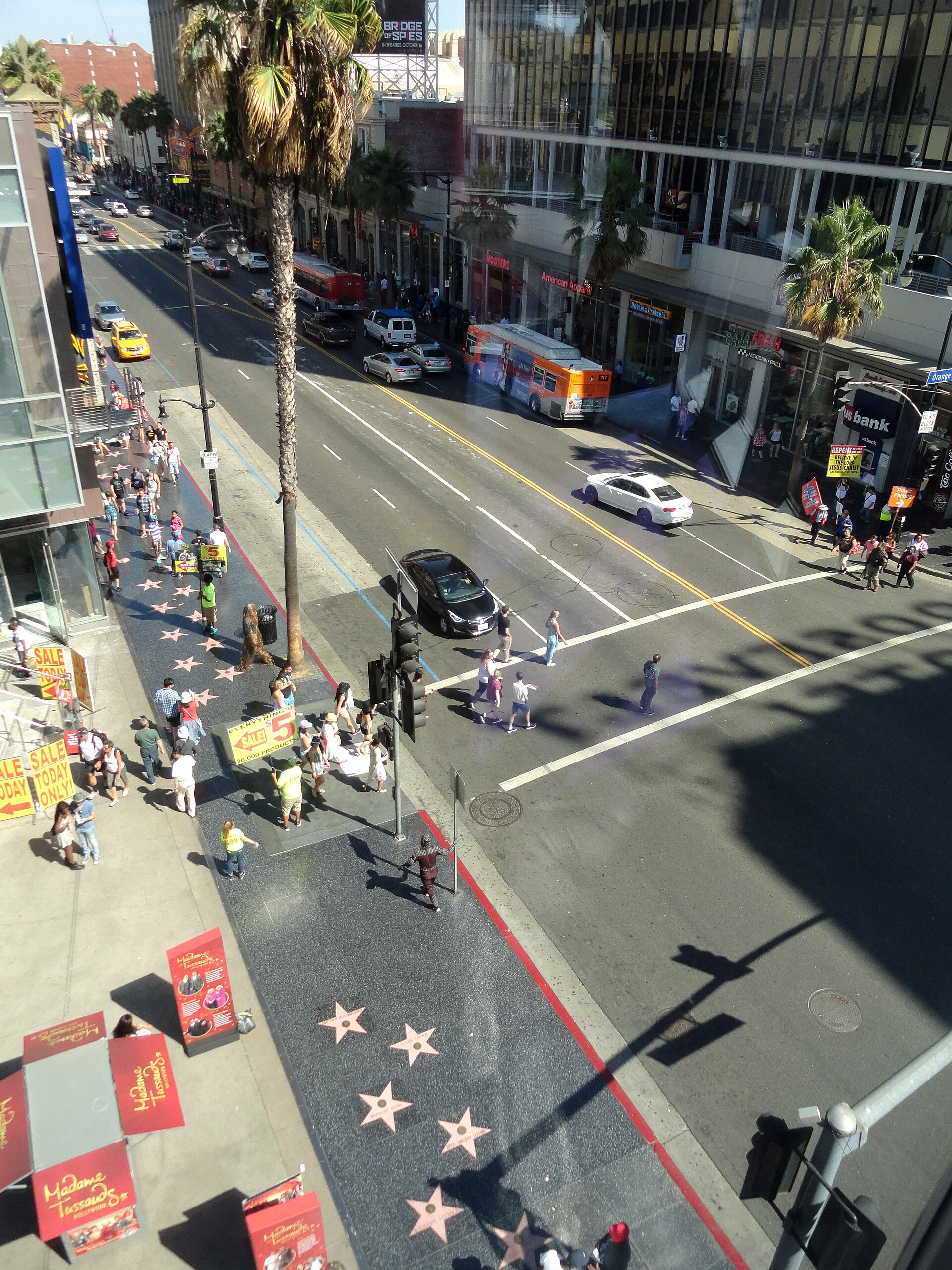
The Hollywood Walk of Fame is a historic landmark consisting of more than 2,700 brass-rimmed, terrazzo stars embedded into the sidewalks along 15 blocks of Hollywood Boulevard and three blocks of Vine Street in Los Angeles. The stars serve as permanent public monuments to individuals and fictional characters who have made significant contributions to the entertainment industry.
Administered by the Hollywood Chamber of Commerce, the Walk of Fame was conceived in 1953 as a means to improve the image of Hollywood. The first permanent star was laid in 1960, and the site has since become one of the most visited tourist attractions in the United States, functioning as both a cultural icon and a tribute to the history of film, television, radio, recording, and live theater.
Key Facts
- Materials
- Terrazzo, Brass
- Civilization
- American
- Accessibility
- Fully accessible public sidewalk
- Date(s)
- 1960-present
- Condition
- Active, ongoing expansion
- Original Function
- Public monument to entertainment industry figures
- Key Figures
- E.M. Stuart, Joanne Woodward, Stanley Kramer
Conception and Planning
1953-1958The idea for the Walk of Fame was proposed by E.M. Stuart, the volunteer president of the Hollywood Chamber of Commerce, to maintain the 'glamour' of Hollywood. A committee was formed to develop the concept, and the Los Angeles City Council approved the project in 1956.
Inauguration
1960Construction began in 1958, and the first permanent star, dedicated to actress Joanne Woodward, was laid on February 9, 1960. By the end of that year, over 1,500 stars had been installed.
Expansion and Modernization
1968-presentThe Walk of Fame underwent a major renovation in the 1990s to restore the terrazzo and brass. The site continues to grow, with new stars added annually through a nomination and selection process managed by the Hollywood Chamber of Commerce.
Cultural Significance
The Hollywood Walk of Fame is a global symbol of the American entertainment industry, representing the 'Golden Age' of Hollywood and the ongoing influence of celebrity culture. It serves as a physical manifestation of the industry's history, drawing millions of visitors annually and acting as a primary site for public celebrations and film premieres.
Beyond its role as a tourist destination, the Walk of Fame is a significant marker of cultural achievement. The selection process for a star is highly competitive, and the unveiling ceremonies are major media events that reinforce the status of the honorees within the global entertainment landscape.
Interpretive Notes
Scholarly debates and areas of uncertainty
Debates often center on the commercialization of the site and the criteria for selection. Critics sometimes argue that the nomination process, which requires a sponsorship fee, favors those with strong public relations backing over those with purely artistic merit. Additionally, there is ongoing discussion regarding the preservation of the sidewalk's integrity amidst the high volume of foot traffic and urban development.
Visiting Information
Entry Rules
The Walk of Fame is a public sidewalk and is open 24 hours a day, 7 days a week. There is no entry fee. Visitors are encouraged to be aware of their surroundings as the area is a busy urban environment.
Best Times to Visit
Early morning on weekdays is recommended to avoid heavy tourist crowds and to allow for easier photography of the stars.
Photography
None. The site is in a public space and photography is permitted.
Preservation Notes
The stars are maintained by the Hollywood Historic Trust. Visitors are asked to respect the sidewalk and avoid littering or damaging the brass and terrazzo surfaces.
Nearby POIs
11 shown- Hollywood Museum0.2 km
- Hollywood Wax Museum0.2 km
- Griffith Observatory4.1 km
- George C. Page Museum4.4 km
- La Brea Tar Pits4.5 km
- Los Angeles County Museum of Art4.6 km
- Academy Museum of Motion Pictures4.6 km
- Petersen Automotive Museum4.8 km
- Grammy Museum9.4 km
- The Broad9.8 km
- Natural History Museum of Los Angeles County10.5 km
Sources & Further Reading
- [1]The Hollywood Walk of Fame: A History — Hollywood Chamber of Commerce. Official Walk of Fame Website (2023)View
- [2]Hollywood: A Celebration of the Stars — Jeffrey B. Snyder. Schiffer Publishing (2003)
Key Facts
- Materials
- Terrazzo, Brass
- Civilization
- American
- Accessibility
- Fully accessible public sidewalk
- Date(s)
- 1960-present
- Condition
- Active, ongoing expansion
- Original Function
- Public monument to entertainment industry figures
- Key Figures
- E.M. Stuart, Joanne Woodward, Stanley Kramer
Nearby POIs
11 shown- Hollywood Museum0.2 km
- Hollywood Wax Museum0.2 km
- Griffith Observatory4.1 km
- George C. Page Museum4.4 km
- La Brea Tar Pits4.5 km
- Los Angeles County Museum of Art4.6 km
- Academy Museum of Motion Pictures4.6 km
- Petersen Automotive Museum4.8 km
- Grammy Museum9.4 km
- The Broad9.8 km
- Natural History Museum of Los Angeles County10.5 km