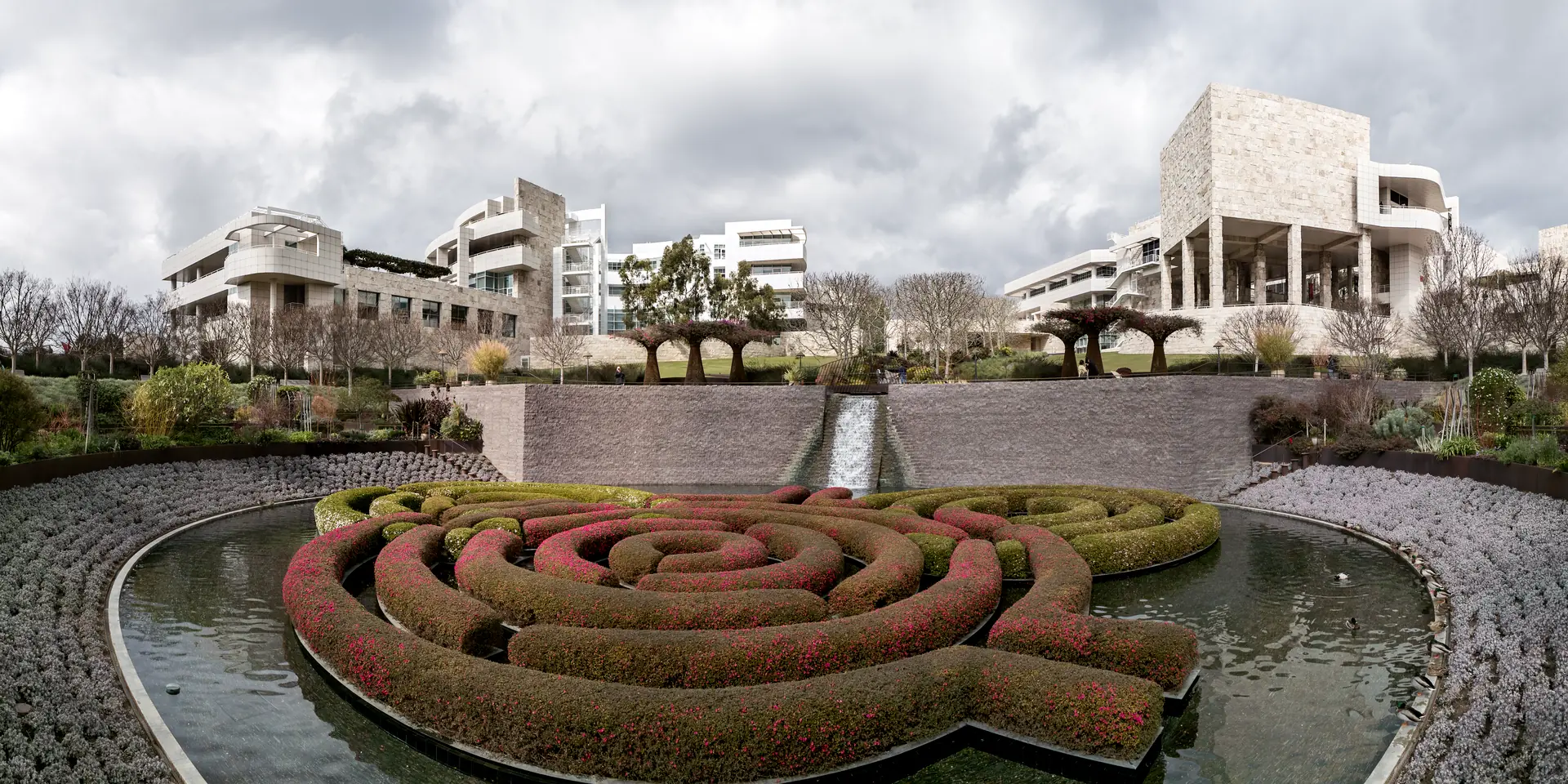
The Getty Center is a major cultural institution located in the Brentwood neighborhood of Los Angeles. Designed by architect Richard Meier, the campus is renowned for its modernist architecture, extensive central garden, and panoramic views of the Los Angeles basin. It serves as the primary location for the J. Paul Getty Museum, alongside the Getty Research Institute and the Getty Conservation Institute.
The site is constructed primarily of travertine stone and white metal panels, integrated into the natural topography of the Santa Monica Mountains. Since its opening in 1997, it has functioned as a global hub for art history, conservation, and public education, housing a significant collection of European paintings, drawings, sculpture, illuminated manuscripts, and decorative arts, as well as 19th- and 20th-century photography.
Key Facts
- Materials
- Travertine, White metal panels, Glass, Steel
- Civilization
- United States
- Accessibility
- Fully ADA compliant with tram access
- Date(s)
- 1984-1997
- Condition
- Excellent, active
- Original Function
- Art museum and research center
- Key Figures
- J. Paul Getty, Richard Meier, Robert Irwin
Founding and Vision
1976-1983Following the death of oil tycoon J. Paul Getty, the J. Paul Getty Trust was established as one of the wealthiest art institutions in the world. The trustees decided to consolidate various programs into a single campus, selecting a 110-acre site in the Santa Monica Mountains.
Design and Construction
1984-1997Architect Richard Meier was commissioned to design the campus. The project involved complex engineering to stabilize the hillside and the transport of 1.2 million square feet of Italian travertine. Construction spanned over a decade, culminating in the center's public opening in December 1997.
Institutional Evolution
1998-PresentSince its opening, the Getty Center has expanded its digital archives and conservation efforts. It remains a focal point for international art scholarship and continues to host rotating exhibitions alongside its permanent collection.
Cultural Significance
The Getty Center represents a landmark in late 20th-century institutional architecture, symbolizing the intersection of private wealth and public cultural access. Its design, which emphasizes light and landscape, has influenced museum architecture globally.
Beyond its aesthetic impact, the center is a critical site for the study of art conservation. The Getty Conservation Institute's presence on-site ensures that the institution remains a leader in the preservation of global cultural heritage, influencing how museums manage and restore collections worldwide.
Interpretive Notes
Scholarly debates and areas of uncertainty
The architectural style of the Getty Center has been a subject of debate, with some critics arguing that its stark, modernist aesthetic creates a sense of detachment from the surrounding urban landscape of Los Angeles. Additionally, the institution's acquisition policies and the provenance of certain antiquities have historically been topics of rigorous scholarly and legal scrutiny.
Visiting Information
Entry Rules
Admission is free, but timed-entry reservations are required. The center is closed on Mondays. Visitors must pass through a security screening at the tram arrival plaza.
Best Times to Visit
Weekday mornings are generally less crowded. The gardens are particularly vibrant during the spring bloom.
Photography
Personal photography is permitted in the galleries without flash or tripods. Professional or commercial photography requires prior authorization from the Getty Trust.
Preservation Notes
The travertine surfaces are sensitive; visitors are requested not to touch the exterior walls. Smoking and food are prohibited inside the galleries.
Nearby POIs
11 shown- Hammer Museum3.5 km
- Petersen Automotive Museum10.6 km
- Academy Museum of Motion Pictures10.6 km
- Los Angeles County Museum of Art10.7 km
- La Brea Tar Pits11.1 km
- George C. Page Museum11.1 km
- Hollywood Walk of Fame12.7 km
- Hollywood Museum12.9 km
- Hollywood Wax Museum12.9 km
- Griffith Observatory16.7 km
- Natural History Museum of Los Angeles County18.4 km
Sources & Further Reading
- [1]The Getty Center: Design Process — Richard Meier. Rizzoli (1997)
- [2]Building the Getty — Hilary Lewis. Harry N. Abrams (1999)
Key Facts
- Materials
- Travertine, White metal panels, Glass, Steel
- Civilization
- United States
- Accessibility
- Fully ADA compliant with tram access
- Date(s)
- 1984-1997
- Condition
- Excellent, active
- Original Function
- Art museum and research center
- Key Figures
- J. Paul Getty, Richard Meier, Robert Irwin
Nearby POIs
11 shown- Hammer Museum3.5 km
- Petersen Automotive Museum10.6 km
- Academy Museum of Motion Pictures10.6 km
- Los Angeles County Museum of Art10.7 km
- La Brea Tar Pits11.1 km
- George C. Page Museum11.1 km
- Hollywood Walk of Fame12.7 km
- Hollywood Museum12.9 km
- Hollywood Wax Museum12.9 km
- Griffith Observatory16.7 km
- Natural History Museum of Los Angeles County18.4 km