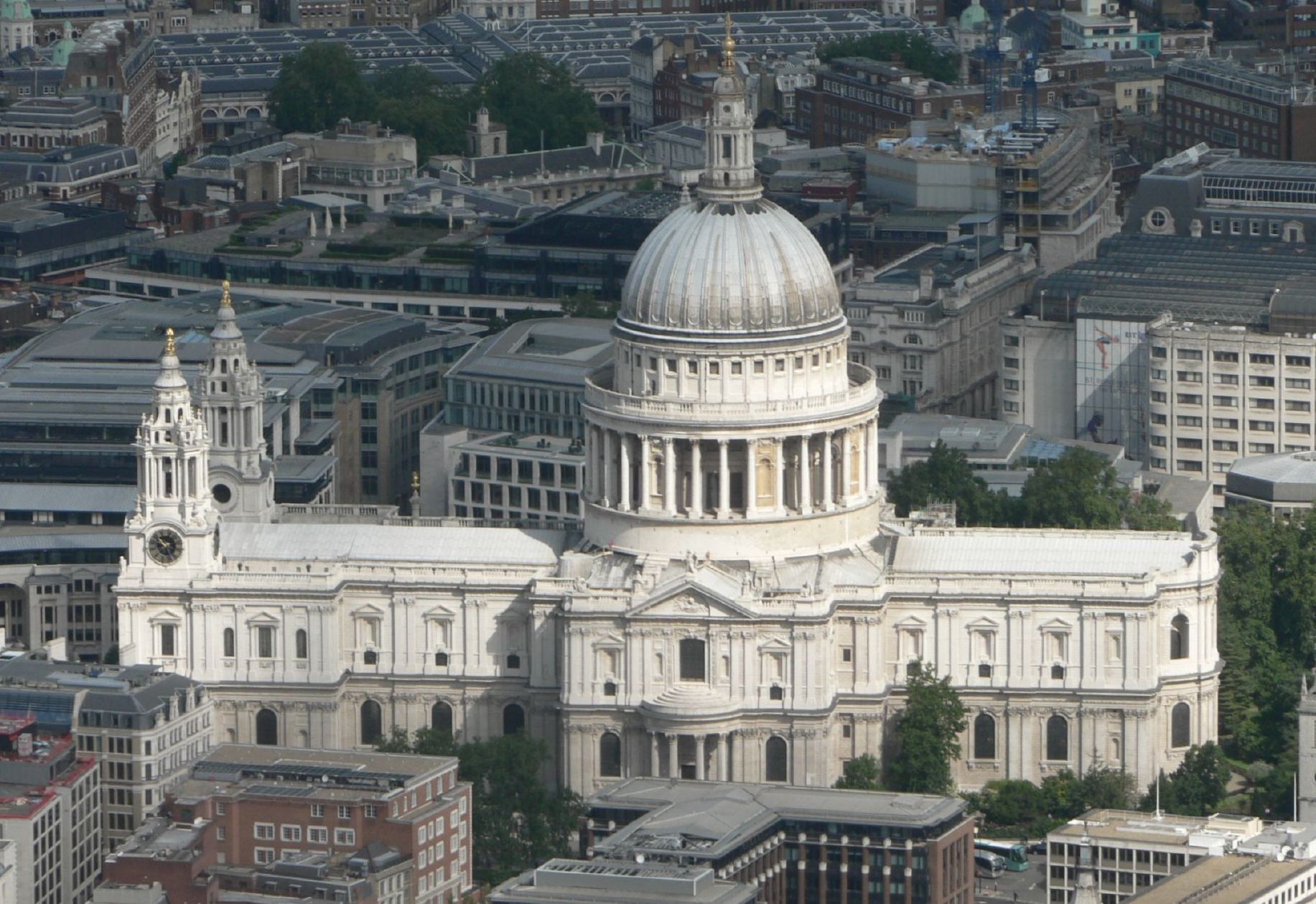
St Paul's Cathedral is an Anglican cathedral in London, serving as the seat of the Bishop of London and the mother church of the Diocese of London. The current structure, the fifth to occupy the site, was designed by Sir Christopher Wren as part of a major rebuilding program following the Great Fire of London in 1666.
Characterized by its iconic dome, which dominates the London skyline, the cathedral is a masterpiece of English Baroque architecture. It features a complex interior layout, including the Whispering Gallery, the crypt, and the Golden Gallery, and has served as the site for numerous significant national events, including state funerals and royal weddings.
Key Facts
- Materials
- Portland stone, Brick, Lead, Iron
- Civilization
- British
- Accessibility
- Wheelchair accessible via the south churchyard entrance
- Date(s)
- 1675-1710
- Condition
- Active place of worship and tourist site
- Original Function
- Anglican Cathedral
- Key Figures
- Sir Christopher Wren, King Charles II, Bishop Henry Compton
Predecessors and the Great Fire
604-1666The site has hosted a cathedral dedicated to St Paul since 604 CE. The medieval 'Old St Paul's' was a massive Gothic structure that fell into disrepair before being completely destroyed in the Great Fire of London in 1666.
Wren's Design and Construction
1675-1710Following the fire, Sir Christopher Wren was commissioned to design a replacement. His final design, a synthesis of Neoclassical, Gothic, and Baroque elements, was approved in 1675. Construction spanned 35 years, with the final stone laid in 1710.
The Blitz and Restoration
1940-1945During the Second World War, the cathedral became a symbol of British resilience. Despite being hit by incendiary bombs during the Blitz, it survived largely intact due to the efforts of the St Paul's Watch.
Modern Era
20th century-presentThe cathedral continues to function as a major religious and cultural institution. Extensive cleaning and restoration projects in the late 20th and early 21st centuries have preserved its exterior stonework and interior mosaics.
Cultural Significance
St Paul's Cathedral is a central symbol of London's identity and endurance. Beyond its religious function, it has served as a venue for national commemorations, including the funerals of Lord Nelson, the Duke of Wellington, and Sir Winston Churchill, as well as the wedding of Prince Charles and Lady Diana Spencer.
Its architectural influence extends globally, having served as a prototype for numerous civic and religious buildings throughout the British Empire and the United States, most notably the United States Capitol.
Interpretive Notes
Scholarly debates and areas of uncertainty
Architectural historians frequently debate the extent to which Wren's design was influenced by contemporary French Baroque architecture versus his own interpretation of Italian Renaissance principles. Additionally, the structural integrity of the dome's inner and outer shells remains a subject of ongoing engineering study.
Visiting Information
Entry Rules
Open to visitors Monday through Saturday. Tickets are required for sightseeing, which includes access to the floor, crypt, and galleries. As an active church, visitors are expected to dress modestly and remain quiet during services.
Best Times to Visit
Weekday mornings shortly after opening (8:30 AM) to avoid the heaviest tourist crowds. Mid-week visits are generally quieter than weekends.
Photography
Photography is permitted for personal use on the cathedral floor. Photography is strictly prohibited during services and in the crypt.
Preservation Notes
The cathedral is a living building; please respect cordoned-off areas during ongoing maintenance. Do not touch the marble or historic monuments.
Nearby POIs
11 shownSources & Further Reading
- [1]St Paul's Cathedral: The Official History — Jane Lang. Phoenix House (1956)
- [2]Sir Christopher Wren: The Design of St Paul's Cathedral — Kerry Downes. Trefoil Publications (1987)
Key Facts
- Materials
- Portland stone, Brick, Lead, Iron
- Civilization
- British
- Accessibility
- Wheelchair accessible via the south churchyard entrance
- Date(s)
- 1675-1710
- Condition
- Active place of worship and tourist site
- Original Function
- Anglican Cathedral
- Key Figures
- Sir Christopher Wren, King Charles II, Bishop Henry Compton