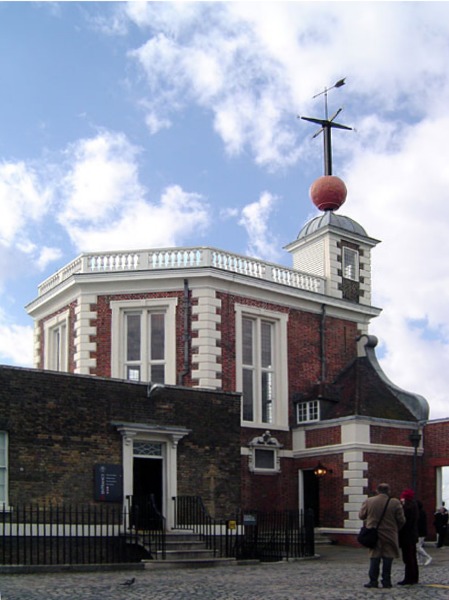
The Royal Observatory in Greenwich was commissioned by King Charles II in 1675 to improve navigation and the accuracy of astronomical tables. Designed by Sir Christopher Wren, the original building, known as Flamsteed House, served as the residence for the Astronomer Royal and the site of early telescopic observations.
Over the following centuries, the institution became the center of global timekeeping and navigation. It is the site of the Prime Meridian of the world, defined as 0° longitude, and the origin of Greenwich Mean Time (GMT). Today, it functions as a museum and planetarium, preserving the history of scientific discovery and the development of precision chronometry.
Key Facts
- Materials
- Brick, Portland stone
- Civilization
- British
- Accessibility
- Partially accessible; historic buildings have limited lift access
- Date(s)
- 1675-1676
- Condition
- Well-preserved museum and heritage site
- Original Function
- Astronomical observatory
- Key Figures
- King Charles II, John Flamsteed, Sir Christopher Wren, George Airy
Foundation and Early Years
1675-1700King Charles II established the observatory to solve the 'longitude problem' for maritime navigation. John Flamsteed was appointed the first Astronomer Royal, tasked with mapping the stars and improving lunar tables.
Defining the Meridian
18th-19th centuryThe observatory became the international standard for longitude. In 1884, the Greenwich Meridian was formally adopted as the Prime Meridian of the world at the International Meridian Conference.
Modernization and Relocation
20th centuryDue to light pollution in London, the Royal Greenwich Observatory moved its research functions to Herstmonceux Castle in 1948. The Greenwich site was subsequently repurposed as a public museum.
Cultural Significance
The Royal Observatory is a global symbol of scientific progress and the standardization of time. Its role in defining the Prime Meridian and Greenwich Mean Time fundamentally shaped international commerce, communication, and navigation systems that remain in use today.
As part of the Maritime Greenwich UNESCO World Heritage site, it represents the intersection of British imperial power and the Enlightenment-era pursuit of empirical knowledge. It remains a focal point for public engagement with astronomy and the history of science.
Interpretive Notes
Scholarly debates and areas of uncertainty
There is ongoing historical discussion regarding the extent to which the observatory's early work was driven by the practical needs of the British Navy versus the purely theoretical interests of the Royal Society. Additionally, the legacy of the Prime Meridian is sometimes debated in the context of colonial history and the imposition of European-centric cartographic standards.
Visiting Information
Entry Rules
Open daily. Tickets are required for entry to the Meridian Courtyard and the historic Flamsteed House. Advance booking is recommended during peak tourist seasons.
Best Times to Visit
Weekdays during the school term to avoid large crowds. Arrive at opening time to photograph the Prime Meridian line without significant queues.
Photography
Personal photography is permitted in most areas. Flash is prohibited inside the historic galleries and near sensitive astronomical instruments.
Preservation Notes
The site contains delicate 17th-century architecture and antique scientific instruments. Visitors are requested to refrain from touching displays and to remain within designated visitor areas.
Nearby POIs
11 shownSources & Further Reading
- [1]The Royal Observatory, Greenwich: A History — Derek Howse. National Maritime Museum (1975)
- [2]Greenwich Time and the Longitude — Derek Howse. Philip Wilson Publishers (1997)
Key Facts
- Materials
- Brick, Portland stone
- Civilization
- British
- Accessibility
- Partially accessible; historic buildings have limited lift access
- Date(s)
- 1675-1676
- Condition
- Well-preserved museum and heritage site
- Original Function
- Astronomical observatory
- Key Figures
- King Charles II, John Flamsteed, Sir Christopher Wren, George Airy