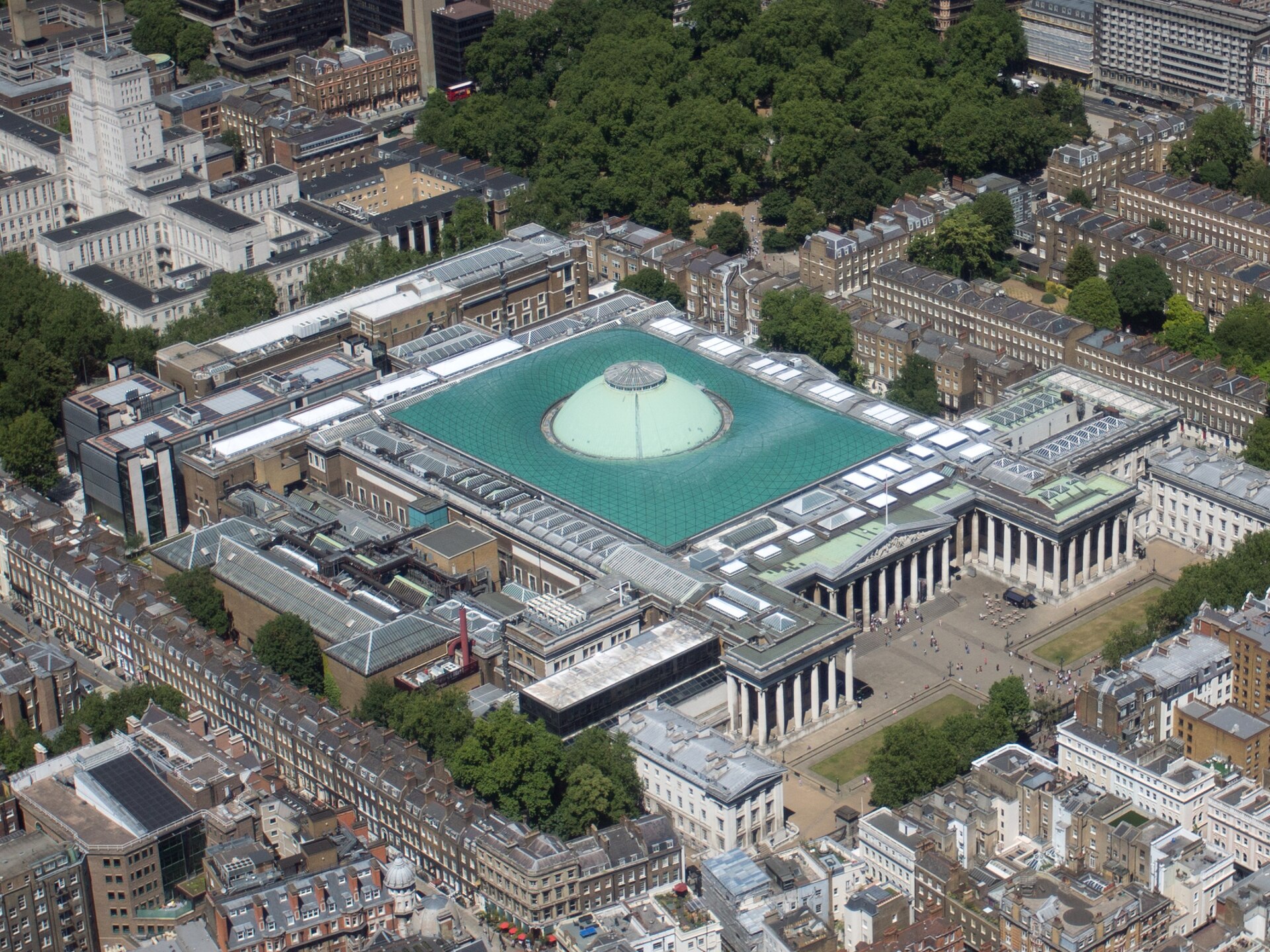
The British Museum is a public institution dedicated to human history, art, and culture, located in the Bloomsbury area of London. Established in 1753, it was the first national public museum in the world. Its permanent collection, numbering some eight million works, is among the largest and most comprehensive in existence, having been curated during the era of the British Empire.
The museum's architecture is defined by its iconic Greek Revival facade and the Great Court, which features a massive glass-and-steel roof designed by Foster and Partners. The institution serves as a global repository for artifacts from all continents, illustrating and documenting the story of human culture from its beginnings to the present day.
Key Facts
- Materials
- Portland stone, Steel, Glass
- Civilization
- British
- Accessibility
- Fully accessible with elevators and ramps
- Date(s)
- 1823-1852
- Condition
- Active, well-preserved
- Original Function
- National museum and library
- Key Figures
- Sir Hans Sloane, Robert Smirke, Lord Elgin
Founding and Early Years
1753The museum was founded based on the collections of the physician and naturalist Sir Hans Sloane. It was established by an Act of Parliament and opened to the public in 1759 at Montagu House.
Expansion and New Building
19th CenturyDue to the rapid growth of the collection, the original Montagu House was demolished. Architect Robert Smirke designed the current Greek Revival building, which was constructed in stages between 1823 and 1852.
Modernization and The Great Court
2000The museum underwent a major transformation with the opening of the Queen Elizabeth II Great Court. This project enclosed the former inner courtyard, creating the largest covered public square in Europe.
Cultural Significance
The British Museum acts as a central pillar of global cultural heritage, housing iconic artifacts such as the Rosetta Stone and the Parthenon Sculptures. It represents the historical intersection of Enlightenment ideals and imperial collection practices, serving as a primary site for the study of world civilizations.
Its role in the modern era is deeply tied to its status as a public educational resource. It remains a focal point for international discourse regarding the ethics of museum collections and the repatriation of cultural property to countries of origin.
Interpretive Notes
Scholarly debates and areas of uncertainty
The most prominent debate concerns the provenance of its collections, particularly the Parthenon Sculptures (Elgin Marbles) and the Benin Bronzes. Scholars and international bodies continue to debate the legal and ethical frameworks surrounding the retention of these items versus their return to their nations of origin.
Visiting Information
Entry Rules
Open daily. General admission is free, though booking a timed entry slot online is strongly recommended to guarantee access. Security screening is mandatory for all visitors.
Best Times to Visit
Weekday mornings (10:00-11:30) or Friday evenings when the museum remains open late. Avoid weekends and school holidays to minimize crowds.
Photography
Personal photography is permitted in most galleries for non-commercial use. Flash, tripods, and selfie sticks are prohibited. Specific temporary exhibitions may have stricter rules.
Preservation Notes
Do not touch artifacts or display cases. Large bags are not permitted in the galleries and must be left in the cloakroom. Follow all signage regarding restricted areas.
Nearby POIs
11 shownKey Facts
- Materials
- Portland stone, Steel, Glass
- Civilization
- British
- Accessibility
- Fully accessible with elevators and ramps
- Date(s)
- 1823-1852
- Condition
- Active, well-preserved
- Original Function
- National museum and library
- Key Figures
- Sir Hans Sloane, Robert Smirke, Lord Elgin