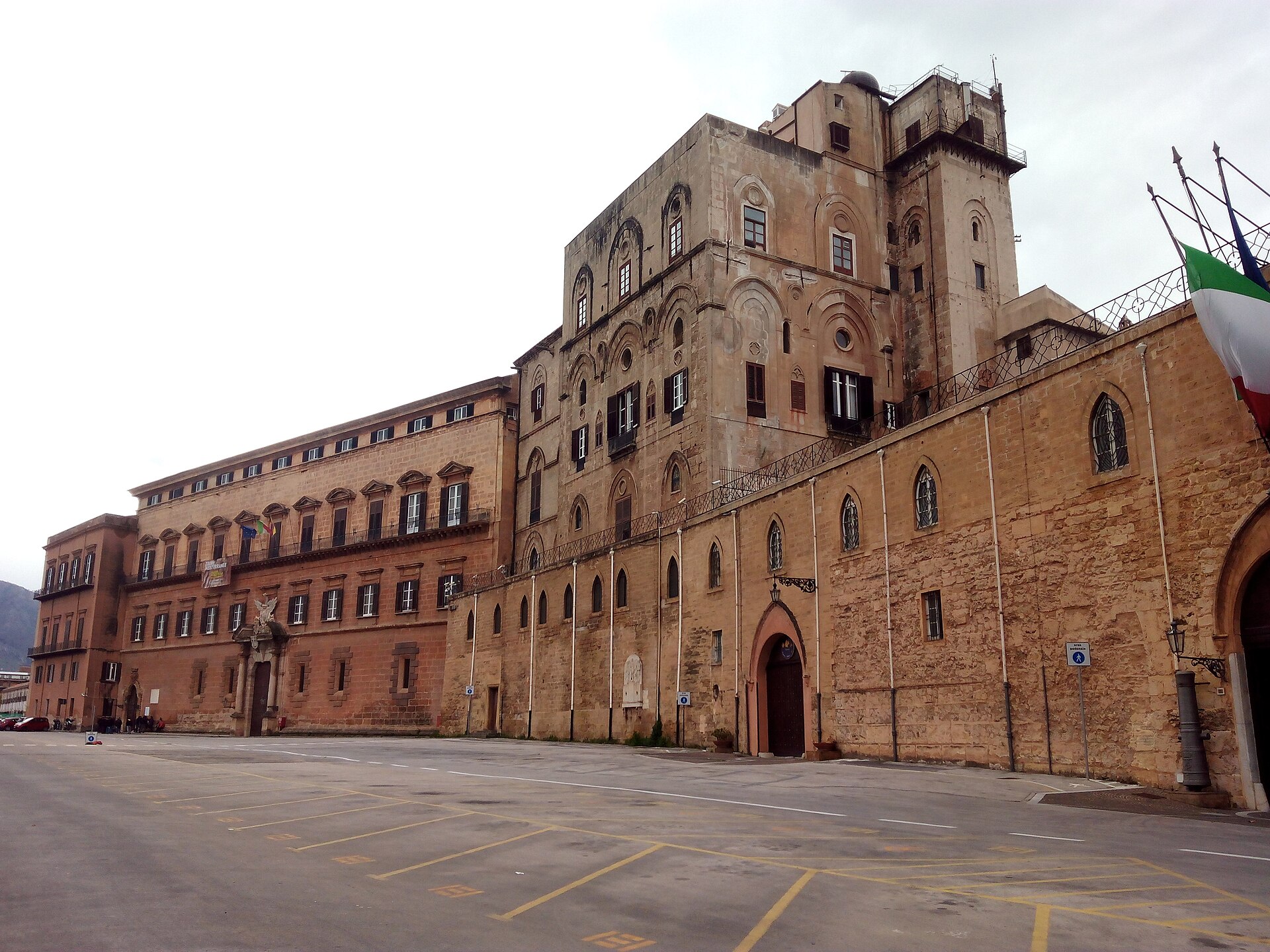
The Palazzo dei Normanni, also known as the Royal Palace of Palermo, stands on the highest point of the ancient city center. Originally constructed by the Emir of Sicily in the 9th century, it was significantly expanded by the Norman kings following their conquest of the island in 1072. The palace serves as a primary example of Arab-Norman-Byzantine architectural synthesis, blending Islamic structural techniques with Western Romanesque and Byzantine decorative elements.
Today, the palace functions as the seat of the Sicilian Regional Assembly. Its most renowned feature is the Palatine Chapel, a masterpiece of 12th-century mosaic art commissioned by Roger II. The structure has undergone numerous modifications over the centuries, most notably during the Spanish period, which added the current Renaissance and Baroque facades surrounding the internal courtyards.
Key Facts
- Materials
- Limestone, Marble, Gold leaf (mosaics), Brick
- Civilization
- Arab-Norman
- Accessibility
- Partially accessible; some areas involve stairs
- Date(s)
- 9th century (original foundation), 11th-12th century (Norman expansion)
- Condition
- Well-preserved, active seat of government
- Original Function
- Fortified residence of the Emir of Sicily
- Key Figures
- Roger II of Sicily, William I of Sicily, Frederick II, Holy Roman Emperor
Islamic Origins
9th centuryThe site was originally established as a fortified palace (qasr) by the Aghlabid emirs who ruled Sicily. It occupied a strategic position overlooking the harbor and the surrounding plain.
Norman Transformation
11th-12th centuryFollowing the Norman conquest, the palace became the royal residence. Roger II commissioned the Palatine Chapel and the Torre Pisana, integrating Islamic artisans to create a unique multicultural aesthetic.
Imperial and Spanish Eras
13th-17th centuryUnder the Hohenstaufen dynasty, the palace remained a center of intellectual life. During the Spanish viceroyalty, the structure was heavily renovated, adding the Maqueda courtyard and the grand staircase.
Modern Era
1946-presentSince 1946, the palace has served as the official seat of the Sicilian Regional Assembly. Extensive restoration projects have been conducted to preserve the mosaics and structural integrity of the Norman-era wings.
Cultural Significance
The Palazzo dei Normanni is a symbol of the 'Norman Sicily' period, representing a rare historical moment of religious and cultural tolerance where Islamic, Byzantine, and Latin traditions coexisted. It remains the most significant architectural testament to the Mediterranean's complex medieval history.
As the seat of the Sicilian Regional Assembly, the palace continues to be the political heart of the island. Its status as a UNESCO World Heritage site underscores its importance in the global history of art and architecture, particularly regarding the development of mosaic programs in the Middle Ages.
Interpretive Notes
Scholarly debates and areas of uncertainty
The extent of the original Islamic layout remains a subject of archaeological investigation. While the Norman-era additions are well-documented, the exact configuration of the 9th-century qasr is debated, as much of the original foundation was subsumed by later construction.
Visiting Information
Entry Rules
Open daily. Tickets are required for entry to the Royal Apartments and the Palatine Chapel. Security checks are mandatory. Modest dress is required for the chapel area.
Best Times to Visit
Early morning or late afternoon to avoid cruise ship crowds. Weekdays are generally quieter than weekends.
Photography
Photography is permitted in most areas without flash. Tripods are prohibited. Photography is strictly forbidden inside the Palatine Chapel during religious services.
Preservation Notes
The mosaics are highly sensitive to humidity and light. Visitors are requested to refrain from touching walls or decorative surfaces. Restoration work is ongoing in various wings of the palace.
Nearby POIs
6 shownSources & Further Reading
- [1]
- [2]Arab-Norman Sicily: The Architecture of the Mediterranean — Azzara, Claudio. Viella Libreria Editrice (2015)
Key Facts
- Materials
- Limestone, Marble, Gold leaf (mosaics), Brick
- Civilization
- Arab-Norman
- Accessibility
- Partially accessible; some areas involve stairs
- Date(s)
- 9th century (original foundation), 11th-12th century (Norman expansion)
- Condition
- Well-preserved, active seat of government
- Original Function
- Fortified residence of the Emir of Sicily
- Key Figures
- Roger II of Sicily, William I of Sicily, Frederick II, Holy Roman Emperor