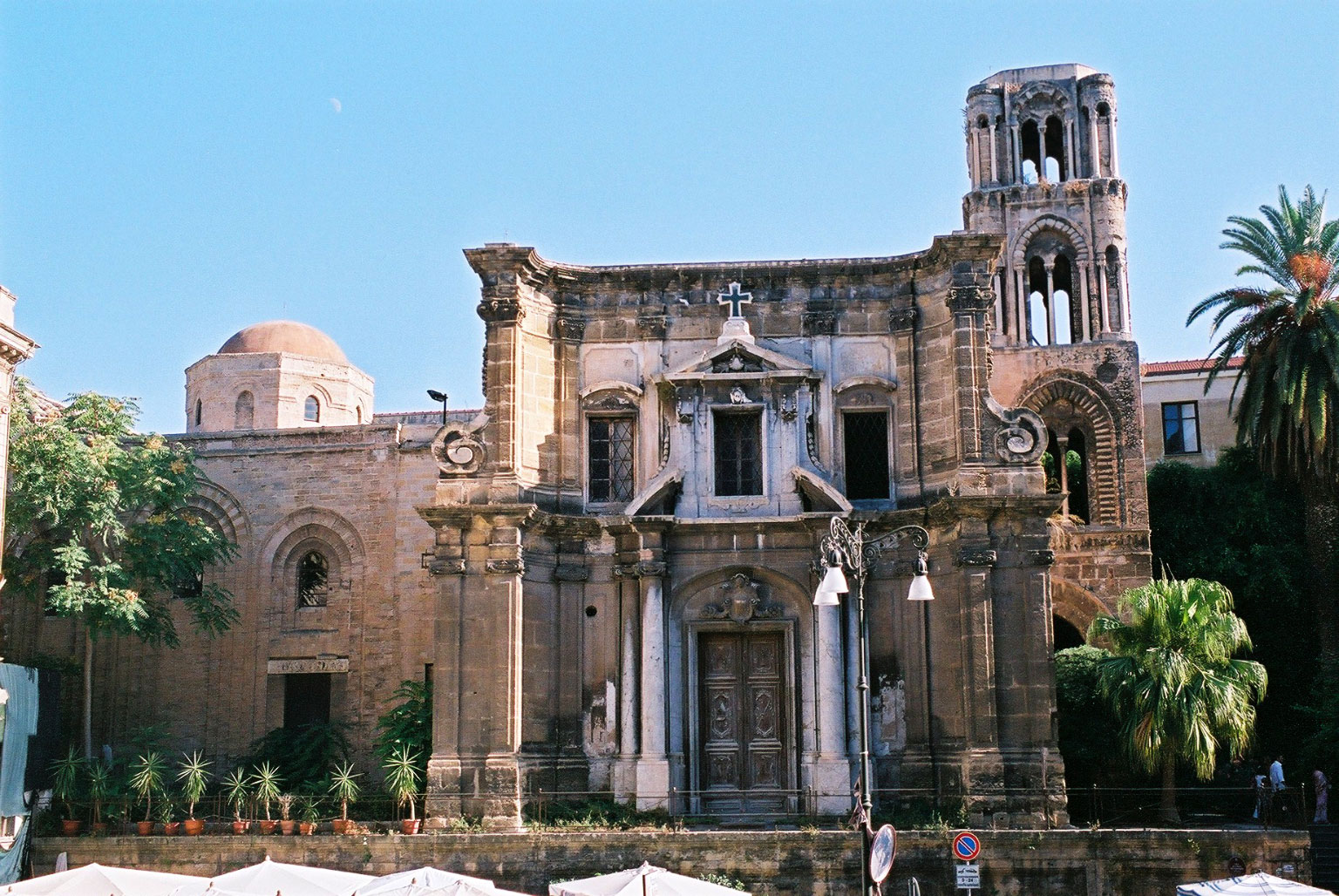
The Church of Santa Maria dell'Ammiraglio, also known as La Martorana, is a co-cathedral of the Italo-Albanian Catholic Church in Palermo. Founded in 1143 by George of Antioch, the admiral of King Roger II of Sicily, the structure serves as a significant example of the cultural synthesis characteristic of the Norman Kingdom of Sicily, blending Byzantine, Islamic, and Romanesque architectural influences.
The interior is renowned for its extensive 12th-century Byzantine mosaics, which are among the oldest in Sicily. While the original structure followed a Greek cross plan, the church underwent significant modifications during the 17th and 18th centuries, resulting in a Baroque facade and interior additions that contrast with the medieval core.
Key Facts
- Materials
- Marble, Gold leaf tesserae, Limestone
- Civilization
- Norman-Sicilian
- Accessibility
- Ground level access, limited space for mobility aids
- Date(s)
- 1143 CE
- Condition
- Active church, well-preserved mosaics
- Original Function
- Private chapel and burial site
- Key Figures
- George of Antioch, Roger II of Sicily
Foundation and Norman Origins
1143 CECommissioned by George of Antioch, the church was established as a Greek-rite monastery and a private chapel for the admiral's family. The original design featured a central-plan structure decorated with high-quality Byzantine mosaics.
The Martorana Convent
1431 CEThe church was ceded to the adjacent Benedictine convent founded by Eloisa Martorana, from which the site derives its common name, 'La Martorana'. During this period, the convent expanded, leading to structural changes.
Baroque Transformations
17th-18th centuryThe church underwent major renovations to align with Baroque aesthetics. A new facade was constructed, and the interior was updated with frescoes and marble decorations, though the original Byzantine mosaic cycle in the central dome and apse was largely preserved.
Italo-Albanian Rite
1935-presentThe church was designated as the co-cathedral for the Eparchy of Piana degli Albanesi. It continues to serve the Italo-Albanian Catholic community, maintaining the Byzantine liturgical tradition.
Cultural Significance
The church stands as a primary monument of the Arab-Norman architectural style, reflecting the multi-ethnic and multi-religious environment of 12th-century Sicily. It remains a vital center for the Italo-Albanian community, preserving Eastern Christian rites within the Roman Catholic framework.
Its inclusion in the UNESCO World Heritage list as part of the 'Arab-Norman Palermo' serial site underscores its importance in the history of Mediterranean art and cultural exchange.
Interpretive Notes
Scholarly debates and areas of uncertainty
Scholars frequently discuss the extent of the original Greek cross plan versus later additions. There is also ongoing research regarding the specific iconographic program of the mosaics, particularly the depiction of King Roger II being crowned by Christ, which serves as a significant political statement of the era.
Visiting Information
Entry Rules
Open to the public daily. Modest dress is required as it is an active place of worship. Entry fees apply for tourists.
Best Times to Visit
Early morning or late afternoon to avoid peak cruise ship crowds. Weekday mornings are generally quieter.
Photography
Photography is permitted for personal use without flash. Tripods are prohibited.
Preservation Notes
The mosaics are extremely fragile; do not touch the walls or columns. Restoration work is ongoing to stabilize the medieval masonry.
Nearby POIs
5 shownSources & Further Reading
- [1]The Art of the Norman Kingdom of Sicily — Ernst Kitzinger. Princeton University Press (1990)
- [2]Arab-Norman Palermo: UNESCO World Heritage Nomination — Hellenic Ministry of Culture. UNESCO World Heritage Centre (2015)View
Key Facts
- Materials
- Marble, Gold leaf tesserae, Limestone
- Civilization
- Norman-Sicilian
- Accessibility
- Ground level access, limited space for mobility aids
- Date(s)
- 1143 CE
- Condition
- Active church, well-preserved mosaics
- Original Function
- Private chapel and burial site
- Key Figures
- George of Antioch, Roger II of Sicily