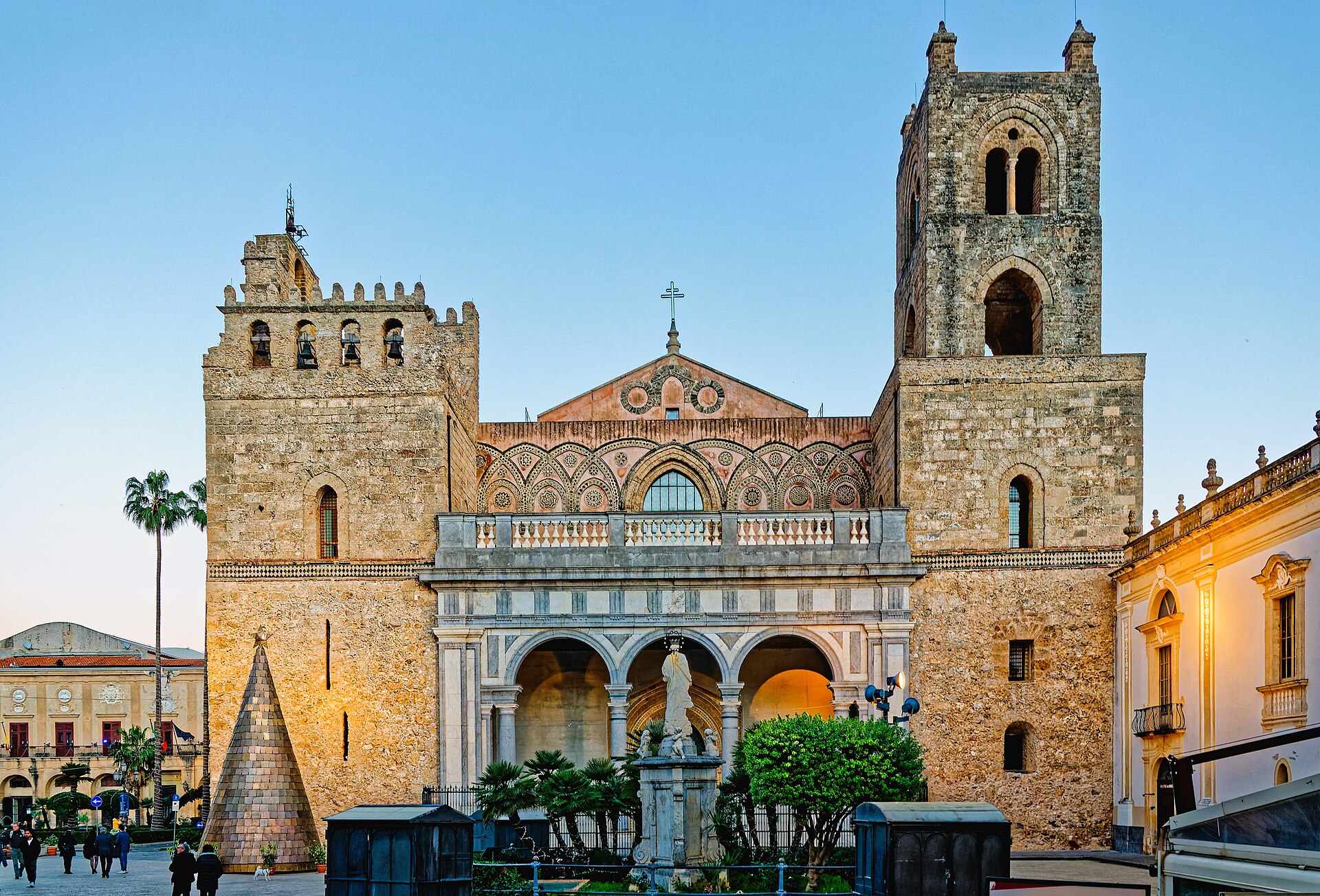
The Cathedral of Monreale, dedicated to Santa Maria Nuova, is a masterpiece of Norman-Arab-Byzantine architecture located on the slopes of Monte Caputo overlooking the Conca d'Oro valley. Commissioned by King William II of Sicily in 1174, the structure serves as a synthesis of the diverse cultural influences present in 12th-century Sicily, blending Latin architectural planning with Byzantine mosaic artistry and Islamic decorative motifs.
The interior is world-renowned for its extensive cycle of golden mosaics, covering over 6,000 square meters. These depictions follow a strict Byzantine iconographic program, centered on the colossal image of Christ Pantocrator in the apse. The cathedral remains an active place of worship and a primary example of the Arab-Norman architectural style recognized for its historical and artistic synthesis.
Key Facts
- Materials
- Limestone, Gold leaf tesserae, Marble, Porphyry
- Civilization
- Norman-Sicilian
- Accessibility
- Ground floor accessible; cloister requires separate entry
- Date(s)
- 1174–1189 CE
- Condition
- Well-preserved, active cathedral
- Original Function
- Royal Cathedral and Benedictine Abbey
- Key Figures
- William II of Sicily, Pope Lucius III
Foundation and Construction
1174–1189King William II commissioned the cathedral to establish a royal presence and a Benedictine abbey. The construction proceeded rapidly, utilizing the labor of local craftsmen trained in various Mediterranean traditions.
Architectural Synthesis
12th CenturyThe design integrated a Latin cross plan with Byzantine-style apses and Islamic-inspired interlacing arches on the exterior walls, reflecting the multicultural administration of the Norman Kingdom of Sicily.
Restoration and Preservation
19th Century–PresentFollowing a fire in 1811 that damaged parts of the nave, extensive restoration work was undertaken. Today, the site is managed as part of the UNESCO World Heritage serial site 'Arab-Norman Palermo and the Cathedral Churches of Cefalù and Monreale'.
Cultural Significance
The Duomo di Monreale represents the peak of the Norman-Arab-Byzantine style, illustrating the unique religious and political tolerance of the Sicilian court under the Hauteville dynasty. It serves as a visual record of the Mediterranean's interconnected history, where Latin, Greek, and Islamic artistic traditions converged to create a singular aesthetic identity.
Beyond its architectural value, the cathedral is a site of deep regional pride and remains a focal point for the religious life of the Archdiocese of Monreale, continuing to draw pilgrims and scholars interested in medieval art history.
Interpretive Notes
Scholarly debates and areas of uncertainty
Scholars frequently debate the extent of the influence of Islamic craftsmen on the specific geometric patterns found in the cathedral's exterior masonry. While the structural form is distinctly Norman, the decorative techniques suggest a high degree of collaboration with local artisans who maintained Fatimid-era traditions.
Visiting Information
Entry Rules
Open daily. Entry to the cathedral is free, though a fee is required to access the cloister and the roof terraces. Modest dress is strictly enforced; shoulders and knees must be covered.
Best Times to Visit
Early morning or late afternoon to avoid the peak tourist crowds arriving from Palermo. Spring and autumn offer the most comfortable temperatures for exploring the surrounding cloister.
Photography
Photography is permitted without flash. Tripods and professional video equipment require prior authorization from the ecclesiastical authorities.
Preservation Notes
The mosaics are highly sensitive to humidity and light. Visitors are requested to remain on marked paths and refrain from touching the walls or columns. Restoration work is ongoing; some areas may be temporarily obscured.
Nearby POIs
6 shownKey Facts
- Materials
- Limestone, Gold leaf tesserae, Marble, Porphyry
- Civilization
- Norman-Sicilian
- Accessibility
- Ground floor accessible; cloister requires separate entry
- Date(s)
- 1174–1189 CE
- Condition
- Well-preserved, active cathedral
- Original Function
- Royal Cathedral and Benedictine Abbey
- Key Figures
- William II of Sicily, Pope Lucius III