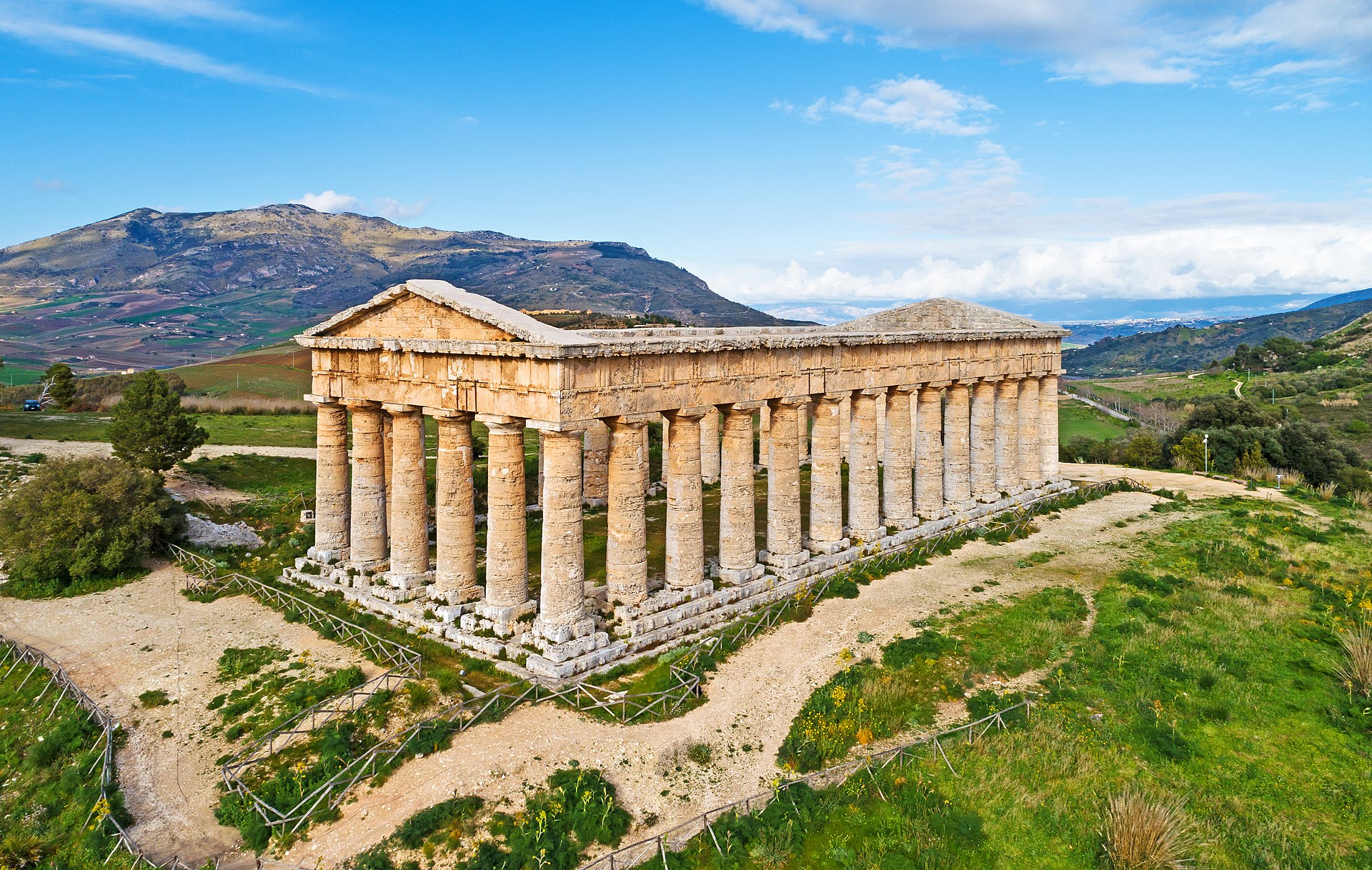
The Temple of Segesta is a remarkably well-preserved Doric peripteral temple located in the hills of northwestern Sicily. Constructed in the late 5th century BCE by the Elymian people, the structure is notable for its lack of a cella (inner chamber) and the presence of unfinished column fluting, which has led to significant scholarly debate regarding whether the temple was ever completed or if it was intended to be an open-air sanctuary.
The temple features 36 columns in a 6x14 arrangement, standing on a massive limestone base. Despite the absence of a roof and interior walls, the structure remains one of the most intact examples of Greek-style architecture in the Mediterranean, offering insight into the cultural synthesis between the indigenous Elymian population and the influence of neighboring Greek colonies.
Key Facts
- Materials
- Local limestone
- Civilization
- Elymian
- Accessibility
- Accessible via shuttle from the visitor center; some uneven terrain
- Date(s)
- c. 430–420 BCE
- Condition
- Well-preserved exterior structure, never completed
- Original Function
- Religious sanctuary
- Key Figures
- Thucydides
Origins and Construction
5th century BCEThe temple was commissioned by the city of Segesta, a major Elymian center. Its architectural style is distinctly Greek, reflecting the strong cultural and political ties between the Elymians and the nearby Greek city of Selinunte.
Abandonment
Late 5th century BCEConstruction appears to have been halted abruptly, likely due to the outbreak of conflict between Segesta and Selinunte, or the subsequent Carthaginian intervention in the region. The columns remain unfluted and the stylobate lacks the final finishing touches.
Modern Preservation
19th century - presentThe site became a popular destination for travelers on the Grand Tour. Systematic archaeological investigations in the 20th century clarified the site's Elymian origins, distinguishing it from purely Greek colonial foundations.
Cultural Significance
The Temple of Segesta serves as a primary example of the 'Hellenization' of the Elymian people. It represents the complex identity of ancient Sicily, where indigenous groups adopted Greek architectural forms to assert their status and political alignment within the Mediterranean power structure.
Today, the site is a cornerstone of Sicilian heritage, celebrated for its dramatic placement in the landscape. It remains a subject of study regarding the transmission of architectural technology and the limits of cultural assimilation in the ancient world.
Interpretive Notes
Scholarly debates and areas of uncertainty
The primary debate concerns the 'unfinished' nature of the temple. While traditional interpretations suggest construction was interrupted by war, some scholars argue that the temple was designed as a hypaethral (open-air) structure, intended to function without a roof or cella to accommodate specific Elymian religious rites.
Visiting Information
Entry Rules
Open daily. Tickets are required for entry to the archaeological park, which includes both the temple and the nearby ancient theater. Visitors are advised to wear comfortable walking shoes.
Best Times to Visit
Early morning or late afternoon to avoid the intense Sicilian sun, as there is no shade around the temple structure.
Photography
Personal photography is permitted. Commercial photography requires prior authorization from the regional archaeological authority.
Preservation Notes
Do not climb on the temple base or attempt to enter the column perimeter. Stay on designated paths to protect the surrounding archaeological strata.
Nearby POIs
3 shownSources & Further Reading
- [1]The Temple of Segesta: A Study in Elymian Architecture — Christopher Smith. Journal of Roman Archaeology (2005)
- [2]Sicily: An Archaeological Guide — Margaret Guido. Faber & Faber (1977)
Key Facts
- Materials
- Local limestone
- Civilization
- Elymian
- Accessibility
- Accessible via shuttle from the visitor center; some uneven terrain
- Date(s)
- c. 430–420 BCE
- Condition
- Well-preserved exterior structure, never completed
- Original Function
- Religious sanctuary
- Key Figures
- Thucydides