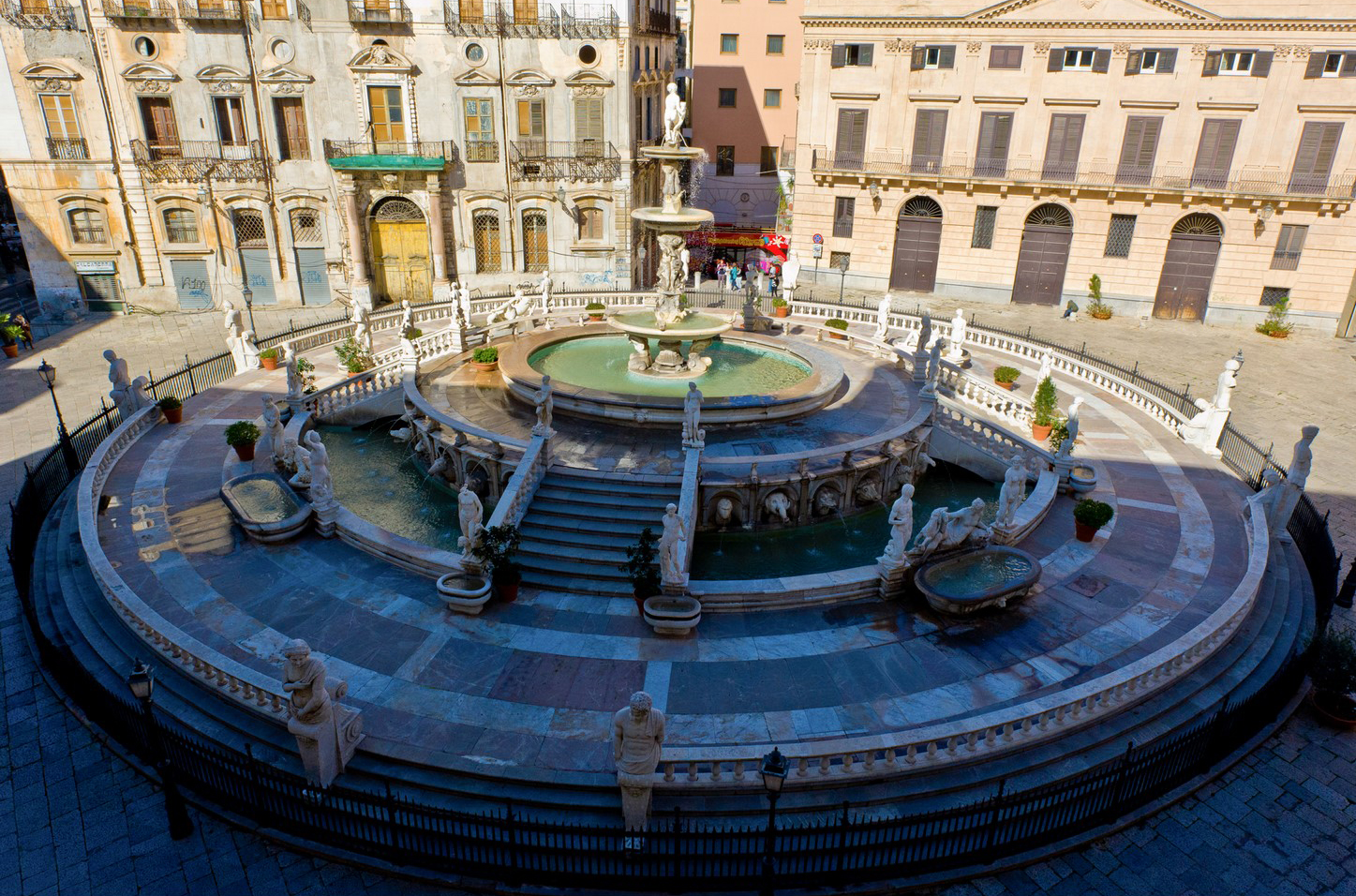
The Fontana Pretoria is a monumental fountain located in the Piazza Pretoria in Palermo, Sicily. Originally commissioned in 1554 by Don Luigi de Toledo for his private garden in Florence, the fountain was designed by the sculptor Francesco Camilliani and his assistant Michelangelo Naccherino. It features a complex arrangement of mythological figures, animals, and allegorical representations of rivers, arranged in a series of concentric basins.
In 1573, the Senate of Palermo purchased the fountain to serve as the centerpiece for the city's newly renovated Piazza Pretoria. To transport the massive structure, it was dismantled into 644 individual pieces and shipped to Sicily. Upon arrival, it was reassembled by Camillo Camilliani, the son of the original sculptor, who adapted the layout to fit the square, which is now colloquially known as the 'Piazza della Vergogna' due to the nudity of the statues.
Key Facts
- Materials
- Carrara marble
- Civilization
- Italian Renaissance
- Accessibility
- Public square, ground level access
- Date(s)
- 1554-1573
- Condition
- Restored and active
- Original Function
- Private garden fountain
- Key Figures
- Francesco Camilliani, Don Luigi de Toledo, Camillo Camilliani
Commission and Design
1554The fountain was commissioned by Don Luigi de Toledo for his villa in Florence. Francesco Camilliani, a student of Baccio Bandinelli, executed the design, incorporating Mannerist stylistic elements that were popular in mid-16th century Tuscany.
Acquisition and Relocation
1573Facing financial difficulties, the Toledo family sold the fountain to the Senate of Palermo. The structure was dismantled into hundreds of numbered pieces and transported by sea to Sicily to be installed in the heart of the city.
Reassembly in Palermo
1574-1581Camillo Camilliani oversaw the reassembly of the fountain in the Piazza Pretoria. He modified the original design to suit the urban space, adding new elements and adjusting the orientation of the statues to fit the square's geometry.
Modern Restoration
1998-2003Following years of environmental degradation and structural instability, the fountain underwent a comprehensive restoration project. The work involved cleaning the marble, repairing hydraulic systems, and stabilizing the sculptural elements.
Cultural Significance
The Fontana Pretoria serves as a prime example of the transfer of Renaissance artistic culture from Tuscany to Sicily. Its presence in Palermo highlights the city's historical role as a center of Mediterranean power and patronage during the Spanish viceroyalty.
The fountain's nickname, 'Piazza della Vergogna' (Square of Shame), reflects the historical tension between the secular, classical nudity of the statues and the surrounding religious institutions, including the Church of Santa Caterina and the Convent of San Giuseppe dei Teatini.
Interpretive Notes
Scholarly debates and areas of uncertainty
There is ongoing academic discussion regarding the extent to which Camillo Camilliani altered the original Florentine design during the reassembly process. While some scholars argue the current configuration is a faithful reconstruction, others suggest that the spatial constraints of the piazza necessitated significant deviations from the original plan.
Visiting Information
Entry Rules
The fountain is located in a public square and is accessible at all times. Visitors are prohibited from climbing on the fountain or entering the basins.
Best Times to Visit
Early morning or late evening to avoid the heat and heavy pedestrian traffic of the city center.
Photography
Personal photography is permitted. Commercial photography requires authorization from the Municipality of Palermo.
Preservation Notes
The marble is highly susceptible to pollution and acid rain. Visitors are strictly prohibited from touching the sculptures or throwing objects into the water.
Nearby POIs
5 shownSources & Further Reading
- [1]The Fontana Pretoria in Palermo — Giuseppe Bellafiore. Palermo University Press (1996)
- [2]Mannerism in Sicily: The Sculpture of the Camilliani — Maria Antonietta Spadaro. Edizioni d'Arte (2004)
Key Facts
- Materials
- Carrara marble
- Civilization
- Italian Renaissance
- Accessibility
- Public square, ground level access
- Date(s)
- 1554-1573
- Condition
- Restored and active
- Original Function
- Private garden fountain
- Key Figures
- Francesco Camilliani, Don Luigi de Toledo, Camillo Camilliani