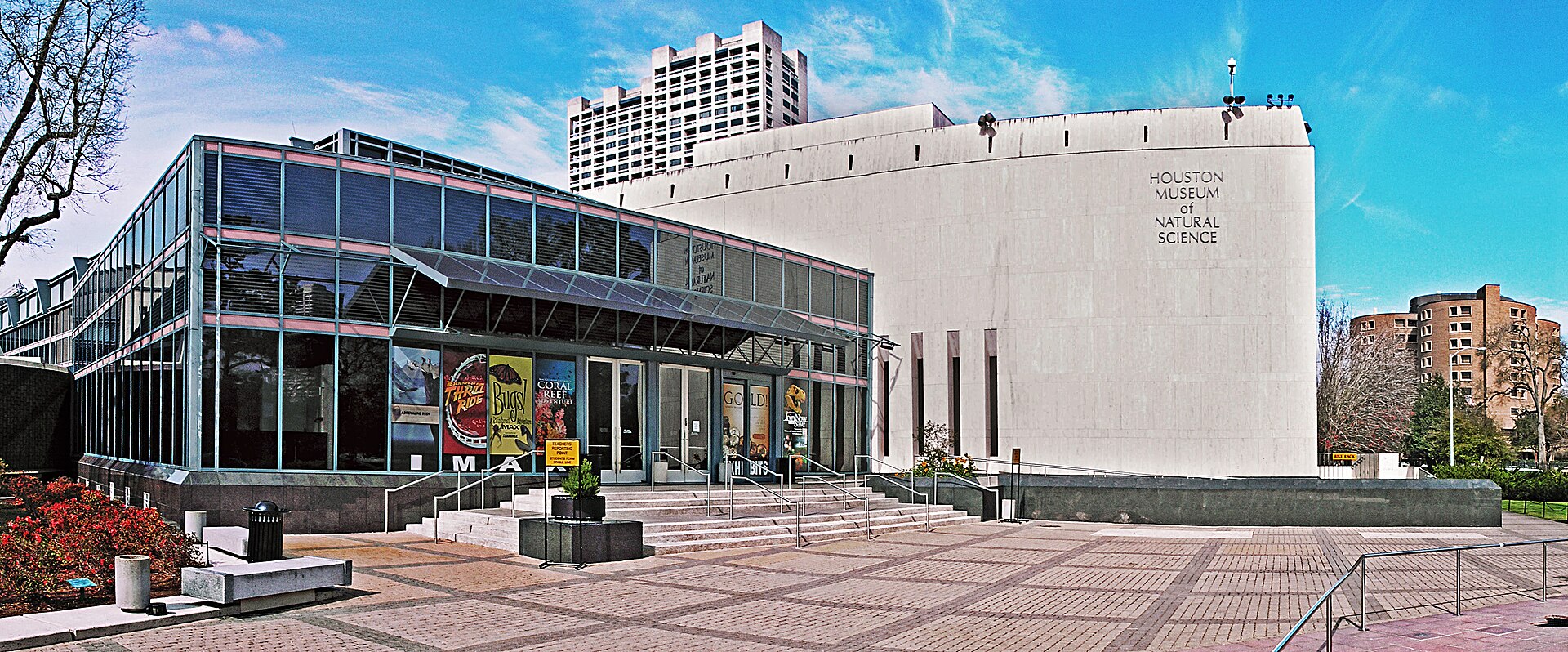
The Houston Museum of Natural Science (HMNS) is a major scientific and educational institution located on the northern border of Hermann Park in Houston, Texas. Established in 1909, the museum has grown into one of the most visited cultural attractions in the United States, featuring four floors of permanent exhibits that span paleontology, astronomy, energy, and gems and minerals.
In addition to its core exhibition halls, the museum complex includes the Burke Baker Planetarium, the Cockrell Butterfly Center, and the Wortham Giant Screen Theatre. The facility serves as a significant hub for scientific research and public education, frequently hosting traveling international exhibitions and maintaining extensive collections that document natural history and physical science.
Key Facts
- Materials
- Concrete, Steel, Glass
- Civilization
- United States
- Accessibility
- Fully wheelchair accessible
- Date(s)
- 1969 (current building)
- Condition
- Active, well-maintained
- Original Function
- Natural science education and research
- Key Figures
- Robert A. Welch, John P. McGovern
Founding and Early Years
1909-1960sThe Houston Museum and Scientific Society was incorporated in 1909 with the goal of providing free education to the public. For several decades, the museum's collections were housed in various temporary locations, including the Houston Public Library and the Houston Zoo.
Establishment in Hermann Park
1969The museum moved to its current permanent location in Hermann Park in 1969. This facility provided the necessary space to house the growing collection and allowed for the expansion of educational programming and permanent exhibition halls.
Expansion and Modernization
1990s-PresentThe museum underwent significant expansion in the late 20th and early 21st centuries, including the addition of the Cockrell Butterfly Center in 1994 and the Paleontology Hall expansion in 2012. These additions solidified the museum's status as a premier destination for natural science education.
Cultural Significance
The Houston Museum of Natural Science serves as a cornerstone of Houston's Museum District, reflecting the city's commitment to scientific literacy and public engagement. It acts as a primary educational resource for the region, bridging the gap between academic research and public curiosity through its diverse programming and extensive fossil and mineral collections.
Visiting Information
Entry Rules
Open daily. Tickets are required for general admission and special exhibitions. Members receive free admission to permanent halls. Visitors are encouraged to purchase tickets online in advance.
Best Times to Visit
Weekday mornings are generally less crowded than weekends or school holidays.
Photography
Personal photography is permitted in most permanent exhibit halls without flash. Commercial photography requires prior authorization.
Preservation Notes
Please refrain from touching display cases or artifacts. Food and drink are restricted to designated areas.
Nearby POIs
8 shownKey Facts
- Materials
- Concrete, Steel, Glass
- Civilization
- United States
- Accessibility
- Fully wheelchair accessible
- Date(s)
- 1969 (current building)
- Condition
- Active, well-maintained
- Original Function
- Natural science education and research
- Key Figures
- Robert A. Welch, John P. McGovern