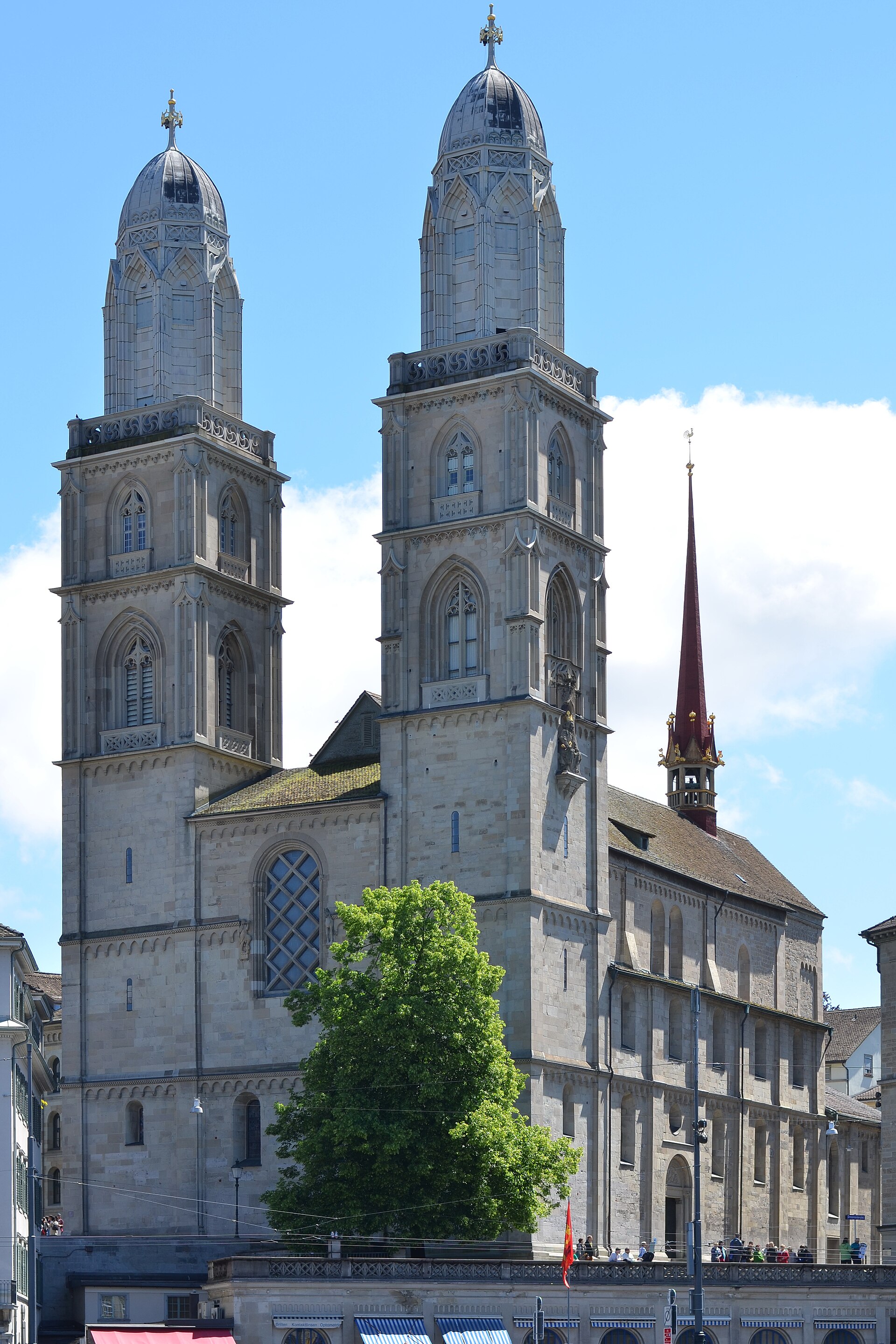
The Grossmünster is a Romanesque-style Protestant church in Zurich, Switzerland, and one of the city's most iconic landmarks. According to legend, the church was founded by Charlemagne, whose horse fell to its knees over the graves of the city's patron saints, Felix and Regula. The current structure, characterized by its distinctive twin towers, was primarily constructed between the 12th and 13th centuries.
The church holds profound historical importance as the site where Huldrych Zwingli initiated the Swiss-German Reformation in 1519. This transformation shifted the religious and political landscape of Zurich, moving the city away from Catholic influence and establishing a new theological foundation that continues to define the church's identity today.
Key Facts
- Materials
- Sandstone, Limestone
- Civilization
- Swiss
- Accessibility
- Ground floor accessible; tower climb involves steep stairs
- Date(s)
- 1100 CE - 1220 CE
- Condition
- Well-preserved, active Protestant church
- Original Function
- Collegiate church
- Key Figures
- Charlemagne, Huldrych Zwingli, Heinrich Bullinger
Foundations and Romanesque Construction
12th CenturyConstruction of the current Romanesque building began around 1100 on the site of an earlier Carolingian church. The structure was built as a collegiate church and served as a center of ecclesiastical power in the region.
The Reformation
1519-1531Huldrych Zwingli served as the people's priest at the Grossmünster starting in 1519. From this pulpit, he launched the Reformation in Zurich, leading to the removal of religious imagery and the restructuring of church liturgy.
Architectural Evolution
15th-18th CenturyThe iconic twin towers were added in the late 15th century. Following a fire in 1763, the towers were topped with neo-Gothic wooden spires, which were later replaced by the current stone structures in the 19th century.
Modern Era
20th Century - PresentThe church underwent significant restoration in the 20th century, including the installation of modern stained glass windows by Sigmar Polke and Augusto Giacometti, blending historical architecture with contemporary art.
Cultural Significance
The Grossmünster serves as the primary symbol of Zurich and a testament to the city's Reformation heritage. It represents the transition from medieval monastic tradition to the intellectual and theological rigor of the Protestant Reformation.
Beyond its religious role, the church is a focal point for local identity. The twin towers are a defining feature of the Zurich skyline, and the church remains a site of active worship, cultural events, and historical tourism.
Interpretive Notes
Scholarly debates and areas of uncertainty
The extent of Charlemagne's actual involvement in the founding of the church remains a subject of historical debate. While the legend is central to the church's identity, archaeological evidence suggests the site's religious significance predates the Carolingian era, leading to ongoing discussions about the site's pre-medieval origins.
Visiting Information
Entry Rules
Open daily to the public. Entry to the church interior is free, though a small fee is charged for climbing the towers. Visitors are expected to maintain a respectful demeanor as it is an active place of worship.
Best Times to Visit
Early morning or late afternoon to avoid peak tourist crowds. The tower climb is best attempted on clear days for panoramic views of the city and the Alps.
Photography
Photography is permitted inside the church without flash. Tripods are generally prohibited. Commercial photography requires prior authorization from the church administration.
Preservation Notes
The structure is subject to ongoing maintenance due to the weathering of its sandstone exterior. Visitors are asked to refrain from touching the historical stonework and to remain on designated paths.
Nearby POIs
10 shownSources & Further Reading
- [1]Zwingli: God's Armed Prophet — Bruce Gordon. Yale University Press (2009)
- [2]The Reformation in Zurich — Emidio Campi. Zwingliana (2005)
Key Facts
- Materials
- Sandstone, Limestone
- Civilization
- Swiss
- Accessibility
- Ground floor accessible; tower climb involves steep stairs
- Date(s)
- 1100 CE - 1220 CE
- Condition
- Well-preserved, active Protestant church
- Original Function
- Collegiate church
- Key Figures
- Charlemagne, Huldrych Zwingli, Heinrich Bullinger