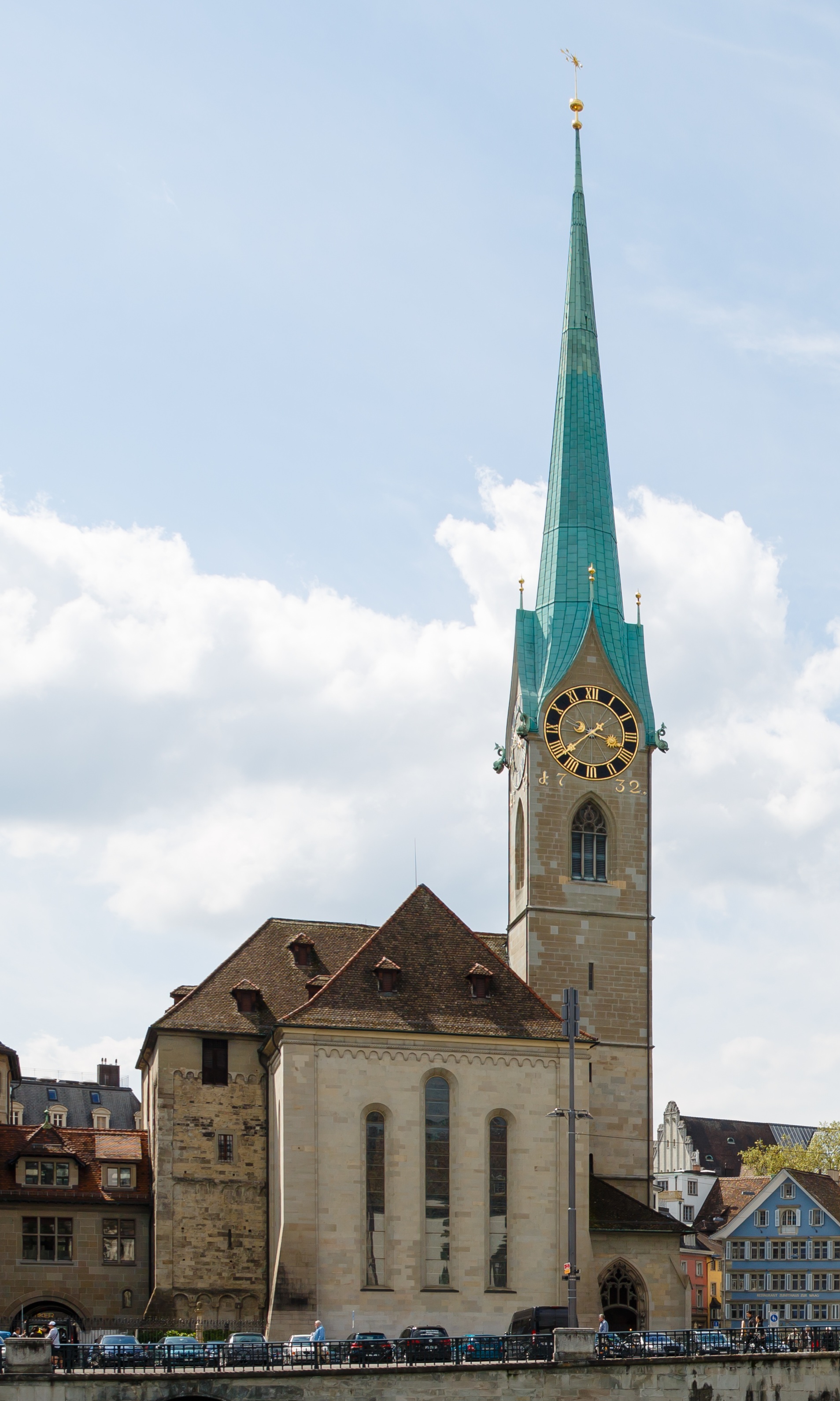
The Fraumünster is a prominent church in Zurich, Switzerland, founded in 853 by King Louis the German for his daughter Hildegard. Originally established as an abbey for aristocratic women, the convent held significant political and economic power throughout the Middle Ages, including the right to mint coins for the city of Zurich.
The current structure is a blend of architectural styles, featuring a Romanesque choir and a high vaulted Gothic nave. It is internationally recognized for its five stained-glass windows designed by Marc Chagall, installed in 1970, and the north transept window created by Augusto Giacometti in 1945.
Key Facts
- Materials
- Sandstone, Stained glass
- Civilization
- Medieval European
- Accessibility
- Wheelchair accessible
- Date(s)
- 853 CE (founding), 13th-15th century (current structure)
- Condition
- Active church
- Original Function
- Benedictine convent
- Key Figures
- King Louis the German, Hildegard of Zurich, Marc Chagall, Augusto Giacometti
Foundation and Abbey Status
853 CEThe abbey was founded by King Louis the German for his daughter, Hildegard. It served as a convent for noblewomen and was granted extensive land and the right to mint coins, making the abbess one of the most powerful figures in medieval Zurich.
Architectural Evolution
12th-15th centuryThe original Carolingian structure was replaced by a Romanesque choir and transept in the 12th and 13th centuries. The nave was later rebuilt in the Gothic style during the 14th and 15th centuries, defining the church's current silhouette.
Reformation and Secularization
16th centuryDuring the Swiss Reformation, the convent was dissolved in 1524. The church buildings were repurposed for Protestant worship, and the abbey's political influence over the city was transferred to the municipal authorities.
Modern Artistic Additions
20th centuryThe church underwent significant interior modernization in the 20th century with the addition of stained-glass cycles by Augusto Giacometti and Marc Chagall, which have since become the site's most famous features.
Cultural Significance
The Fraumünster is a symbol of Zurich's historical transition from a feudal religious center to a modern urban hub. The abbey's former control over the city's currency and land rights remains a key element of Zurich's civic history.
Today, the church serves as a cultural landmark, bridging the gap between its medieval religious origins and its status as a gallery for 20th-century sacred art. The Chagall windows attract visitors globally, cementing the church's role in the city's tourism and artistic identity.
Interpretive Notes
Scholarly debates and areas of uncertainty
There is ongoing academic discussion regarding the extent of the political autonomy held by the abbesses of Fraumünster versus the influence of the local Zurich nobility during the 13th and 14th centuries.
Visiting Information
Entry Rules
Open to the public for visits and worship. An entry fee is required for tourists to view the interior and the stained-glass windows. Modest dress is expected.
Best Times to Visit
Morning hours are best to view the stained-glass windows when the light is most favorable. Weekdays are generally quieter than weekends.
Photography
Photography is strictly prohibited inside the church to maintain the sanctity of the space and protect the artwork.
Preservation Notes
The stained-glass windows are subject to strict climate control and monitoring. Visitors are requested to remain quiet and follow marked paths.
Nearby POIs
10 shownSources & Further Reading
- [1]The Fraumünster in Zurich — Irene Gysel. Swiss Art Guide (2015)
- [2]Chagall's Windows at the Fraumünster — Marc Chagall. Zurich Church Archives (1970)
Key Facts
- Materials
- Sandstone, Stained glass
- Civilization
- Medieval European
- Accessibility
- Wheelchair accessible
- Date(s)
- 853 CE (founding), 13th-15th century (current structure)
- Condition
- Active church
- Original Function
- Benedictine convent
- Key Figures
- King Louis the German, Hildegard of Zurich, Marc Chagall, Augusto Giacometti