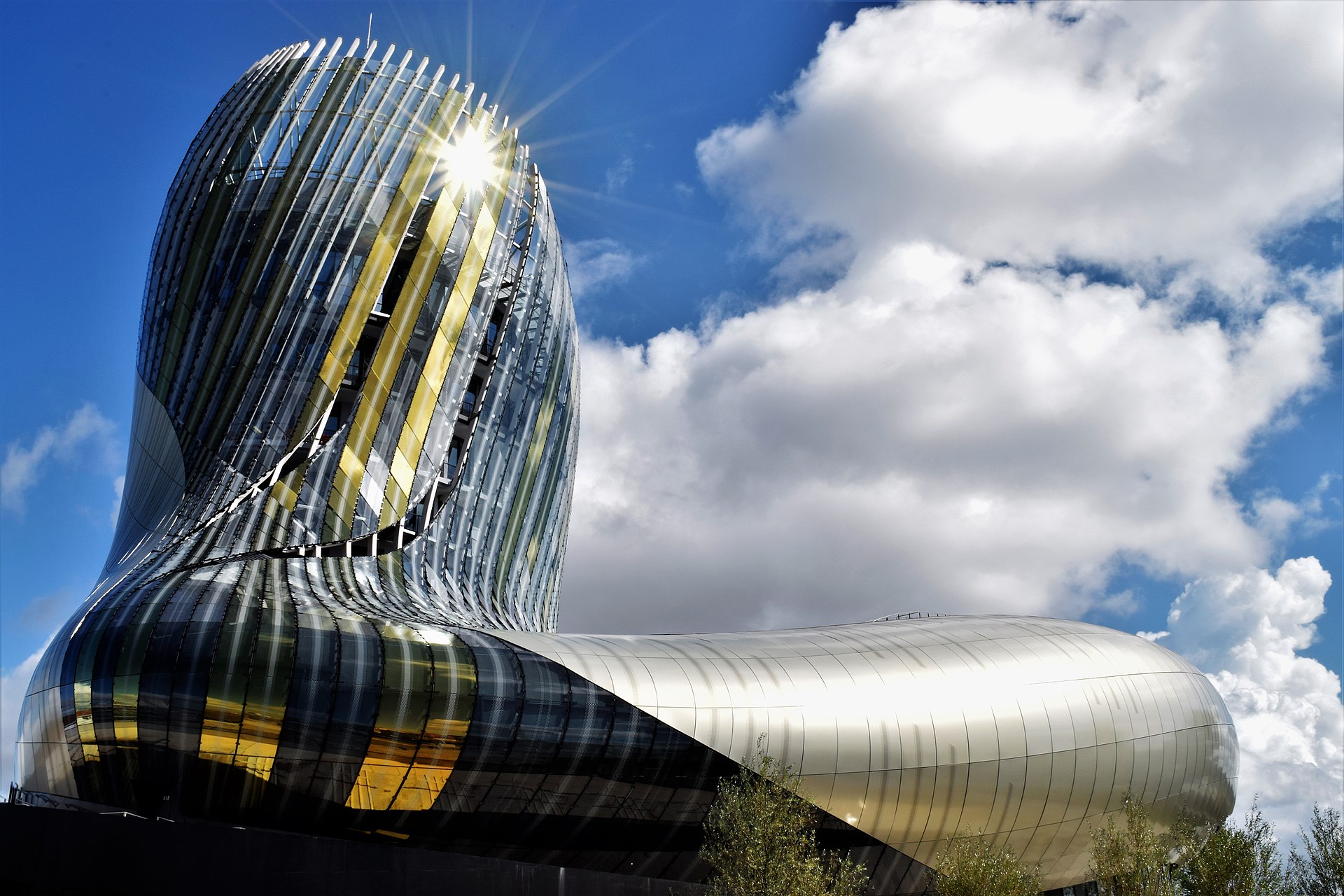
La Cité du Vin is a cultural center and museum located in Bordeaux, France, dedicated to the universal heritage of wine. Opened in 2016, the building is renowned for its bold architectural design, featuring a curved, fluid structure intended to evoke the movement of wine in a glass and the Garonne River.
The museum offers an immersive, sensory-focused permanent exhibition that explores the history, geography, and cultural significance of wine across global civilizations. Beyond its exhibition spaces, the facility serves as a venue for academic seminars, film screenings, and workshops, functioning as a hub for oenological research and public education.
Key Facts
- Materials
- Aluminum panels, Glass, Glulam timber
- Civilization
- Modern French
- Accessibility
- Fully wheelchair accessible
- Date(s)
- 2013-2016
- Condition
- Active
- Original Function
- Wine cultural center and museum
- Key Figures
- Anouk Legendre, Nicolas Desmazières
Conception and Design
2009-2013The project was initiated by the Bordeaux City Council to create a landmark institution celebrating the city's historical identity as a global wine capital. The architectural firm XTU was selected to design a structure that avoided traditional museum tropes, resulting in the iconic 'decanter' shape.
Construction and Inauguration
2013-2016Construction began in 2013 on the site of a former industrial area along the Garonne. The building was inaugurated on June 1, 2016, by French President François Hollande and Mayor Alain Juppé, marking a significant urban renewal effort for the district.
Modern Operations
2016-PresentSince its opening, the museum has become a major cultural destination in Bordeaux. It continues to expand its programming to include international temporary exhibitions and serves as a center for the study of viticulture and its socio-economic impact.
Cultural Significance
La Cité du Vin represents the transition of Bordeaux from a traditional wine-trading port to a modern center of cultural tourism. It frames wine not merely as a commodity, but as a global cultural artifact that has shaped human history, religion, and art for millennia.
The institution plays a vital role in the regional economy and identity, reinforcing Bordeaux's status as a leader in the global wine industry while providing a platform for critical discourse on the future of viticulture in the face of climate change.
Interpretive Notes
Scholarly debates and areas of uncertainty
There is ongoing academic discussion regarding the museum's focus on the 'universal' history of wine versus the specific regional heritage of Bordeaux. Some critics argue that the museum's global scope occasionally overshadows the specific historical nuances of the local terroir, while others praise the decision to avoid a purely parochial narrative.
Visiting Information
Entry Rules
Open daily. Tickets can be purchased online or at the entrance. Visitors are encouraged to book time slots in advance during peak tourist seasons. No specific dress code is required.
Best Times to Visit
Weekdays during the shoulder seasons (May-June or September-October) offer the best balance of crowd levels and accessibility to the panoramic viewing deck.
Photography
Personal photography is permitted throughout the museum. Professional filming or commercial photography requires prior authorization from the administration.
Preservation Notes
The building is a modern structure; visitors are asked to respect the interactive exhibits and refrain from touching sensitive digital displays. The site is strictly non-smoking.
Nearby POIs
6 shownKey Facts
- Materials
- Aluminum panels, Glass, Glulam timber
- Civilization
- Modern French
- Accessibility
- Fully wheelchair accessible
- Date(s)
- 2013-2016
- Condition
- Active
- Original Function
- Wine cultural center and museum
- Key Figures
- Anouk Legendre, Nicolas Desmazières