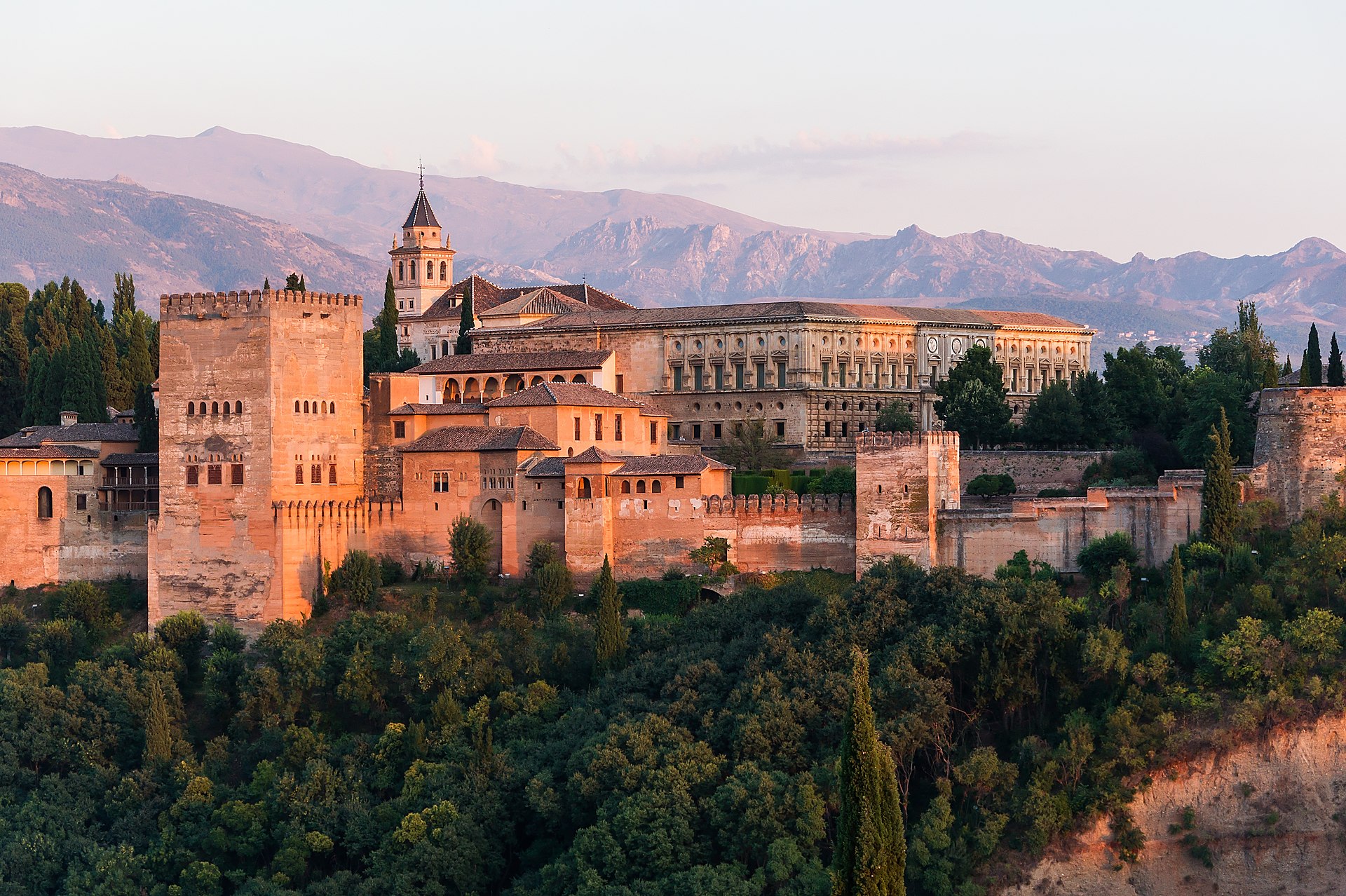
The Alhambra is a palace and fortress complex located in Granada, Spain, originally constructed as a small fortress in 889 CE and largely rebuilt in the mid-13th century by the Nasrid emir Mohammed ben Al-Ahmar. It served as the royal palace of the Nasrid dynasty, the last Muslim rulers in Spain, and represents one of the most significant examples of Islamic architecture in the Western world.
The complex includes the Nasrid Palaces, the Generalife gardens, and the Alcazaba fortress. Following the Christian Reconquista in 1492, the site became the Royal Court of Ferdinand and Isabella, leading to the addition of Renaissance-style structures, most notably the Palace of Charles V, which contrasts sharply with the intricate geometric and calligraphic ornamentation of the earlier Islamic sections.
Key Facts
- Materials
- Red clay, Stucco, Marble, Wood, Ceramic tile
- Civilization
- Nasrid Dynasty, Kingdom of Castile
- Accessibility
- Partial accessibility due to historic terrain and stairs
- Date(s)
- 889 CE - 16th century
- Condition
- Well-preserved, major tourist site
- Original Function
- Fortress and Royal Palace
- Key Figures
- Mohammed ben Al-Ahmar, Boabdil, Ferdinand II of Aragon, Isabella I of Castile, Charles V
Nasrid Foundation
1238-1358The site was transformed into a royal residence by the Nasrid dynasty. Key structures like the Comares Palace and the Court of the Lions were built during this era, showcasing the pinnacle of Andalusian decorative arts.
The Reconquista
1492The Alhambra was surrendered to the Catholic Monarchs, Ferdinand and Isabella, marking the end of Muslim rule in the Iberian Peninsula. The site was subsequently adapted for use by the Christian court.
Renaissance Additions
16th centuryEmperor Charles V commissioned a new palace within the complex. Designed by Pedro Machuca, the building introduced Mannerist architecture to the site, creating a distinct stylistic juxtaposition with the existing Moorish structures.
Modern Preservation
19th century - presentAfter a period of neglect and partial damage during the Napoleonic occupation, the Alhambra was rediscovered by Romantic-era travelers. It was declared a national monument in 1870 and has since undergone extensive, ongoing restoration.
Cultural Significance
The Alhambra serves as a profound symbol of the cultural synthesis of Al-Andalus. It is a testament to the sophistication of Islamic science, mathematics, and aesthetics, while also representing the complex transition of power during the Reconquista.
Today, it is a cornerstone of Spanish national identity and a primary driver of cultural tourism. Its influence extends to literature and art, famously inspiring Washington Irving’s 'Tales of the Alhambra', which helped reintroduce the site to the international imagination.
Interpretive Notes
Scholarly debates and areas of uncertainty
Debate persists regarding the extent of the original polychromy of the stucco work and the specific symbolic meanings behind the complex hydraulic systems in the Generalife gardens. Additionally, scholars continue to analyze the degree to which the Palace of Charles V was intended to 'erase' or 'subjugate' the Nasrid aesthetic versus integrating it into a new imperial narrative.
Visiting Information
Entry Rules
Tickets must be purchased well in advance due to strict daily capacity limits. Entry is time-slotted for the Nasrid Palaces. Visitors must present a valid ID matching the ticket holder's name.
Best Times to Visit
Early morning or late afternoon to avoid peak heat and large tour groups. Mid-week visits during the shoulder seasons (spring and autumn) offer the most manageable crowds.
Photography
Personal photography is permitted without flash or tripods. Professional photography requires prior authorization from the Patronato de la Alhambra y Generalife.
Preservation Notes
Do not touch the stucco or tile work. Stay on designated paths. The site involves significant walking on uneven stone surfaces; comfortable footwear is essential.
Nearby POIs
6 shownSources & Further Reading
- [1]The Alhambra: A Cultural History — Robert Irwin. Harvard University Press (2004)
- [2]The Alhambra: From the Ninth Century to the Present — Oleg Grabar. Harvard University Press (1992)
Key Facts
- Materials
- Red clay, Stucco, Marble, Wood, Ceramic tile
- Civilization
- Nasrid Dynasty, Kingdom of Castile
- Accessibility
- Partial accessibility due to historic terrain and stairs
- Date(s)
- 889 CE - 16th century
- Condition
- Well-preserved, major tourist site
- Original Function
- Fortress and Royal Palace
- Key Figures
- Mohammed ben Al-Ahmar, Boabdil, Ferdinand II of Aragon, Isabella I of Castile, Charles V