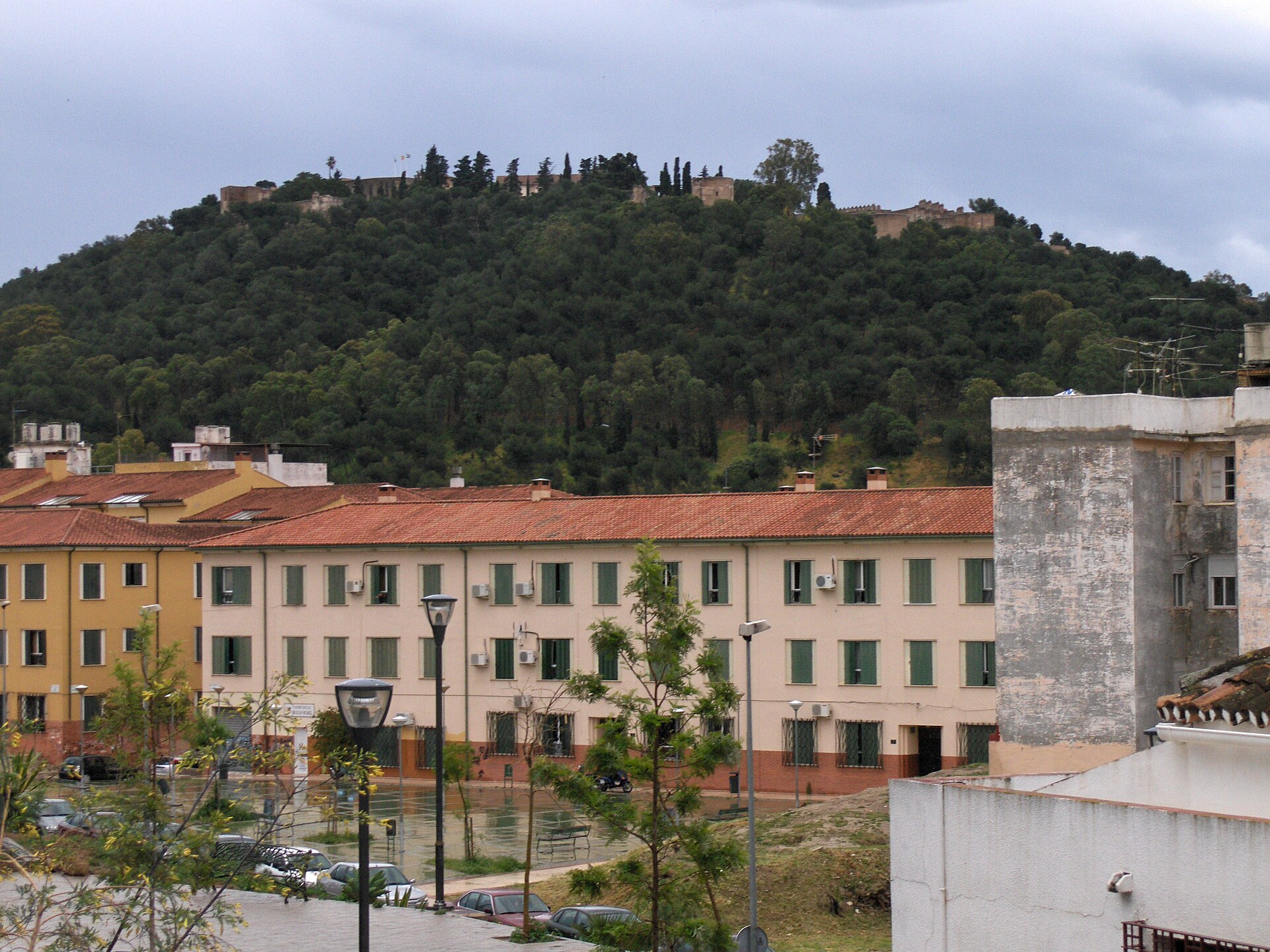
The Castillo de Gibralfaro is a 14th-century fortification situated on the Gibralfaro mountain overlooking the city of Malaga. Originally constructed by the Nasrid ruler Yusuf I to protect the Alcazaba, the fortress was designed to house troops and serve as a strategic lookout point over the Mediterranean harbor.
The site is characterized by its double line of defensive walls and its prominent keep, which remains one of the most significant examples of military architecture from the late Islamic period in Spain. Following the Siege of Malaga in 1487, the fortress was utilized by the Catholic Monarchs, Ferdinand and Isabella, and subsequently served as a military garrison for several centuries.
Key Facts
- Materials
- Stone, Brick, Mortar
- Civilization
- Nasrid Dynasty
- Accessibility
- Steep incline, limited wheelchair access in upper areas
- Date(s)
- 1340 CE
- Condition
- Restored and open to the public
- Original Function
- Military fortress and lookout
- Key Figures
- Yusuf I of Granada, Ferdinand II of Aragon, Isabella I of Castile
Nasrid Foundation
14th CenturyThe fortress was commissioned by Yusuf I of Granada in 1340 to provide a defensive structure for the lower-lying Alcazaba. It was built on the site of a former Phoenician lighthouse, from which the name 'Jabal-Faruk' (Mount of the Lighthouse) is derived.
Siege of Malaga
1487During the Reconquista, the fortress became a focal point of the Siege of Malaga. After a prolonged blockade, the Nasrid defenders eventually surrendered to the forces of the Catholic Monarchs, marking a pivotal shift in the region's control.
Post-Reconquista Use
16th-19th CenturyFollowing the Christian conquest, the castle was used as a military barracks and a prison. It played a strategic role in various conflicts, including the Peninsular War, before being decommissioned as a military site in the 20th century.
Modern Restoration
20th Century - PresentThe site underwent significant restoration in the late 20th century to preserve its defensive walls and internal structures. It is now managed as a cultural heritage site and museum, providing insight into medieval military engineering.
Cultural Significance
The Castillo de Gibralfaro is a defining element of Malaga's skyline and a symbol of the city's complex history as a crossroads between Islamic and Christian civilizations. It serves as a primary site for understanding the defensive strategies employed during the Nasrid period and the subsequent transition of power in Andalusia.
Locally, the fortress is deeply integrated into the cultural identity of Malaga, frequently featured in regional iconography and serving as a major educational site for the study of medieval fortification techniques.
Interpretive Notes
Scholarly debates and areas of uncertainty
There is ongoing academic discussion regarding the exact extent of the Phoenician and Roman foundations beneath the Nasrid structure. While archaeological surveys have confirmed earlier occupation, the degree to which Nasrid builders incorporated or destroyed these earlier layers remains a subject of investigation.
Visiting Information
Entry Rules
Open daily. Tickets can be purchased at the entrance or via the official municipal tourism portal. Visitors are advised that the walk to the summit is steep.
Best Times to Visit
Early morning or late afternoon to avoid peak heat and to capture the best light for photography over the city and harbor.
Photography
Personal photography is permitted. Commercial photography requires prior authorization from the Malaga City Council.
Preservation Notes
Stay on designated paths. The stone walls are fragile; do not climb on or lean against the historical masonry. Carry sufficient water as there are limited facilities at the summit.
Nearby POIs
5 shownSources & Further Reading
- [1]The Nasrid Kingdom of Granada — L.P. Harvey. University of Chicago Press (1990)
- [2]Military Architecture in Islamic Spain — Antonio Almagro. CSIC Press (2015)
Key Facts
- Materials
- Stone, Brick, Mortar
- Civilization
- Nasrid Dynasty
- Accessibility
- Steep incline, limited wheelchair access in upper areas
- Date(s)
- 1340 CE
- Condition
- Restored and open to the public
- Original Function
- Military fortress and lookout
- Key Figures
- Yusuf I of Granada, Ferdinand II of Aragon, Isabella I of Castile