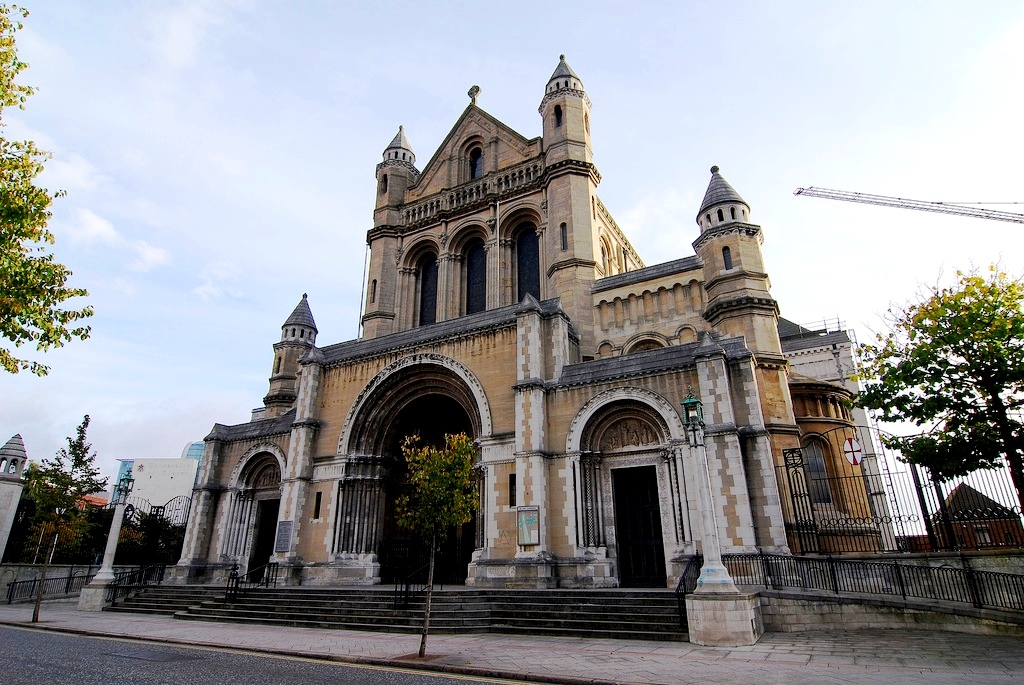
Saint Anne's Cathedral, also known as Belfast Cathedral, is a Church of Ireland cathedral located in the heart of Belfast. Construction began in 1899 on the site of an earlier parish church, with the nave being consecrated in 1904. The building is designed in the Hiberno-Romanesque style, characterized by its rounded arches and intricate stone carvings, reflecting a distinct architectural departure from the Gothic tradition common in many British cathedrals.
The interior is noted for its extensive use of Irish marble, which forms the intricate floor patterns, and its elaborate mosaics. In 2007, the cathedral underwent a significant modern addition with the installation of the 'Spire of Hope,' a 40-meter stainless steel needle that pierces the roof, serving as a landmark for the city and a symbol of peace in post-conflict Northern Ireland.
Key Facts
- Materials
- Scrabo sandstone, Irish marble, Stainless steel
- Civilization
- British/Irish
- Accessibility
- Fully wheelchair accessible
- Date(s)
- 1899-1981
- Condition
- Active place of worship
- Original Function
- Anglican Cathedral
- Key Figures
- Sir Thomas Drew, Lord Shaftesbury
Foundation and Early Construction
1899-1904The foundation stone was laid in 1899 by the Earl of Shaftesbury. The cathedral was built to replace the old parish church of St. Anne, which had served the area since 1776. Sir Thomas Drew was the primary architect, choosing a Romanesque style that utilized local Scrabo sandstone.
Expansion and Completion
1904-1981Construction proceeded in stages throughout the 20th century due to funding constraints and the impact of two World Wars. The west front was completed in 1927, and the baptistery was added later, with the final structural elements not fully realized until 1981.
The Spire of Hope
2007As part of a broader city regeneration project, the 'Spire of Hope' was installed. This modern architectural intervention was designed to provide a contemporary counterpoint to the traditional stone structure and serves as a beacon for the Cathedral Quarter.
Cultural Significance
St. Anne's Cathedral serves as a focal point for civic life in Belfast, hosting major state services and ecumenical events. Its architecture reflects the city's transition from an industrial hub to a modern cultural center. The cathedral is deeply integrated into the 'Cathedral Quarter,' which has become the primary arts and hospitality district of the city.
Interpretive Notes
Scholarly debates and areas of uncertainty
There is occasional architectural discourse regarding the juxtaposition of the 2007 stainless steel Spire of Hope against the traditional Hiberno-Romanesque stone facade, with some critics debating the aesthetic harmony of the modern addition within a historicist framework.
Visiting Information
Entry Rules
Open to the public daily. Entry is free, though donations are encouraged. Visitors are asked to be respectful during prayer times and services.
Best Times to Visit
Mid-morning on weekdays to avoid large tour groups and enjoy the natural light through the mosaics.
Photography
Personal photography is permitted. Tripods and professional equipment require prior permission from the Dean's office.
Preservation Notes
The cathedral requires ongoing maintenance of its sandstone exterior due to urban pollution. Visitors are requested to remain on designated walkways to protect the historic marble flooring.
Nearby POIs
4 shownSources & Further Reading
- [1]Belfast Cathedral: The Church of St. Anne — Johnston, R.. Ulster Architectural Heritage Society (1995)
- [2]The Architecture of St. Anne's — Brett, C.E.B.. Friar's Bush Press (1985)
Key Facts
- Materials
- Scrabo sandstone, Irish marble, Stainless steel
- Civilization
- British/Irish
- Accessibility
- Fully wheelchair accessible
- Date(s)
- 1899-1981
- Condition
- Active place of worship
- Original Function
- Anglican Cathedral
- Key Figures
- Sir Thomas Drew, Lord Shaftesbury