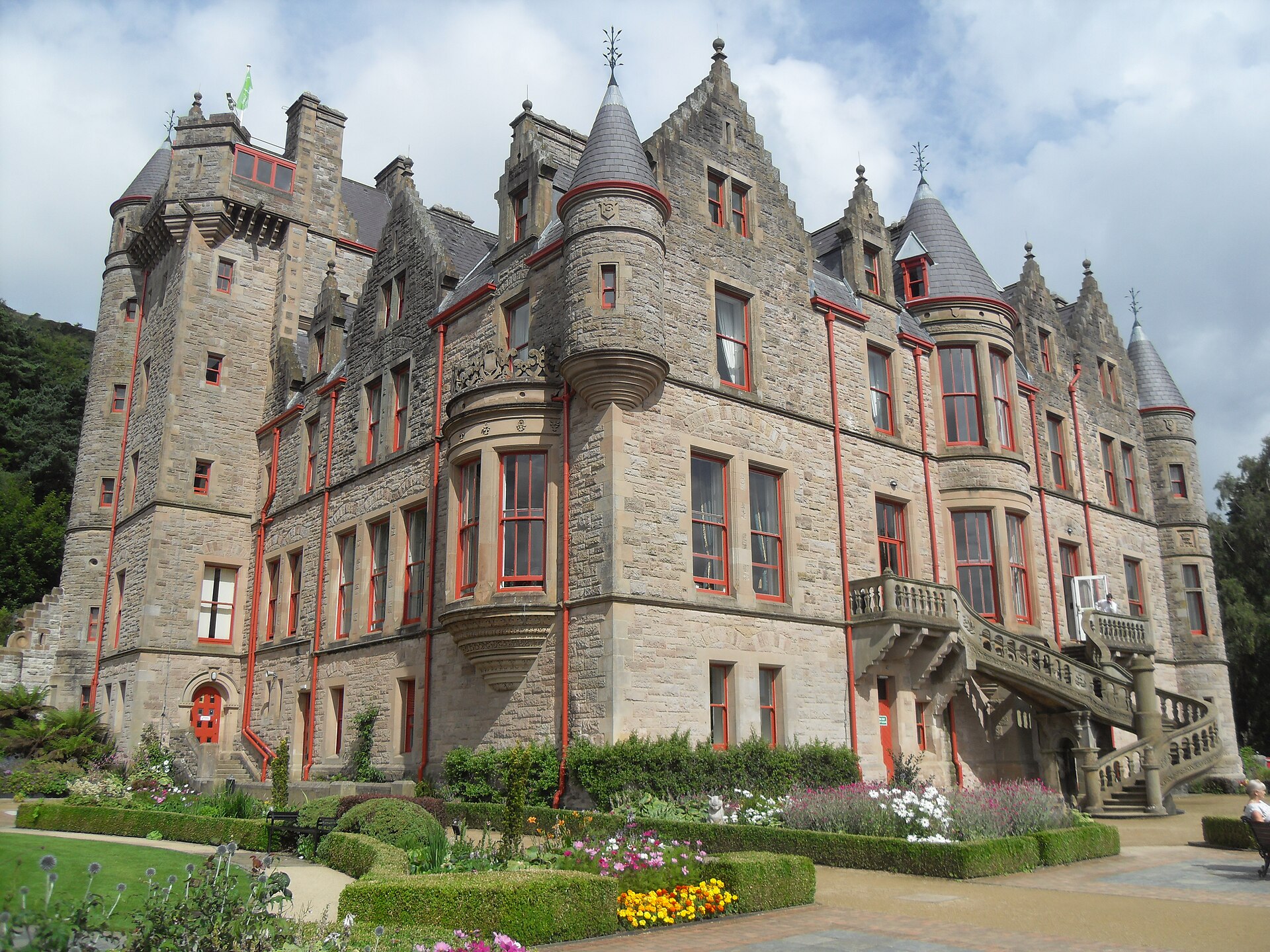
Belfast Castle is a prominent 19th-century residence situated on the slopes of Cave Hill Country Park in Belfast, Northern Ireland. Designed by architect John Lanyon and commissioned by the 3rd Marquess of Donegall, the structure was completed in 1870. It serves as a quintessential example of the Scottish Baronial architectural style, characterized by its asymmetrical facade, steep gables, and decorative turrets.
The castle was built to replace an earlier 12th-century Norman castle located in the city center, which had been destroyed by fire. Following its construction, the estate remained in the Donegall family until it was gifted to the City of Belfast in 1934. Today, the site functions as a public venue, housing a restaurant, antique shop, and event spaces, while offering panoramic views over the city and Belfast Lough.
Key Facts
- Materials
- Sandstone, Limestone
- Civilization
- British
- Accessibility
- Ground floor accessible, upper floors limited
- Date(s)
- 1867-1870
- Condition
- Well-preserved, active public venue
- Original Function
- Private residence
- Key Figures
- 3rd Marquess of Donegall, John Lanyon
The Original Castle
12th centuryThe original Belfast Castle was built by the Normans in the late 12th century. It was located in the town center near the present-day High Street and Castle Place. This structure served as the seat of the Chichester family, the Earls of Donegall, for centuries until it was destroyed by a major fire in 1708.
Construction of the New Estate
1867-1870Following the destruction of the original site, the 3rd Marquess of Donegall decided to build a new residence on the slopes of Cave Hill. Architect John Lanyon was commissioned to design the new castle in the Scottish Baronial style, a popular choice for grand country houses of the Victorian era.
Public Ownership
1934In 1934, the Donegall family gifted the castle and its surrounding estate to the Belfast Corporation (now Belfast City Council). The site was subsequently opened to the public, becoming a popular destination for recreation and social events.
Modern Restoration
1988The castle underwent a major restoration project in 1988, costing approximately £2 million. This initiative aimed to preserve the architectural integrity of the building while modernizing its facilities to accommodate its current role as a public venue and tourist attraction.
Cultural Significance
Belfast Castle represents the transition of landed power structures in Northern Ireland during the industrial era. Its location on Cave Hill links the residence to the city's natural landscape, while its architectural style reflects the Victorian fascination with romanticized historical aesthetics. It remains a significant landmark in Belfast's civic identity, serving as a focal point for local heritage and public gatherings.
Interpretive Notes
Scholarly debates and areas of uncertainty
There is limited scholarly debate regarding the castle, though architectural historians occasionally discuss the extent to which the Scottish Baronial style was used as a deliberate political statement of identity by the Anglo-Irish landed gentry during the late 19th century.
Visiting Information
Entry Rules
Open daily to the public. Entry to the castle grounds and public areas is free. Specific event spaces may be restricted during private functions.
Best Times to Visit
Spring and summer months for access to the surrounding Cave Hill Country Park trails. Weekdays are generally quieter than weekends.
Photography
Personal photography is permitted throughout the grounds and public areas. Commercial photography requires prior permission from the Belfast City Council.
Preservation Notes
The site is a protected building. Visitors are requested to respect the historic fabric of the structure and remain within designated public areas.
Nearby POIs
4 shownSources & Further Reading
- [1]
- [2]The Architecture of John Lanyon — C.E.B. Brett. Ulster Architectural Heritage Society (1996)
Key Facts
- Materials
- Sandstone, Limestone
- Civilization
- British
- Accessibility
- Ground floor accessible, upper floors limited
- Date(s)
- 1867-1870
- Condition
- Well-preserved, active public venue
- Original Function
- Private residence
- Key Figures
- 3rd Marquess of Donegall, John Lanyon