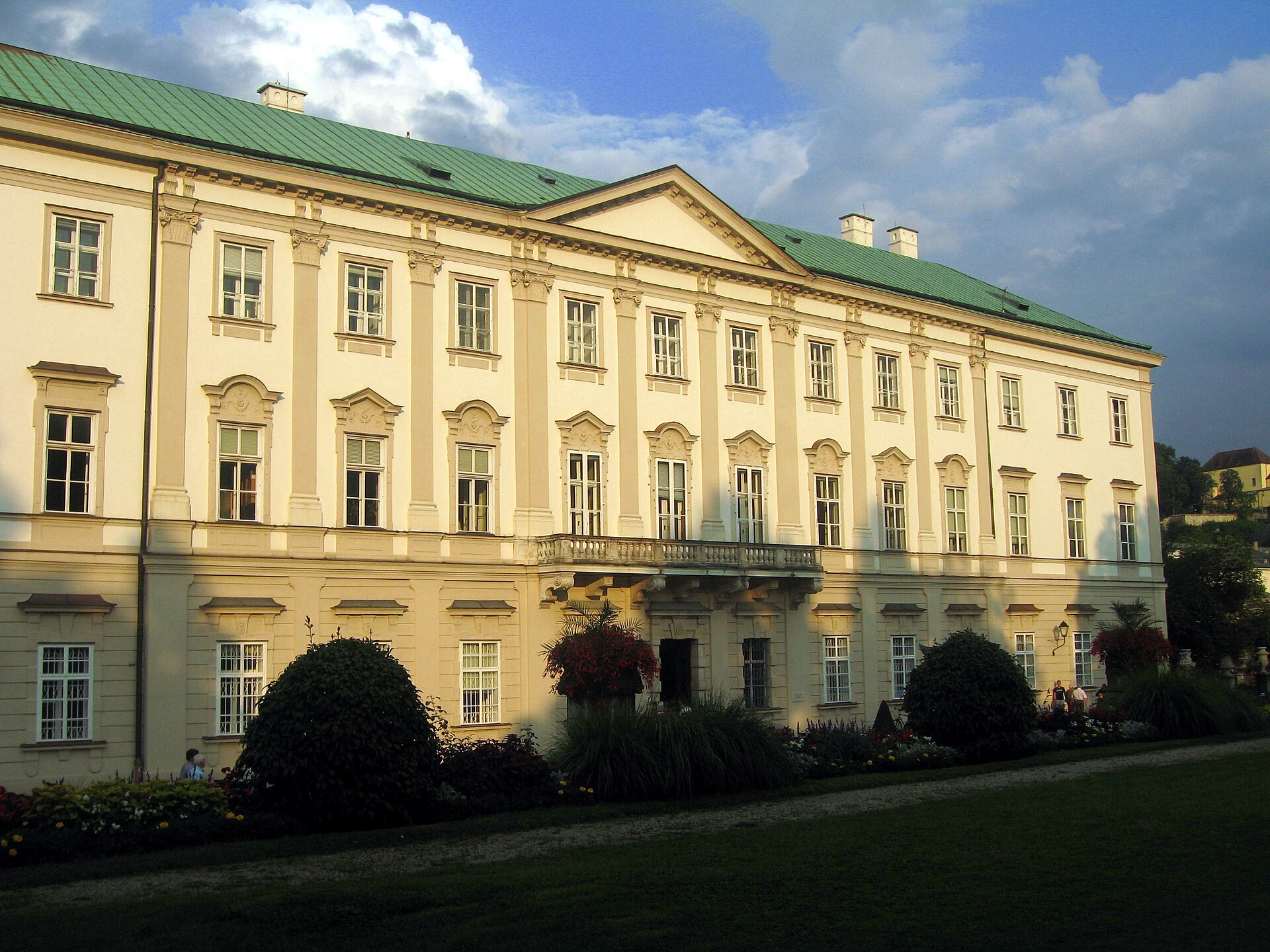
Schloss Mirabell is a historic palace in Salzburg, Austria, originally commissioned in 1606 by Prince-Archbishop Wolf Dietrich von Raitenau for his mistress, Salome Alt. Originally named Schloss Altenau, it was designed to serve as a pleasure palace outside the city's medieval walls, reflecting the wealth and influence of the Salzburg prince-archbishops.
The palace is renowned for its extensive Baroque gardens, which were redesigned in the early 18th century by Johann Bernhard Fischer von Erlach. While the palace interior underwent significant Neoclassical modifications following a fire in 1818, the site remains a central component of the Historic Centre of the City of Salzburg, a designated UNESCO World Heritage site.
Key Facts
- Materials
- Stone, Stucco, Marble
- Civilization
- Austrian
- Accessibility
- Gardens are fully accessible; palace interior has limited access
- Date(s)
- 1606
- Condition
- Well-preserved, serves as municipal offices and concert venue
- Original Function
- Residential palace
- Key Figures
- Wolf Dietrich von Raitenau, Johann Bernhard Fischer von Erlach, Peter de Nobile
Founding and Early Years
1606Prince-Archbishop Wolf Dietrich von Raitenau commissioned the palace as a private residence for his mistress, Salome Alt, and their children. It was situated just outside the city walls to provide a retreat from the political pressures of the episcopal court.
Baroque Expansion
1721-1727Under Archbishop Franz Anton von Harrach, the palace was extensively remodeled into a grand Baroque complex by architect Johann Lukas von Hildebrandt. The gardens were also formalized during this period, incorporating mythological statues and geometric layouts.
Fire and Neoclassical Reconstruction
1818A major fire severely damaged the palace. During the subsequent reconstruction, the interior was largely stripped of its Baroque ornamentation and redesigned in a more restrained Neoclassical style, which remains visible in the Marble Hall today.
Modern Era
1866-PresentThe palace was purchased by the City of Salzburg in 1866. It currently houses the offices of the Mayor and the municipal administration, while the Marble Hall is internationally recognized as one of the world's most prestigious wedding venues.
Cultural Significance
Schloss Mirabell serves as a symbol of the architectural transition between the Baroque and Neoclassical periods in Salzburg. Its gardens are a primary example of European landscape design, influencing the city's urban aesthetic and serving as a major site for cultural events, including classical music concerts.
Beyond its architectural history, the site holds significant cultural status due to its association with the film 'The Sound of Music,' which has made it a global landmark for popular culture and tourism, further cementing its role in the international perception of Salzburg's heritage.
Interpretive Notes
Scholarly debates and areas of uncertainty
There is ongoing academic discussion regarding the extent of the original 17th-century layout versus the 18th-century Baroque modifications. Because the 1818 fire destroyed much of the original interior documentation, scholars rely heavily on comparative analysis of contemporary palaces to reconstruct the original floor plans.
Visiting Information
Entry Rules
The Mirabell Gardens are open to the public daily free of charge. The Marble Hall is open to visitors on specific days when no weddings or concerts are scheduled; check the municipal website for current access hours.
Best Times to Visit
Early morning or late afternoon to avoid peak tourist crowds. Spring and summer are ideal for viewing the floral displays in the gardens.
Photography
Photography is permitted in the gardens and public areas of the palace. Flash photography is prohibited during concerts and ceremonies in the Marble Hall.
Preservation Notes
The gardens are subject to strict maintenance schedules; visitors must remain on designated paths to protect the flowerbeds and historical statuary.
Nearby POIs
5 shownSources & Further Reading
- [1]Salzburg: A History — Robert Hoffmann. Pustet Verlag (2010)
- [2]The Baroque Architecture of Salzburg — Johann Kronbichler. Residenz Verlag (2015)
Key Facts
- Materials
- Stone, Stucco, Marble
- Civilization
- Austrian
- Accessibility
- Gardens are fully accessible; palace interior has limited access
- Date(s)
- 1606
- Condition
- Well-preserved, serves as municipal offices and concert venue
- Original Function
- Residential palace
- Key Figures
- Wolf Dietrich von Raitenau, Johann Bernhard Fischer von Erlach, Peter de Nobile