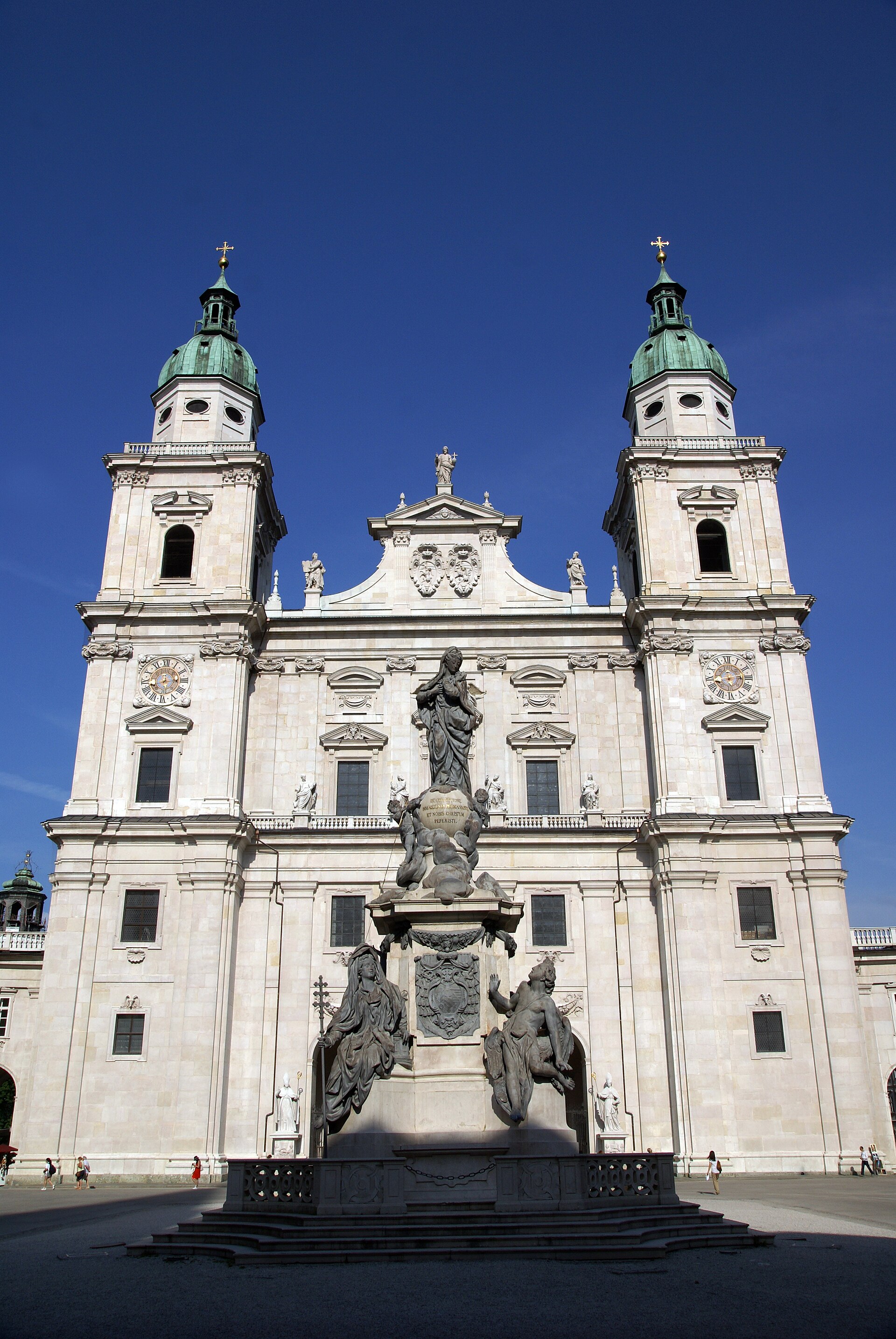
The Salzburger Dom is a 17th-century Baroque cathedral located in the heart of Salzburg, Austria. Dedicated to Saint Rupert and Saint Vergilius, it stands on the site of an earlier Romanesque basilica that was destroyed by fire in 1598. The current structure was commissioned by Prince-Archbishop Markus Sittikus von Hohenems and designed by the Italian architect Santino Solari, serving as a primary symbol of the Counter-Reformation in the region.
The cathedral is renowned for its monumental facade and massive dome, which dominate the Salzburg skyline. Its interior features elaborate stucco work, frescoes, and the historic baptismal font where Wolfgang Amadeus Mozart was baptized in 1756. Despite suffering significant damage during World War II, the cathedral was meticulously restored and remains an active center of religious and cultural life in Salzburg.
Key Facts
- Materials
- Untersberg marble, Stucco, Sandstone
- Civilization
- Austrian
- Accessibility
- Wheelchair accessible via side entrances
- Date(s)
- 1614-1628
- Condition
- Active cathedral, fully restored
- Original Function
- Cathedral
- Key Figures
- Markus Sittikus von Hohenems, Santino Solari, Wolfgang Amadeus Mozart
Early Foundations
774 CEThe first cathedral was consecrated by Saint Virgil of Salzburg in 774. This structure underwent several expansions and reconstructions throughout the Middle Ages, serving as the spiritual center of the Prince-Archbishopric.
Baroque Reconstruction
1614-1628Following a devastating fire in 1598, Prince-Archbishop Markus Sittikus ordered the demolition of the Romanesque ruins. Santino Solari was appointed to design a new cathedral in the Italian Baroque style, which was consecrated in 1628 by Archbishop Paris Lodron.
War and Restoration
1944-1959During the final months of World War II, an Allied bomb destroyed the cathedral's dome and parts of the sanctuary. Reconstruction efforts began shortly after the war and were completed in 1959, restoring the building to its original grandeur.
Cultural Significance
The Salzburger Dom is central to the identity of Salzburg, representing the city's historical status as a powerful ecclesiastical principality. Its role in the baptism of Mozart links the site inextricably to the city's musical heritage, drawing millions of visitors annually.
Beyond its religious function, the cathedral square (Domplatz) serves as the primary stage for the Salzburg Festival, most notably for the annual performances of Hugo von Hofmannsthal's 'Jedermann', reinforcing the site's status as a nexus of European theater and faith.
Interpretive Notes
Scholarly debates and areas of uncertainty
Debates persist regarding the extent to which the current Baroque structure incorporates elements of the original Romanesque foundations. While archaeological excavations have clarified the footprint of the earlier basilica, the integration of these remnants into the modern crypt remains a subject of ongoing architectural study.
Visiting Information
Entry Rules
Open daily. Entry is free, though donations are encouraged. Visitors are expected to maintain a respectful demeanor as it is an active place of worship. Modest dress is requested.
Best Times to Visit
Early morning or late afternoon to avoid peak tourist crowds. The cathedral is particularly significant during the Salzburg Festival in summer and the Advent season.
Photography
Personal photography is permitted without flash or tripods. Professional photography requires prior authorization from the cathedral administration.
Preservation Notes
The cathedral is subject to ongoing maintenance due to the porous nature of the Untersberg marble. Visitors are asked to refrain from touching the stucco and frescoes.
Nearby POIs
5 shownSources & Further Reading
- [1]The Salzburg Cathedral: History and Architecture — Johannes Neuhardt. Salzburg Cathedral Press (1998)
- [2]Baroque Architecture in Central Europe — Hans Sedlmayr. Yale University Press (2005)
Key Facts
- Materials
- Untersberg marble, Stucco, Sandstone
- Civilization
- Austrian
- Accessibility
- Wheelchair accessible via side entrances
- Date(s)
- 1614-1628
- Condition
- Active cathedral, fully restored
- Original Function
- Cathedral
- Key Figures
- Markus Sittikus von Hohenems, Santino Solari, Wolfgang Amadeus Mozart