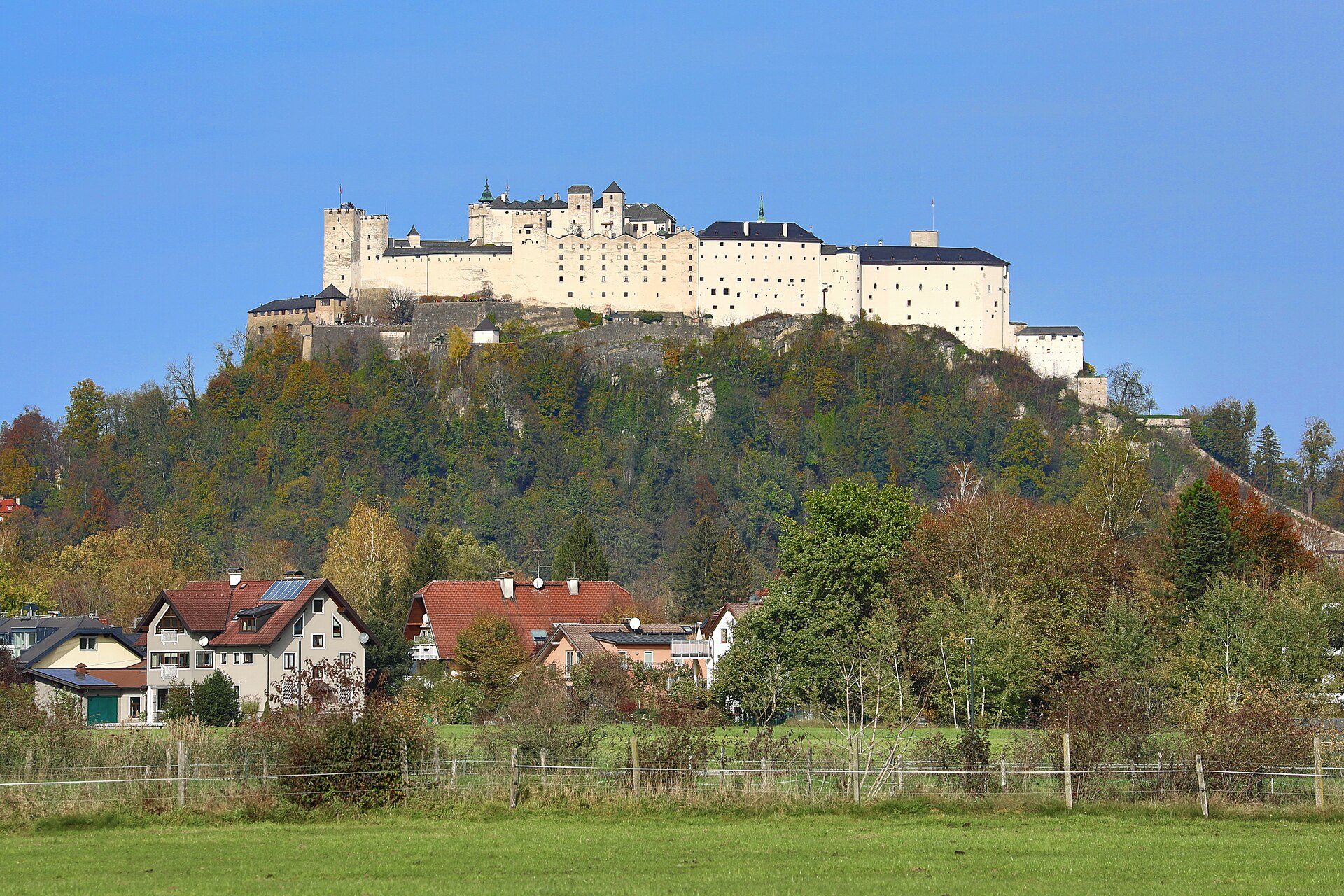
Hohensalzburg Fortress is a medieval fortification situated on the Festungsberg, a small hill in the city of Salzburg, Austria. Founded in 1077 by Archbishop Gebhard of Salzburg, it stands at an altitude of 506 meters and ranks among the largest and best-preserved medieval castle complexes in Europe. The fortress served as a strategic stronghold for the Prince-Archbishops of Salzburg, providing both a defensive bastion and a symbol of their temporal power.
The complex evolved over several centuries, with significant expansions occurring during the 15th and 16th centuries to accommodate modern artillery and defensive requirements. Its architecture reflects a blend of Romanesque, Gothic, and Renaissance styles, featuring extensive curtain walls, bastions, and ornate interior chambers such as the Golden Hall and the Golden Chamber, which remain notable for their late Gothic wood carvings and stucco work.
Key Facts
- Materials
- Stone, Brick, Wood
- Civilization
- Holy Roman Empire
- Accessibility
- Accessible via funicular railway or steep pedestrian path
- Date(s)
- 1077 CE
- Condition
- Well-preserved, museum and public site
- Original Function
- Defensive fortress and residence for Prince-Archbishops
- Key Figures
- Archbishop Gebhard, Archbishop Leonhard von Keutschach
Founding and Early Development
1077 CEThe fortress was established by Archbishop Gebhard during the Investiture Controversy to protect the interests of the Archbishopric of Salzburg against the Holy Roman Emperor.
Expansion and Fortification
1495-1519Archbishop Leonhard von Keutschach significantly expanded the fortress, adding the current outer walls and towers. He is also responsible for the lavish interior decorations of the state apartments.
Military and Administrative Use
17th-19th centuryThe fortress served as a military barracks and prison. It was never captured by enemy forces during its active military life, though it was surrendered to French troops in 1800 during the Napoleonic Wars.
Modern Preservation
20th century - presentFollowing the end of the monarchy, the fortress was opened to the public. It underwent extensive restoration in the 20th century and now serves as one of Austria's most visited cultural landmarks.
Cultural Significance
Hohensalzburg Fortress is the defining landmark of Salzburg, symbolizing the historical autonomy of the Prince-Archbishopric. It represents the transition of power from feudal military control to the administrative and cultural influence of the church in the Alpine region.
Today, the fortress is a central venue for cultural events, including the Salzburg Festival, and serves as a primary site for historical education regarding the medieval and early modern history of the Salzburg region.
Interpretive Notes
Scholarly debates and areas of uncertainty
Debates exist regarding the extent of the original 11th-century structure, as much of the current visible masonry dates from the major 15th-century reconstruction. Scholars also analyze the fortress's role in the broader defensive network of the Holy Roman Empire during the late Middle Ages.
Visiting Information
Entry Rules
Open daily. Tickets are required for entry, which include access to the funicular and the fortress museums. Visitors are advised to check official hours as they vary by season.
Best Times to Visit
Early morning or late afternoon to avoid peak tourist crowds. The fortress offers panoramic views of the city, which are clearest during the autumn months.
Photography
Personal photography is permitted in outdoor areas and most museum sections. Flash and tripods are prohibited inside the interior chambers.
Preservation Notes
The site is a protected monument. Visitors must remain on marked paths and refrain from touching historical wall surfaces or artifacts.
Nearby POIs
5 shownSources & Further Reading
- [1]Hohensalzburg Fortress: A History — Friederike Zaisberger. Salzburg Museum Press (1998)
- [2]The Architecture of the Prince-Archbishops — Karl Heinz Ritschel. University of Salzburg Press (2005)
Key Facts
- Materials
- Stone, Brick, Wood
- Civilization
- Holy Roman Empire
- Accessibility
- Accessible via funicular railway or steep pedestrian path
- Date(s)
- 1077 CE
- Condition
- Well-preserved, museum and public site
- Original Function
- Defensive fortress and residence for Prince-Archbishops
- Key Figures
- Archbishop Gebhard, Archbishop Leonhard von Keutschach