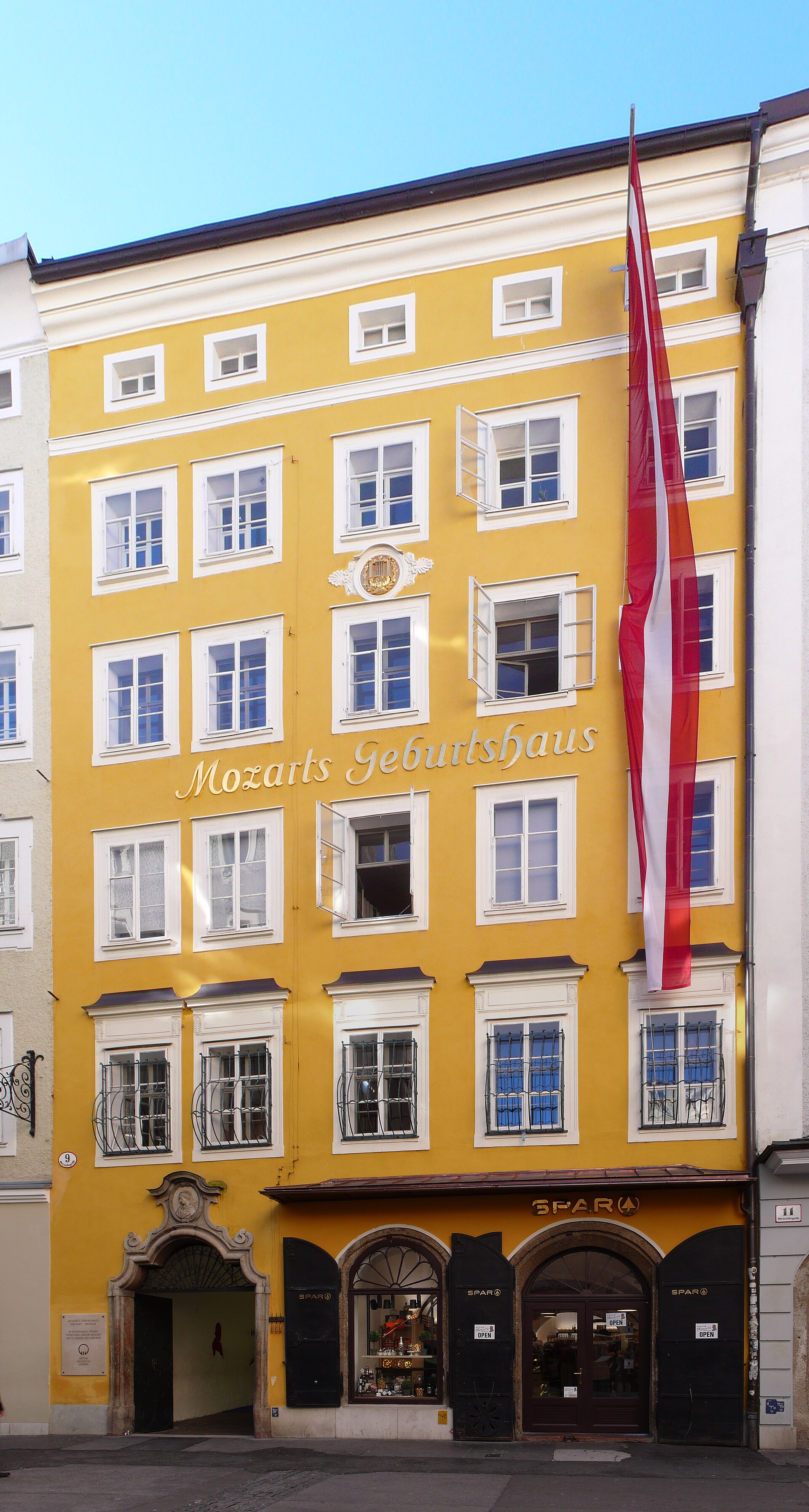
Mozart's Geburtshaus, located at Getreidegasse 9 in Salzburg, is the house where Wolfgang Amadeus Mozart was born on January 27, 1756. The Mozart family lived on the third floor of this building from 1747 to 1773, during which time the young composer spent his formative years before the family relocated to a larger residence.
Today, the building serves as a museum managed by the International Mozarteum Foundation. It houses a significant collection of historical artifacts, including Mozart's childhood violin, his concert violin, clavichord, harpsichord, and various family portraits and letters that document the life and career of the composer.
Key Facts
- Materials
- Stone, Plaster, Wood
- Civilization
- Austrian
- Accessibility
- Limited; historic building with stairs
- Date(s)
- 12th century (original structure)
- Condition
- Well-preserved museum
- Original Function
- Residential building
- Key Figures
- Wolfgang Amadeus Mozart, Leopold Mozart, Anna Maria Mozart
Early History
12th centuryThe building, known as the 'Hagenauer House', was constructed in the 12th century on land owned by the Benedictine monks of St. Peter's Abbey. It served as a typical merchant's residence in the heart of Salzburg's old town.
The Mozart Residency
1747-1773Leopold Mozart, a musician in the service of the Salzburg Archbishop, moved into the third floor of the house in 1747. It was here that all seven of his children were born, though only two survived, including Wolfgang Amadeus.
Establishment of the Museum
1880The International Mozarteum Foundation opened the museum in the house on June 15, 1880. Since then, it has undergone several renovations to preserve the historical integrity of the rooms while expanding the exhibition space.
Cultural Significance
The house is a site of international pilgrimage for music lovers and historians. It represents the domestic life of an 18th-century middle-class family in Salzburg and provides critical context for the early development of one of the world's most influential composers.
As part of the Historic Centre of the City of Salzburg, the site contributes to the city's status as a UNESCO World Heritage site, emphasizing the preservation of its musical and architectural legacy.
Interpretive Notes
Scholarly debates and areas of uncertainty
There is ongoing academic discussion regarding the exact layout of the rooms during the 1750s, as the building underwent various structural modifications over the centuries. Reconstructions of the family's living conditions rely on a combination of archival records and architectural analysis.
Visiting Information
Entry Rules
Open daily from 9:00 to 17:30. Tickets can be purchased online or at the entrance. Large bags and backpacks must be left in lockers.
Best Times to Visit
Early morning or late afternoon to avoid peak tourist crowds in the Getreidegasse shopping district.
Photography
Photography is permitted for private use without flash; video recording and tripods are prohibited.
Preservation Notes
The building is a protected historical monument. Visitors are requested to refrain from touching the artifacts and to follow the designated walking path through the museum.
Nearby POIs
5 shownSources & Further Reading
- [1]
- [2]The Life of Mozart — Maynard Solomon. Harper Perennial (1996)
Key Facts
- Materials
- Stone, Plaster, Wood
- Civilization
- Austrian
- Accessibility
- Limited; historic building with stairs
- Date(s)
- 12th century (original structure)
- Condition
- Well-preserved museum
- Original Function
- Residential building
- Key Figures
- Wolfgang Amadeus Mozart, Leopold Mozart, Anna Maria Mozart