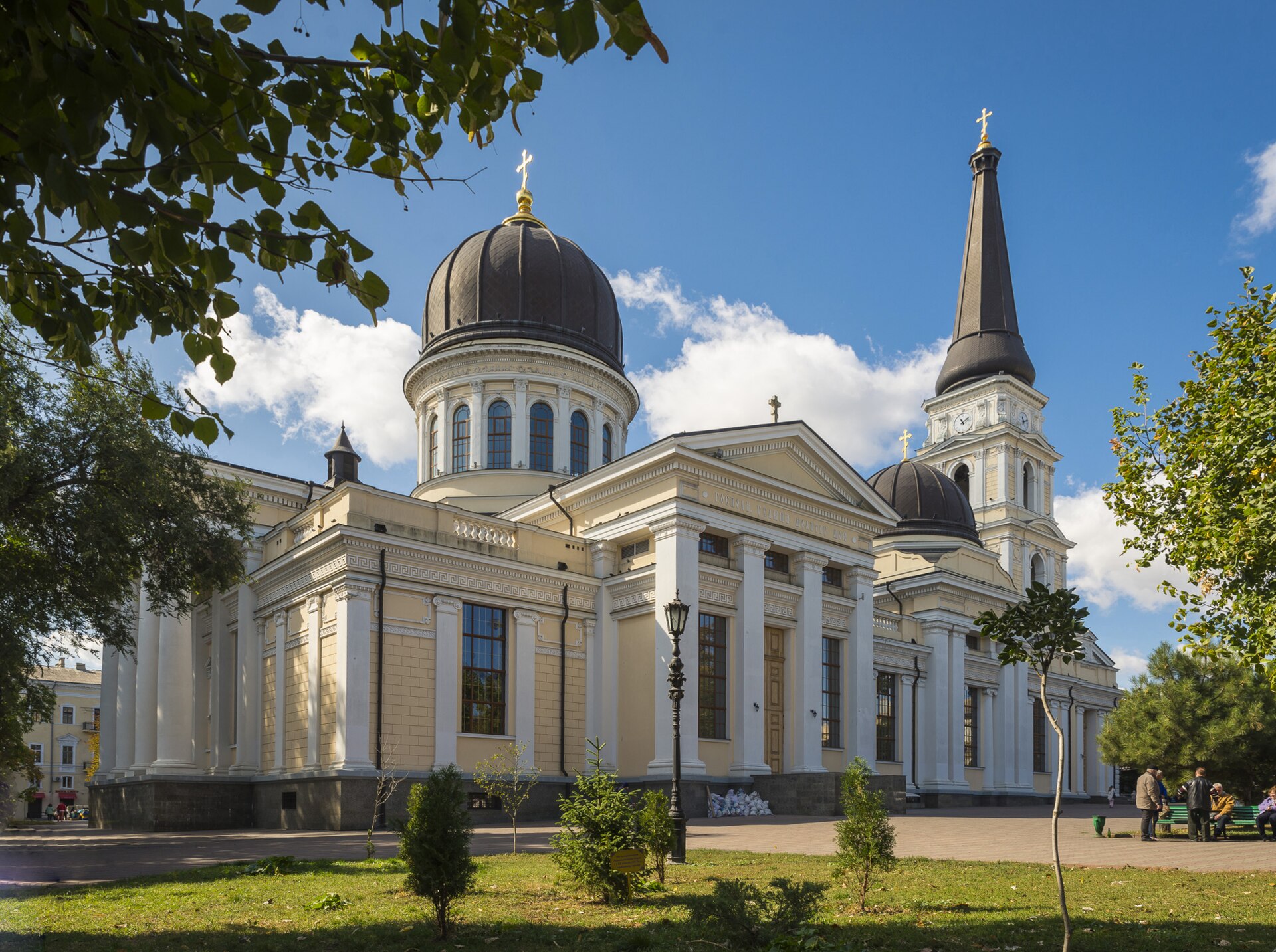
The Spaso-Preobrazhensky Cathedral, located in the heart of Odessa, is the largest Orthodox church in the city. Originally founded in 1794 shortly after the city's establishment, the cathedral has undergone multiple reconstructions, reflecting the turbulent history of the region. It serves as a significant religious and architectural landmark, known for its grand neoclassical design and its role as the burial site for Prince Mikhail Vorontsov and his wife.
The current structure is a faithful reconstruction completed in the early 2000s, following the total demolition of the original building by Soviet authorities in 1936. Today, it functions as an active cathedral under the Ukrainian Orthodox Church and remains a focal point for both religious life and historical commemoration in Odessa.
Key Facts
- Materials
- Stone, Brick, Marble
- Civilization
- Russian Empire / Ukrainian
- Accessibility
- Ground level access available
- Date(s)
- 1794-1809 (original), 1999-2005 (reconstruction)
- Condition
- Fully restored and active
- Original Function
- Orthodox Cathedral
- Key Figures
- Mikhail Vorontsov, Elizabeth Vorontsova
Founding and Early Years
1794-1809The foundation stone was laid in 1794, shortly after the city of Odessa was founded. The project was overseen by architect Francesco Frappoli. It was consecrated in 1809 and quickly became the primary religious center for the growing port city.
Expansion and Imperial Significance
19th CenturyThroughout the 19th century, the cathedral was expanded multiple times to accommodate the city's increasing population. It became the final resting place for Prince Mikhail Vorontsov, the Governor-General of Novorossiya, cementing its status as a site of imperial importance.
Soviet Destruction
1936During the anti-religious campaigns of the Soviet era, the cathedral was closed and subsequently demolished in 1936. The site was repurposed, and the bell tower was destroyed, erasing a major architectural landmark from the city center.
Modern Reconstruction
1999-2005Following the dissolution of the Soviet Union, a city-wide initiative was launched to rebuild the cathedral. Using original blueprints and historical photographs, the structure was meticulously reconstructed, with the new building consecrated in 2005.
Cultural Significance
The cathedral is a symbol of Odessa's resilience and its historical connection to the Orthodox tradition. Its reconstruction is viewed by many residents as a restoration of the city's pre-Soviet identity and a tribute to the historical figures who shaped the development of the Black Sea region.
Interpretive Notes
Scholarly debates and areas of uncertainty
Discussions among historians often focus on the accuracy of the 2000s reconstruction compared to the original 19th-century design, particularly regarding the interior decorative elements and the preservation of the original crypt area.
Visiting Information
Entry Rules
Open daily. Visitors are expected to dress modestly (shoulders and knees covered). Photography is generally permitted, but visitors should remain respectful during ongoing liturgical services.
Best Times to Visit
Morning hours are best for viewing the interior without large crowds. The cathedral square is particularly active during major Orthodox holidays.
Photography
Personal photography is allowed without flash. Professional photography or video equipment requires prior permission from the church administration.
Preservation Notes
The site is well-maintained. Visitors are asked to refrain from touching icons and to follow designated pathways within the sanctuary.
Nearby POIs
5 shownSources & Further Reading
- [1]Odesa: A History — Patricia Herlihy. Harvard University Press (1986)
- [2]The Transfiguration Cathedral in Odesa: History and Architecture — Odesa City Archive. Municipal Publishing House (2007)
Key Facts
- Materials
- Stone, Brick, Marble
- Civilization
- Russian Empire / Ukrainian
- Accessibility
- Ground level access available
- Date(s)
- 1794-1809 (original), 1999-2005 (reconstruction)
- Condition
- Fully restored and active
- Original Function
- Orthodox Cathedral
- Key Figures
- Mikhail Vorontsov, Elizabeth Vorontsova