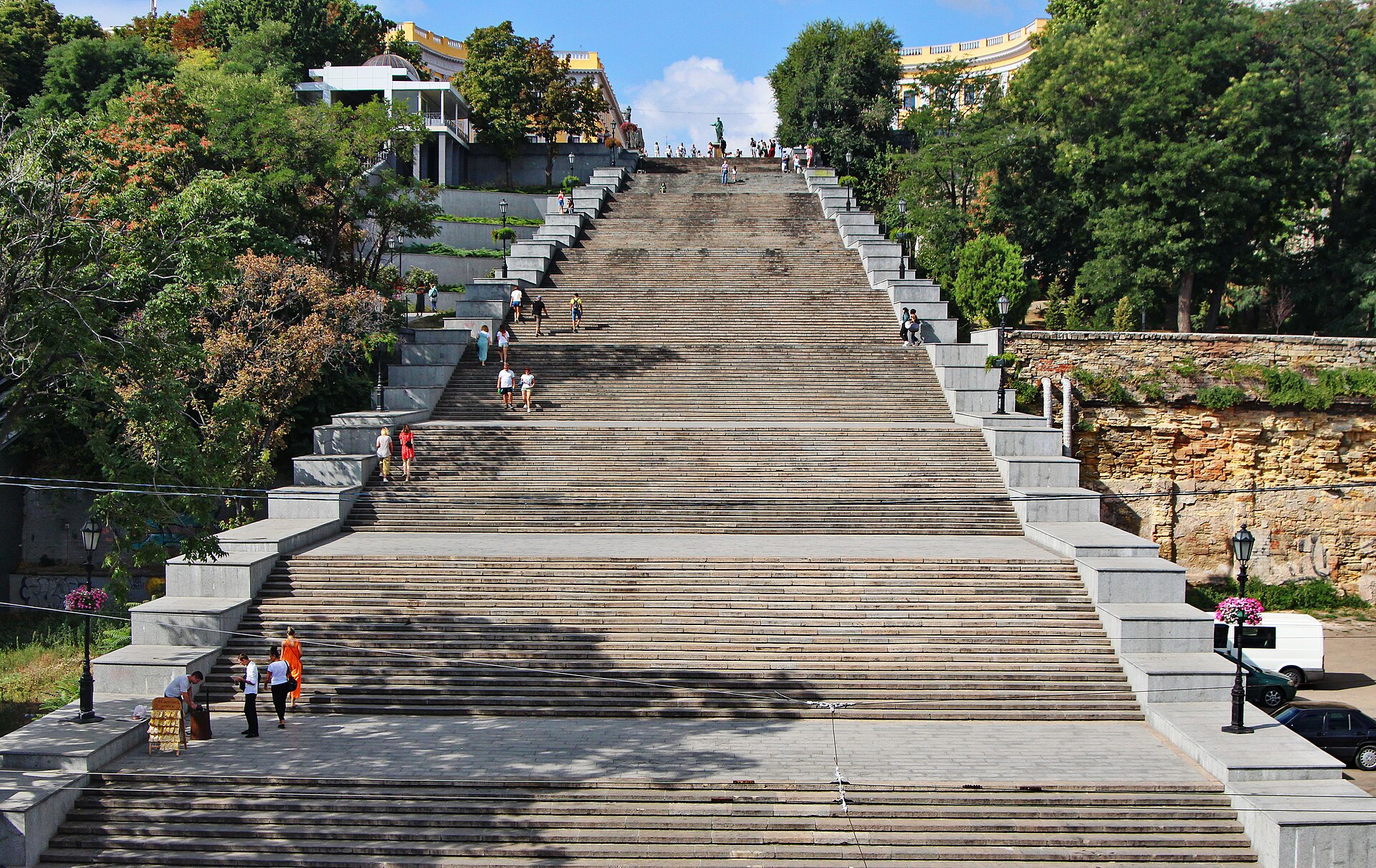
The Potemkin Stairs are a monumental staircase in Odessa, Ukraine, serving as the formal entrance to the city from the Black Sea. Designed by architect Francesco Boffo and constructed between 1837 and 1841, the structure consists of 192 steps that create a forced perspective, making the stairs appear longer when viewed from the bottom and wider when viewed from the top.
Originally known as the Richelieu Steps, they were renamed in 1955 to commemorate the 1905 mutiny on the battleship Potemkin, a historical event immortalized in Sergei Eisenstein's 1925 silent film, 'Battleship Potemkin.' The stairs connect the city center with the harbor and remain a primary architectural symbol of Odesa.
Key Facts
- Materials
- Trieste sandstone, Granite
- Civilization
- Russian Empire
- Accessibility
- Stairs are steep; funicular railway available adjacent to the site
- Date(s)
- 1837-1841
- Condition
- Well-preserved, active public thoroughfare
- Original Function
- Pedestrian access between the harbor and the city center
- Key Figures
- Francesco Boffo, Duke de Richelieu, Sergei Eisenstein
Design and Construction
1837-1841The stairs were commissioned by Prince Mikhail Vorontsov as a gift to his wife, Elizabeth. Architect Francesco Boffo utilized the natural slope of the cliff to create a grand descent, incorporating a clever optical illusion that manipulates the viewer's perception of depth and width.
Cinematic Legacy
1925The stairs gained international fame following the release of Sergei Eisenstein's film 'Battleship Potemkin.' The sequence depicting a baby carriage rolling down the steps during a massacre became one of the most influential scenes in the history of cinema.
Modern Era
20th-21st centuryThe stairs have undergone several renovations to address erosion and structural stability. Today, they serve as a central gathering point for city festivals and are recognized as a protected cultural heritage site of Ukraine.
Cultural Significance
The Potemkin Stairs are the defining landmark of Odessa, representing the city's maritime identity and its historical role as a gateway to the Russian Empire. They function as a bridge between the urban landscape and the sea, embodying the city's neoclassical architectural heritage.
Beyond their physical function, the stairs hold significant cultural weight due to their association with Soviet-era cinema. They are a site of memory for both the 1905 revolution and the artistic legacy of the 20th century, drawing visitors who seek to experience the site of the famous cinematic sequence.
Interpretive Notes
Scholarly debates and areas of uncertainty
There is minor academic debate regarding the exact influence of the stairs on urban planning in the 19th century, specifically whether the design was intended primarily for aesthetic grandeur or as a functional solution to the steep terrain of the Odesa cliffside.
Visiting Information
Entry Rules
Open to the public 24/7. No entry fees. The site is a public thoroughfare.
Best Times to Visit
Early morning or sunset for optimal lighting and lower pedestrian traffic. The stairs are particularly busy during local holidays and the Odesa Film Festival.
Photography
None. Personal photography is permitted.
Preservation Notes
The stairs are a high-traffic area; visitors should exercise caution on the steps, especially during wet weather. Restoration work is conducted periodically by municipal authorities.
Nearby POIs
5 shownSources & Further Reading
- [1]Odessa: A History — Patricia Herlihy. Harvard University Press (1986)
- [2]The Film Factory: Russian and Soviet Cinema in Documents — Richard Taylor, Ian Christie. Routledge (1994)
Key Facts
- Materials
- Trieste sandstone, Granite
- Civilization
- Russian Empire
- Accessibility
- Stairs are steep; funicular railway available adjacent to the site
- Date(s)
- 1837-1841
- Condition
- Well-preserved, active public thoroughfare
- Original Function
- Pedestrian access between the harbor and the city center
- Key Figures
- Francesco Boffo, Duke de Richelieu, Sergei Eisenstein