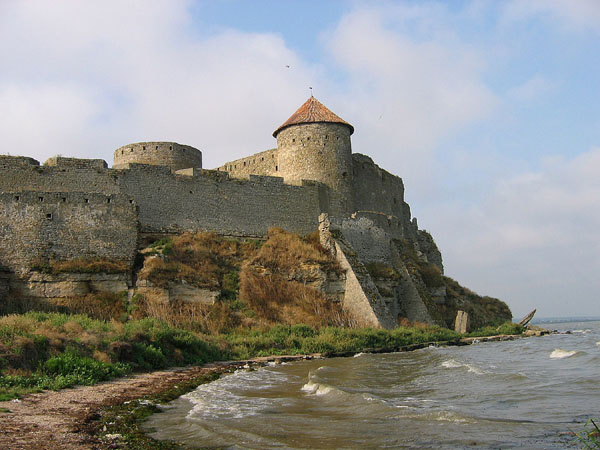
The Bilhorod-Dnistrovskyi fortress, also known as the Akkerman Fortress, is a significant medieval defensive structure located on the banks of the Dniester Liman in southwestern Ukraine. Its construction began in the 13th century, with major expansions occurring throughout the 14th and 15th centuries under the influence of the Republic of Genoa and the Principality of Moldavia.
The fortress is characterized by its massive limestone walls, which extend over two kilometers and are punctuated by over 30 towers and bastions. It served as a vital strategic point for controlling trade routes along the Black Sea coast and underwent numerous sieges and architectural modifications during its transition between Genoese, Moldavian, Ottoman, and Russian control.
Key Facts
- Materials
- Limestone, Mortar
- Civilization
- Genoese, Moldavian, Ottoman
- Accessibility
- Ground level accessible, uneven terrain within walls
- Date(s)
- 13th - 15th century
- Condition
- Partially restored, open-air museum
- Original Function
- Military fortification and trade hub
- Key Figures
- Stephen the Great
Foundation and Genoese Influence
13th - 14th centuryThe fortress was established on the site of the ancient Greek city of Tyras. Genoese merchants, seeking to secure their trade interests in the Black Sea region, initiated the construction of the primary defensive walls and towers.
Moldavian Expansion
15th centuryDuring the reign of Stephen the Great, the fortress was significantly expanded and strengthened to serve as a key defensive bastion for the Principality of Moldavia against encroaching powers.
Ottoman Era
1484 - 1812The Ottoman Empire captured the fortress in 1484, renaming it Akkerman. For over three centuries, it served as a major Ottoman administrative and military center, undergoing further structural reinforcements to accommodate artillery.
Modern Era
19th century - presentFollowing the Russo-Turkish Wars, the fortress lost its military significance. It was eventually designated as a historical monument, and today it functions as a protected cultural site and a popular destination for archaeological research and tourism.
Cultural Significance
The fortress stands as a testament to the complex geopolitical history of the Northern Black Sea coast, reflecting the intersection of Mediterranean trade networks and Eastern European power struggles. It is a symbol of regional identity for the city of Bilhorod-Dnistrovskyi and serves as a primary site for historical education and cultural events in the Odessa region.
Interpretive Notes
Scholarly debates and areas of uncertainty
There is ongoing academic discussion regarding the exact extent of the original Genoese contribution versus the later Moldavian and Ottoman modifications, as the layers of construction are deeply integrated and often difficult to distinguish without extensive stratigraphic analysis.
Visiting Information
Entry Rules
Open daily. Tickets are required for entry to the interior courtyards and wall walks. Visitors are advised to wear comfortable footwear due to uneven stone surfaces.
Best Times to Visit
Late spring and early autumn offer the most pleasant weather for exploring the extensive outdoor grounds. Avoid midday during summer months due to high temperatures and lack of shade.
Photography
Personal photography is permitted. Commercial filming or professional photography sessions require prior authorization from the fortress administration.
Preservation Notes
The site is an active archaeological zone. Visitors must stay within marked pathways and refrain from climbing on unrestored wall sections to ensure both personal safety and the preservation of the masonry.
Nearby POIs
5 shownSources & Further Reading
- [1]The Akkerman Fortress: A History of the Dniester Frontier — O. V. Savchenko. Odessa University Press (2015)
- [2]Medieval Fortifications of the Black Sea Coast — I. P. Petrov. Journal of Eastern European Archaeology (2019)
Key Facts
- Materials
- Limestone, Mortar
- Civilization
- Genoese, Moldavian, Ottoman
- Accessibility
- Ground level accessible, uneven terrain within walls
- Date(s)
- 13th - 15th century
- Condition
- Partially restored, open-air museum
- Original Function
- Military fortification and trade hub
- Key Figures
- Stephen the Great