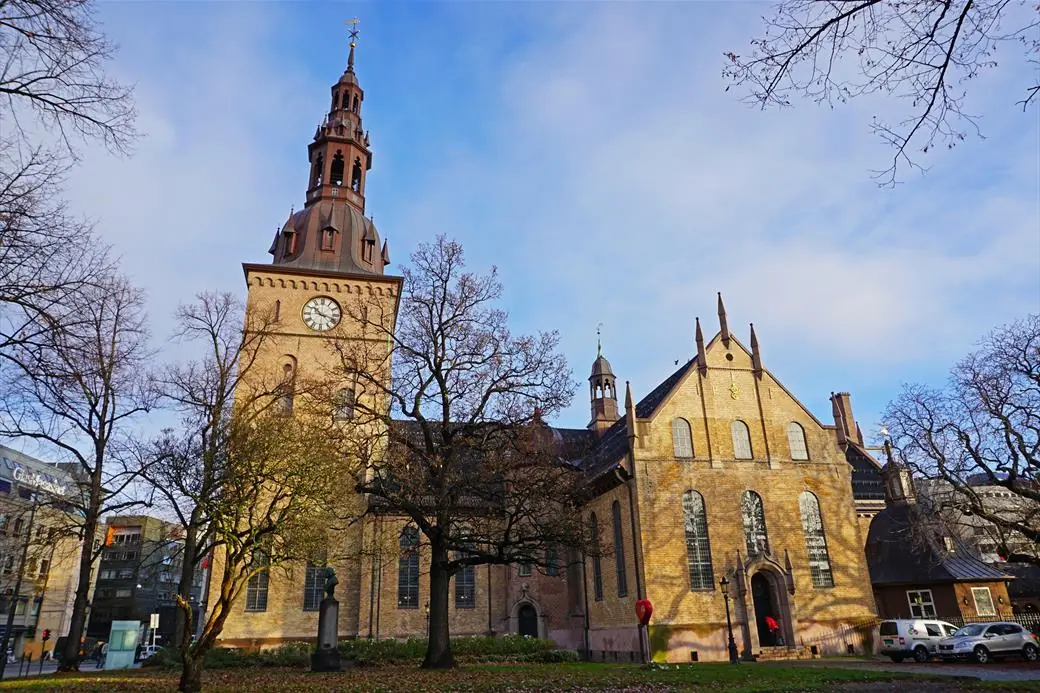
Oslo Cathedral, known as Oslo Domkirke, is the main church for the Church of Norway Diocese of Oslo. Consecrated in 1697, it is the third cathedral to serve the city, replacing the older Holy Trinity Church. The structure is built in a cruciform plan with a prominent western tower, reflecting the Dutch Baroque architectural style prevalent in the region during the late 17th century.
The interior is noted for its extensive 17th and 18th-century furnishings, including a significant altarpiece and pulpit. The ceiling is adorned with large-scale murals painted by Hugo Lous Mohr between 1936 and 1950, which depict biblical scenes. As the primary church for the Norwegian royal family and the state, it serves as the venue for major national events, including royal weddings and state funerals.
Key Facts
- Materials
- Brick, Wood, Stucco
- Civilization
- Dano-Norwegian
- Accessibility
- Wheelchair accessible via side entrance
- Date(s)
- 1694-1697
- Condition
- Well-preserved and active
- Original Function
- Cathedral
- Key Figures
- King Christian V, Hugo Lous Mohr, Emanuel Vigeland
Construction and Consecration
1694-1697The cathedral was commissioned to replace the dilapidated Holy Trinity Church. Construction began in 1694 under the direction of architect Jørgen Wiggers. It was consecrated on Palm Sunday in 1697, serving the growing population of Christiania, as Oslo was then known.
18th Century Renovations
1718-1722The tower was rebuilt following a fire in 1718. During this period, the interior was heavily furnished with Baroque-style woodcarvings, including the ornate pulpit and the altarpiece, which remain central features of the cathedral's aesthetic.
Modernization and Murals
1936-1950In preparation for the 900th anniversary of Oslo, the interior underwent a significant restoration. Artist Hugo Lous Mohr was commissioned to paint the ceiling murals, which were completed in 1950, adding a distinct 20th-century layer to the Baroque structure.
Cultural Significance
Oslo Cathedral serves as the spiritual heart of the Norwegian capital and the primary site for official state and royal ceremonies. Its role in national life is underscored by its use for the weddings of Crown Prince Haakon and Crown Princess Mette-Marit in 2001, as well as the funeral services for national figures.
The cathedral also acts as a cultural repository, housing significant works of Norwegian religious art. The integration of 17th-century woodcarvings with 20th-century muralism illustrates the continuity of the site as a living monument that evolves alongside the nation's history.
Interpretive Notes
Scholarly debates and areas of uncertainty
There is occasional academic discussion regarding the extent of the 1950s restoration and whether the addition of the Hugo Lous Mohr murals compromised the original Baroque integrity of the interior. While some argue the murals provide a necessary modern narrative, others suggest they obscure the original architectural intent of the 17th-century design.
Visiting Information
Entry Rules
Open to the public daily. Entry is free, though the cathedral may be closed during private services or state events. Visitors are expected to maintain a quiet demeanor and respect the sanctity of the space.
Best Times to Visit
Weekday mornings are generally quieter. The cathedral is particularly significant during national holidays and major state events, though access may be restricted during these times.
Photography
Photography is permitted for personal use without flash. Tripods and professional equipment require prior authorization from the church administration.
Preservation Notes
The cathedral is a protected cultural heritage site. Visitors are asked to refrain from touching the historic woodcarvings and to remain within designated visitor areas.
Nearby POIs
11 shownSources & Further Reading
- [1]
- [2]The Murals of Hugo Lous Mohr — Ingrid Reed. Norwegian Journal of Art History (2015)
Key Facts
- Materials
- Brick, Wood, Stucco
- Civilization
- Dano-Norwegian
- Accessibility
- Wheelchair accessible via side entrance
- Date(s)
- 1694-1697
- Condition
- Well-preserved and active
- Original Function
- Cathedral
- Key Figures
- King Christian V, Hugo Lous Mohr, Emanuel Vigeland