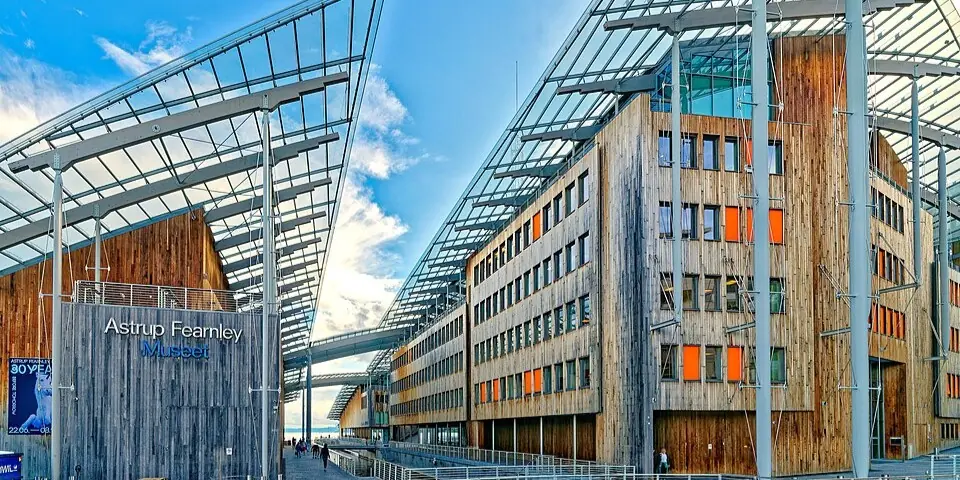
The Astrup Fearnley Museum of Modern Art is a private contemporary art museum located at Tjuvholmen in Oslo, Norway. Established in 1993, the museum moved to its current location in 2012, occupying a striking complex designed by the Italian architect Renzo Piano. The building consists of three pavilions sheltered by a distinctive, sail-like glass roof that mimics the surrounding harbor landscape.
The museum houses the Astrup Fearnley Collection, one of Northern Europe's most significant private collections of contemporary art. The collection features works by internationally renowned artists such as Jeff Koons, Damien Hirst, Cindy Sherman, and Richard Prince, alongside a rotating program of temporary exhibitions that explore current trends in global contemporary art.
Key Facts
- Materials
- Glass, Timber, Steel
- Civilization
- Norwegian
- Accessibility
- Fully wheelchair accessible
- Date(s)
- 2012
- Condition
- Active
- Original Function
- Art Museum
- Key Figures
- Renzo Piano, Hans Rasmus Astrup
Founding and Early Years
1993-2011The museum was founded in 1993 by Hans Rasmus Astrup, based on the Astrup Fearnley Collection. It was originally located at Dronningens gate in downtown Oslo, where it operated for nearly two decades before outgrowing its space.
Relocation to Tjuvholmen
2012In 2012, the museum relocated to the Tjuvholmen district, a former wharf area redeveloped into a cultural hub. The new facility was designed by Renzo Piano Building Workshop, integrating the museum into a public park and waterfront promenade.
Contemporary Evolution
2013-PresentThe museum continues to expand its collection and influence, focusing on international contemporary art. It remains a central institution in the Nordic art scene, hosting major retrospectives and thematic exhibitions.
Cultural Significance
The museum serves as a cornerstone of Oslo's modern cultural identity, transforming the Tjuvholmen district into a major destination for international art tourism. Its architecture is considered a landmark of 21st-century design in Norway, symbolizing the city's transition into a global hub for contemporary culture.
Beyond its architectural impact, the museum plays a vital role in the Norwegian art ecosystem by providing public access to high-profile international works that would otherwise remain in private hands. It fosters dialogue between local artists and the global contemporary art market.
Interpretive Notes
Scholarly debates and areas of uncertainty
The museum's role as a private institution with public-facing functions occasionally sparks debate regarding the influence of private wealth on public cultural narratives. Additionally, the curatorial focus on high-profile American and British contemporary artists has prompted discussions about the balance between international 'blue-chip' art and the representation of local Nordic contemporary practices.
Visiting Information
Entry Rules
Open Tuesday through Sunday. Tickets can be purchased online or at the entrance. Visitors are requested to leave large bags in lockers. No food or drink is permitted in the galleries.
Best Times to Visit
Weekday mornings are generally quieter. The museum is a popular destination during the summer months when the surrounding Tjuvholmen park is active.
Photography
Non-commercial photography is permitted for personal use without flash or tripods. Professional photography or filming requires prior written permission.
Preservation Notes
Maintain a respectful distance from all artworks. Do not touch the exhibits. The building's glass roof requires specialized maintenance to manage light levels and temperature for the protection of the collection.
Nearby POIs
11 shownKey Facts
- Materials
- Glass, Timber, Steel
- Civilization
- Norwegian
- Accessibility
- Fully wheelchair accessible
- Date(s)
- 2012
- Condition
- Active
- Original Function
- Art Museum
- Key Figures
- Renzo Piano, Hans Rasmus Astrup