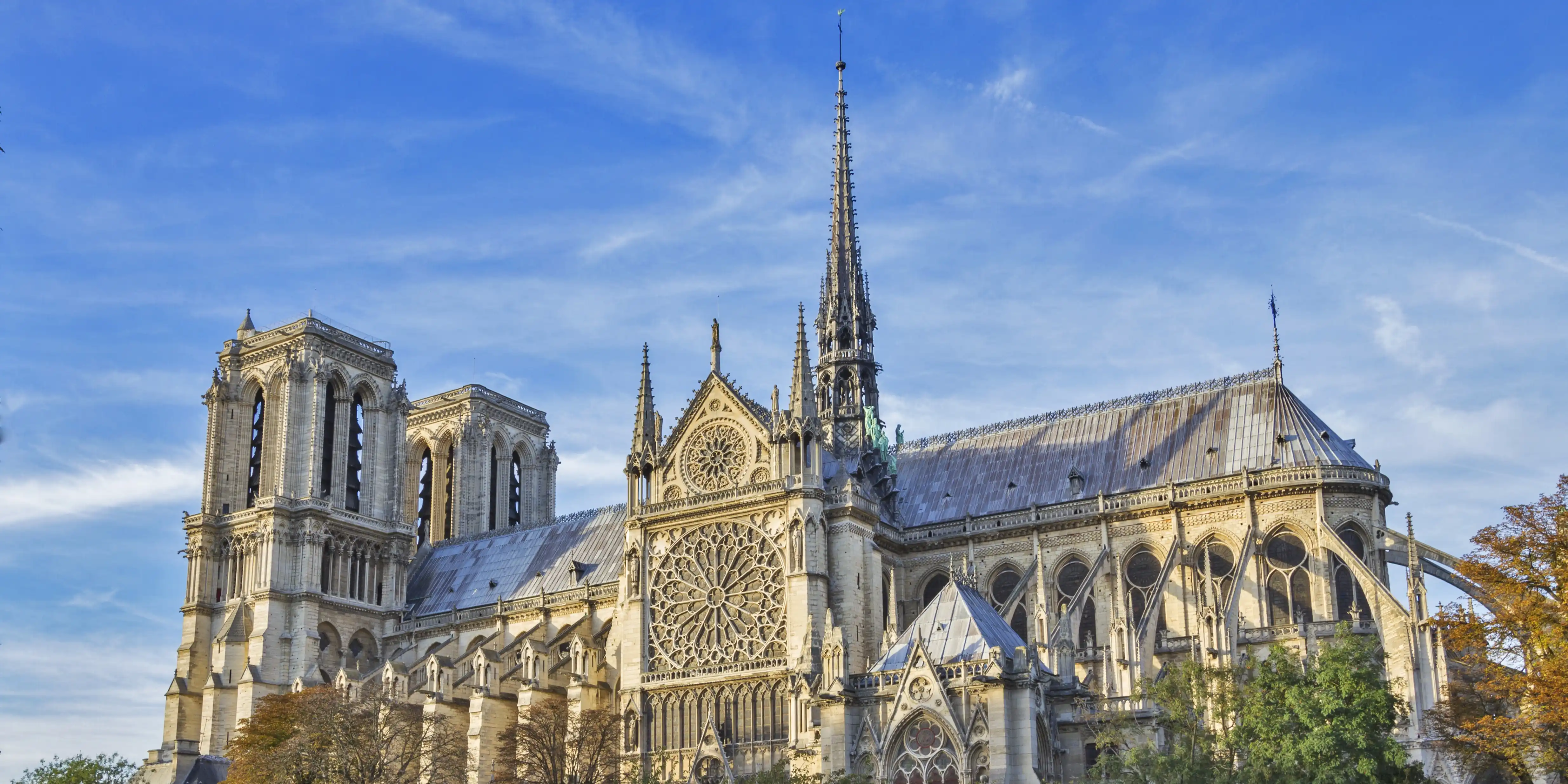
Notre-Dame de Paris is a medieval Catholic cathedral located on the Île de la Cité in Paris. Construction began in 1163 under Bishop Maurice de Sully and continued over nearly two centuries, resulting in one of the most significant examples of French Gothic architecture. The cathedral is characterized by its ribbed vaults, flying buttresses, sculpted portals, and rose windows. It has served as a site of major religious ceremonies and national events throughout French history.
Key Facts
- Materials
- Limestone, Timber (original roof structure), Lead
- Civilization
- Kingdom of France
- Date(s)
- 1163-1345
- Condition
- Restored cathedral reopened following 2019 fire damage
- Original Function
- Cathedral church of the Archdiocese of Paris
- Key Figures
- Maurice de Sully, Louis VII, Napoleon I, Eugène Viollet-le-Duc
Medieval Construction
1163-1345Construction began in 1163 and progressed in phases, incorporating advancements in Gothic engineering such as flying buttresses and expansive stained-glass windows. The cathedral became a central religious institution in medieval Paris.
Revolutionary Damage
1789-1799During the French Revolution, the cathedral was desecrated, statues were destroyed, and the building was repurposed as a Temple of Reason.
19th-Century Restoration
1844-1864Following renewed interest sparked by Victor Hugo’s novel, architect Eugène Viollet-le-Duc led an extensive restoration that included reconstruction of the spire and sculptural programs.
2019 Fire and Reconstruction
2019-2024A fire in April 2019 destroyed the 19th-century spire and much of the timber roof. A national and international restoration campaign led to structural stabilization and reconstruction based on historical documentation.
Cultural Significance
Notre-Dame de Paris is a foundational monument of Gothic architecture and a central symbol of French religious and national identity. The cathedral has hosted coronations, state funerals, and major civic ceremonies, reinforcing its role as both a spiritual and political landmark.
Interpretive Notes
Scholarly debates and areas of uncertainty
Scholars debate the interpretive choices made during Viollet-le-Duc’s 19th-century restoration, particularly the degree to which additions reflected medieval precedent versus modern invention. The reconstruction following the 2019 fire has prompted discussions regarding historical authenticity, material selection, and contemporary conservation ethics.
Visiting Information
Entry Rules
Open to visitors during designated hours. Security screening in place. Religious services may restrict tourist access during liturgical events. Entry is free of charge, however you may reserve your place in the church online to skip lines at the door.
Best Times to Visit
Early morning visits reduce queue times. Weekdays typically experience lower visitor volume.
Photography
Photography permitted without flash. Tripods and professional equipment require authorization.
Preservation Notes
Ongoing monitoring and conservation efforts continue following the 2019 fire. Visitors must remain within designated public areas.
Nearby POIs
11 shownSources & Further Reading
- [1]Notre-Dame of Paris: The Biography of a Cathedral — Claude Gauvard. University of Chicago Press
- [2]The Gothic Cathedral — Christopher Wilson. Thames & Hudson (2000)
Key Facts
- Materials
- Limestone, Timber (original roof structure), Lead
- Civilization
- Kingdom of France
- Date(s)
- 1163-1345
- Condition
- Restored cathedral reopened following 2019 fire damage
- Original Function
- Cathedral church of the Archdiocese of Paris
- Key Figures
- Maurice de Sully, Louis VII, Napoleon I, Eugène Viollet-le-Duc