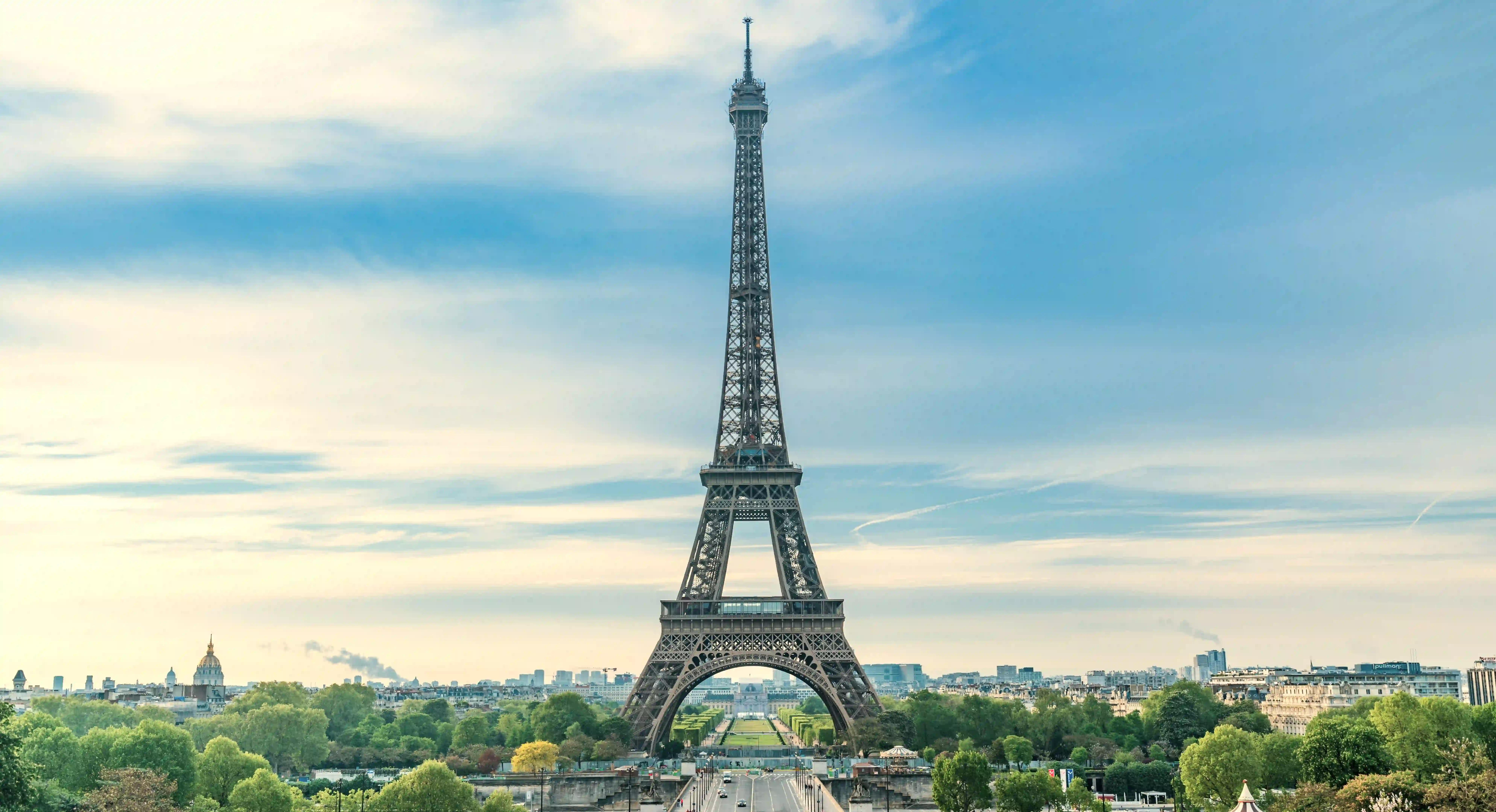
The Eiffel Tower is a wrought-iron lattice tower constructed on the Champ de Mars in Paris for the 1889 Exposition Universelle, commemorating the centennial of the French Revolution. Designed by engineer Gustave Eiffel and his company, it was the tallest man-made structure in the world at the time of its completion. Originally intended as a temporary exhibition structure, the tower became a permanent fixture of the Paris skyline and a landmark of industrial-age engineering.
Key Facts
- Materials
- Wrought iron
- Civilization
- French Third Republic
- Date(s)
- 1887-1889
- Condition
- Operational monument and observation tower
- Original Function
- Entrance arch and centerpiece for the 1889 Exposition Universelle
- Key Figures
- Gustave Eiffel, Maurice Koechlin, Émile Nouguier, Stephen Sauvestre
Design and Construction
1887-1889The tower was engineered by Maurice Koechlin and Émile Nouguier under the direction of Gustave Eiffel. Constructed from prefabricated iron components, it reached a height of approximately 300 meters upon completion.
Exposition Universelle
1889The structure served as the focal point of the 1889 World’s Fair, symbolizing technological progress and marking the centennial of the French Revolution.
Scientific and Military Use
Late 19th-20th centuriesThe tower was utilized for meteorological research and radio transmission experiments, including early wireless communication that contributed to its preservation beyond its initial permit period.
Global Landmark
20th century-presentThe Eiffel Tower became an international symbol of France and remains one of the most visited paid monuments in the world.
Cultural Significance
The Eiffel Tower represents the technological optimism of the Industrial Revolution and the engineering capabilities of late 19th-century France. Initially criticized by segments of the Parisian artistic community, the structure later became a central symbol of national identity and modern architectural innovation.
Interpretive Notes
Scholarly debates and areas of uncertainty
Historians analyze contemporary opposition to the tower as evidence of tensions between academic artistic traditions and industrial modernity. Architectural scholars examine the tower’s influence on subsequent steel-frame construction and its role in redefining monumental form.
Visiting Information
Entry Rules
Paid admission required for access to upper levels. Security screening in place. Advance ticket purchase recommended.
Best Times to Visit
Early morning or late evening visits reduce queue times. Illuminations occur nightly after sunset.
Photography
Daytime photography permitted. Nighttime illumination is protected by copyright for commercial use.
Preservation Notes
Regular repainting occurs approximately every seven years to prevent corrosion. Visitors must remain within designated public areas.
Nearby POIs
11 shownSources & Further Reading
- [1]Eiffel's Tower — Jill Jonnes. Viking (2009)
- [2]The Eiffel Tower — Bertrand Lemoine. Abrams (2004)
Key Facts
- Materials
- Wrought iron
- Civilization
- French Third Republic
- Date(s)
- 1887-1889
- Condition
- Operational monument and observation tower
- Original Function
- Entrance arch and centerpiece for the 1889 Exposition Universelle
- Key Figures
- Gustave Eiffel, Maurice Koechlin, Émile Nouguier, Stephen Sauvestre