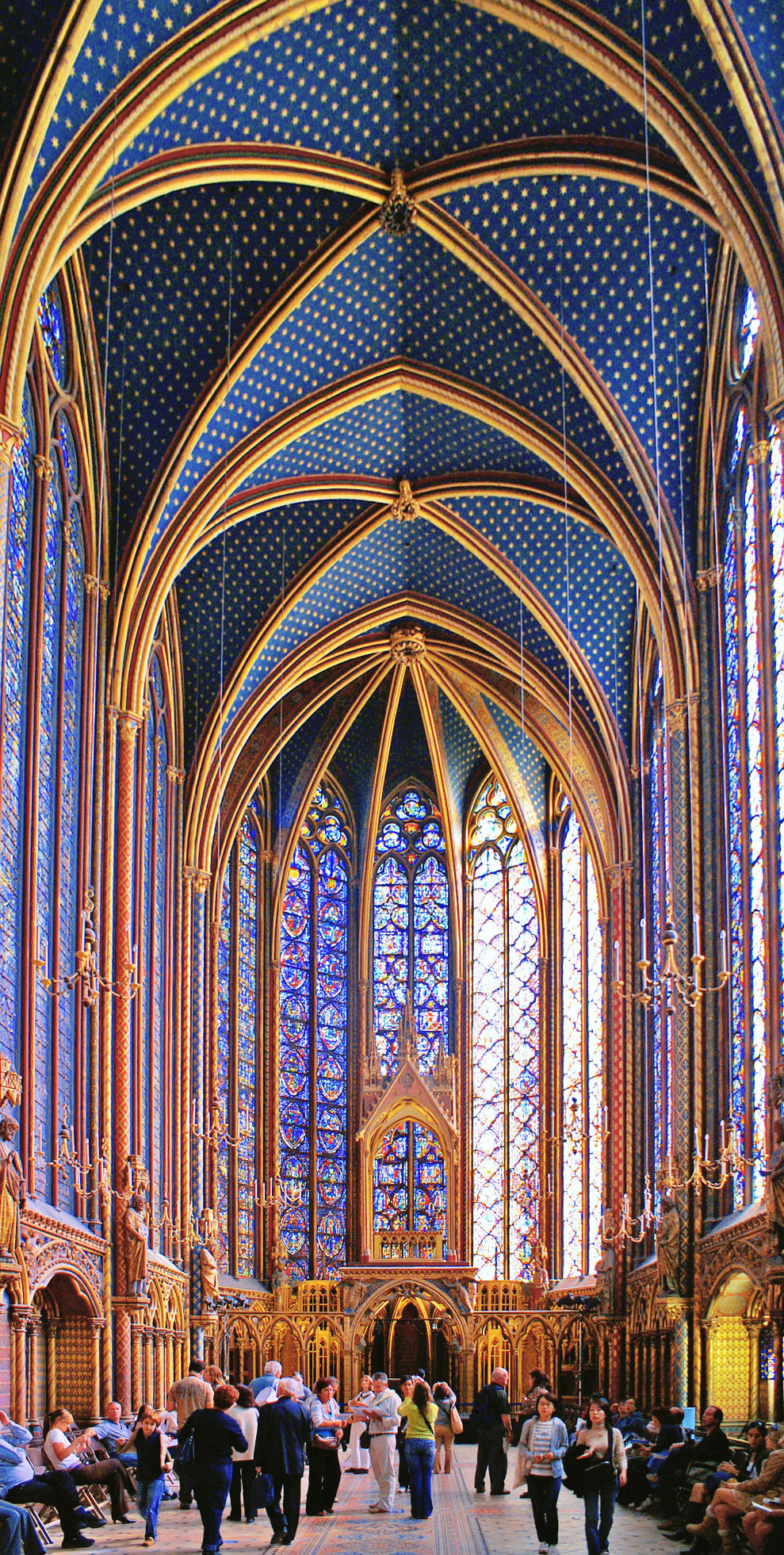
Sainte-Chapelle is a royal chapel in the Gothic Rayonnant style, located within the medieval Palais de la Cité, the residence of the Kings of France in Paris. It was commissioned by King Louis IX to house his collection of Passion relics, including the Crown of Thorns, which he had acquired from the Latin Emperor Baldwin II of Constantinople.
Consecrated in 1248, the structure is renowned for its extensive collection of 13th-century stained glass, which covers 600 square meters of wall space. The chapel is divided into two levels: a lower chapel, which served as the parish church for the palace staff, and an upper chapel, which was reserved for the royal family and the display of the relics.
Key Facts
- Materials
- Limestone, Stained glass, Iron, Lead
- Civilization
- French (Capetian)
- Accessibility
- Wheelchair accessible via lift to the upper chapel
- Date(s)
- 1242-1248
- Condition
- Extensively restored in the 19th century
- Original Function
- Royal palatine chapel and reliquary
- Key Figures
- Louis IX, Pierre de Montreuil
Commission and Construction
1242-1248King Louis IX commissioned the chapel to provide a monumental setting for the Passion relics. Construction proceeded rapidly under the direction of an unknown architect, often attributed to Pierre de Montreuil, completing the structure in just six years.
The Reliquary Function
13th-18th centuryThe chapel functioned as the spiritual heart of the French monarchy. The relics were kept in a massive silver-gilt chest in the upper chapel, reinforcing the King's status as the most Christian monarch in Europe.
Revolutionary Damage and Restoration
1789-1862During the French Revolution, the chapel was desecrated and the reliquary destroyed. It served as a storage space for archives before undergoing a major restoration led by Eugène Viollet-le-Duc and Jean-Baptiste Lassus in the mid-19th century.
Cultural Significance
Sainte-Chapelle represents the pinnacle of the Rayonnant Gothic style, characterized by the reduction of structural mass to maximize light. It served as a powerful political tool, positioning the French monarchy as the successor to the Byzantine Empire and the protector of Christendom.
Today, it is a primary example of medieval architectural preservation and a significant site for the study of 13th-century glasswork, drawing millions of visitors annually to witness its unique light-filled interior.
Interpretive Notes
Scholarly debates and areas of uncertainty
The identity of the master mason remains a subject of debate among architectural historians, as no contemporary documents explicitly name the architect. Additionally, the extent to which the 19th-century restoration altered the original medieval glass and stone masonry is a frequent topic of technical analysis.
Visiting Information
Entry Rules
Open daily. Tickets must be purchased online in advance. Security screening is mandatory for all visitors. No large bags are permitted.
Best Times to Visit
Early morning or late afternoon to experience the changing light through the stained glass. Avoid weekends during peak tourist season.
Photography
Personal photography is permitted without flash or tripods. Professional photography requires prior authorization.
Preservation Notes
The stained glass is extremely fragile; do not touch the windows or the stone tracery. The site is subject to ongoing maintenance to protect the lead cames holding the glass.
Nearby POIs
11 shownSources & Further Reading
- [1]Sainte-Chapelle and the Construction of Sacral Monarchy — Meredith Cohen. Cambridge University Press (2015)View
- [2]The Sainte-Chapelle: A History — Robert Branner. Journal of the Society of Architectural Historians (1966)
Key Facts
- Materials
- Limestone, Stained glass, Iron, Lead
- Civilization
- French (Capetian)
- Accessibility
- Wheelchair accessible via lift to the upper chapel
- Date(s)
- 1242-1248
- Condition
- Extensively restored in the 19th century
- Original Function
- Royal palatine chapel and reliquary
- Key Figures
- Louis IX, Pierre de Montreuil