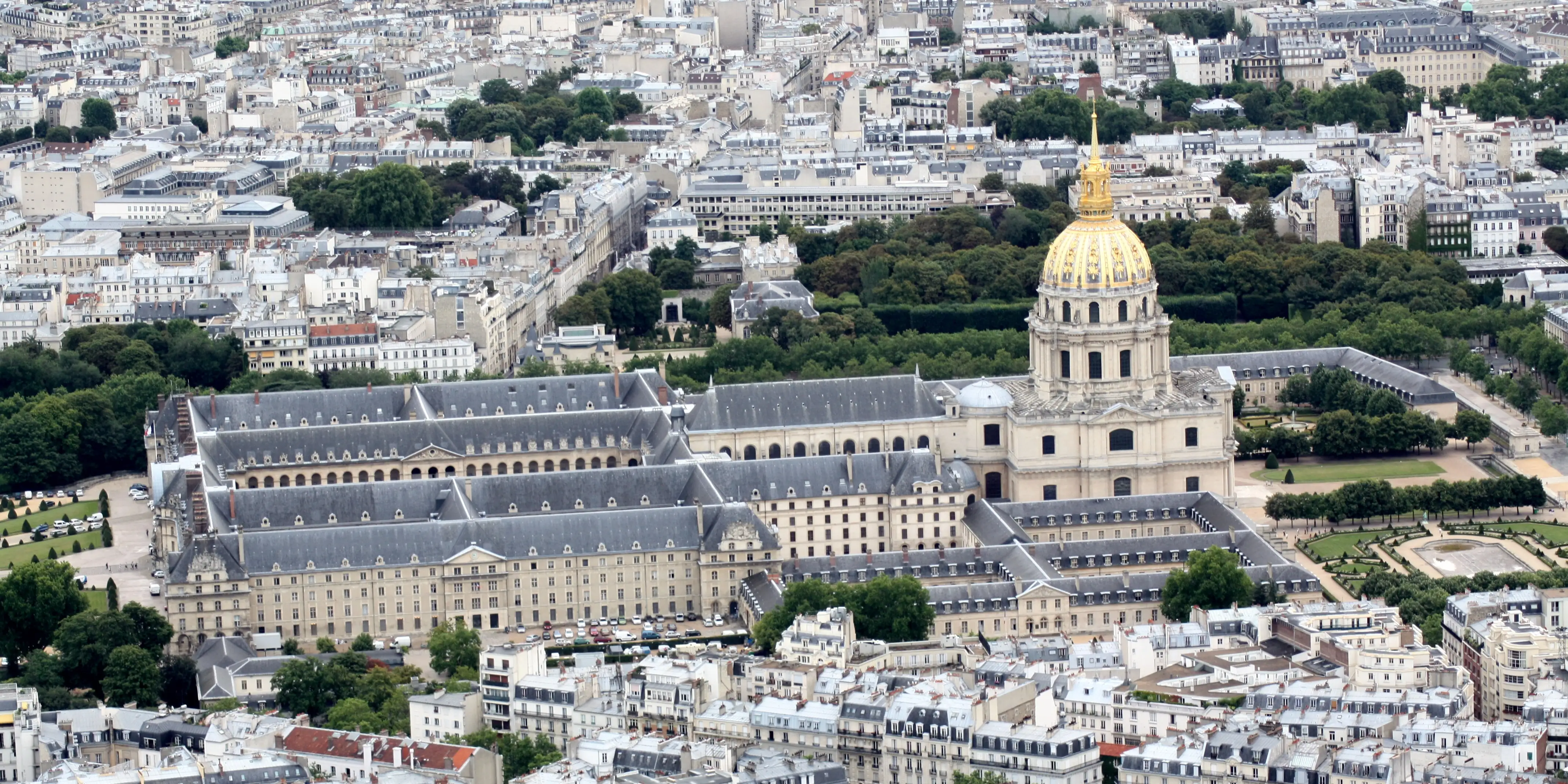
The Hôtel des Invalides is a complex in Paris originally commissioned by King Louis XIV in 1670 as a residence, hospital, and retirement home for injured and retired soldiers. The site included dormitories, a chapel, and administrative buildings to support military veterans. The Dome Church (Église du Dôme), completed in 1708, houses the tomb of Napoleon Bonaparte. Today, the complex functions as a museum of military history and a national monument commemorating France's armed forces.
Key Facts
- Materials
- Stone, Brick, Copper (dome)
- Civilization
- Kingdom of France
- Date(s)
- 1670-1708
- Condition
- Well-preserved, functioning as museum and monument
- Original Function
- Residence and hospital for veterans
- Key Figures
- Louis XIV, Napoleon Bonaparte
Foundation and Purpose
1670-1676King Louis XIV commissioned the Hôtel des Invalides to provide housing and care for disabled and retired soldiers. The first buildings, including dormitories and administrative spaces, were completed by 1676.
Dome Church Construction
1677-1708The Église du Dôme was designed by architect Jules Hardouin-Mansart and completed in 1708. Its gilded dome became a symbol of French Baroque architecture.
Napoleon’s Tomb
1840Napoleon Bonaparte’s remains were transferred to the Dome Church in 1840, creating a major focal point of national reverence and attracting visitors from across France and abroad.
Modern Museum and Commemoration
19th century - presentThe complex now houses several museums on military history, including the Musée de l'Armée. It continues to serve as a site for national ceremonies and commemorations.
Cultural Significance
The Hôtel des Invalides embodies the French monarchy’s commitment to veterans and the institutionalization of military care. Its Dome Church and Napoleon’s tomb reinforce national identity and historical memory in France. It serves both as a functional museum and a symbolic site for remembrance, linking French military history to national pride and ceremonial tradition.
Interpretive Notes
Scholarly debates and areas of uncertainty
Historians debate the degree to which the complex represented genuine care for soldiers versus a tool for royal propaganda. Architectural scholars also discuss the Dome Church’s influence on Baroque church design in France and Europe.
Visiting Information
Entry Rules
Paid admission required for museum areas. Security screening in place. Certain areas may be restricted during military ceremonies.
Best Times to Visit
Weekday mornings or late afternoons minimize crowds. National holidays may feature ceremonies that limit visitor movement.
Photography
Personal photography permitted in museum spaces without flash. Dome Church photography allowed, but drone use prohibited. Commercial photography requires a permit.
Preservation Notes
Visitors must remain on marked paths and avoid touching historical artifacts. Ongoing conservation work may restrict access to certain areas.
Nearby POIs
11 shownSources & Further Reading
- [1]Hôtel des Invalides: History and Architecture — Jean-Pierre Babelon. Éditions du Patrimoine (2010)
- [2]The Musée de l’Armée at Les Invalides — Maurice Agulhon. Paris Historical Press (2015)
Key Facts
- Materials
- Stone, Brick, Copper (dome)
- Civilization
- Kingdom of France
- Date(s)
- 1670-1708
- Condition
- Well-preserved, functioning as museum and monument
- Original Function
- Residence and hospital for veterans
- Key Figures
- Louis XIV, Napoleon Bonaparte