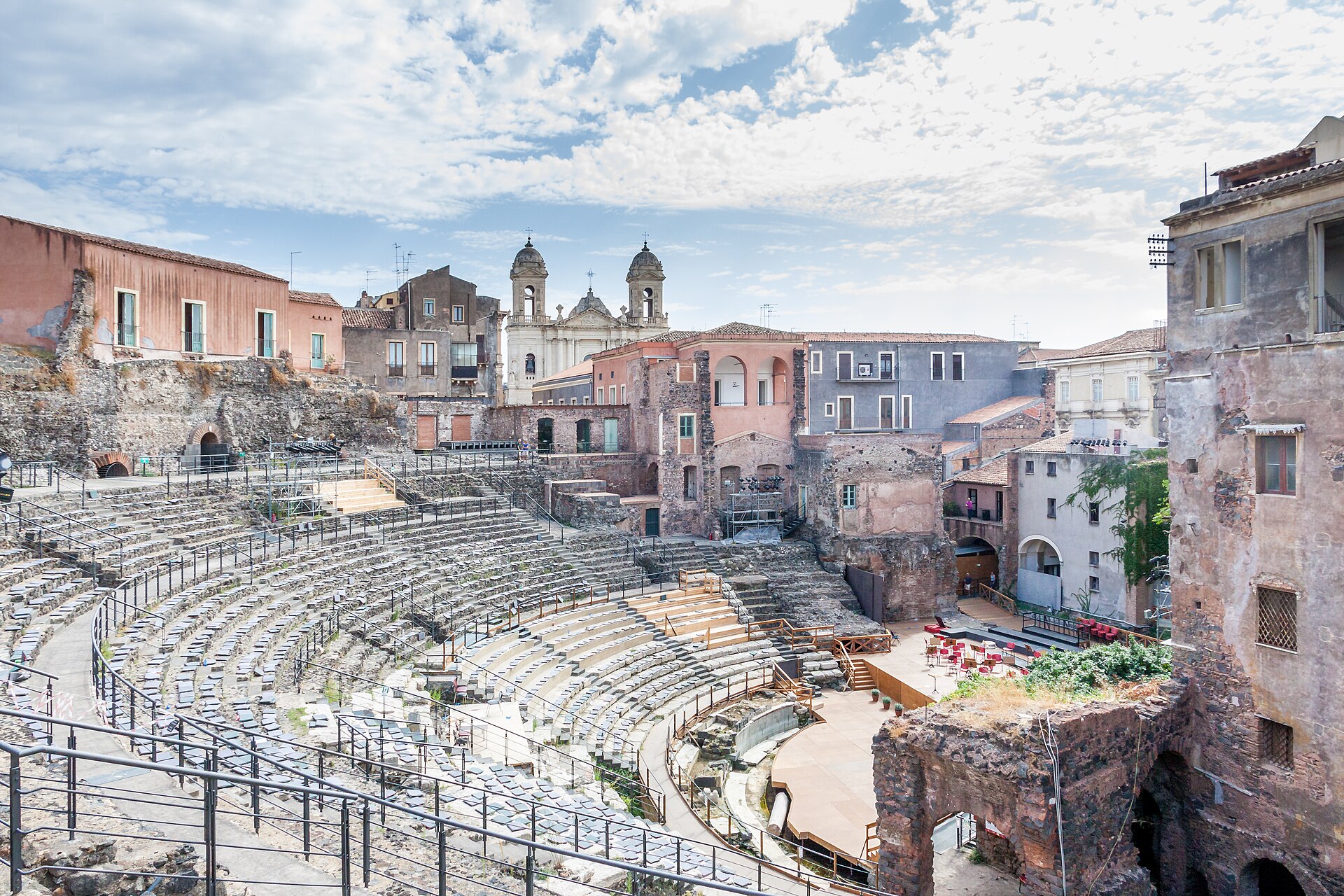
The Roman Theatre of Catania is an ancient structure located in the historic center of the city, nestled between the modern streets of Via Vittorio Emanuele and Via Teatro Greco. Constructed during the 2nd century CE, the theatre was built upon the remains of an earlier Greek structure, utilizing the natural slope of the hill to support its cavea.
The site consists of two distinct parts: the main theatre, which could accommodate approximately 7,000 spectators, and a smaller odeon, used for musical performances and smaller gatherings. Although much of the original marble was repurposed in later centuries for the construction of other buildings in Catania, the remaining lava stone foundations and architectural fragments provide significant insight into the urban planning and cultural life of Roman Catana.
Key Facts
- Materials
- Lava stone, Marble, Brick
- Civilization
- Roman
- Accessibility
- Limited due to uneven ancient surfaces
- Date(s)
- 2nd century CE
- Condition
- Partially preserved archaeological site
- Original Function
- Theatrical performances and public gatherings
- Key Figures
- Alcibiades (associated with the earlier Greek site)
Origins and Construction
2nd century CEThe theatre was constructed during the Roman imperial period, likely replacing an older Greek theatre. It served as a central hub for the city's social and cultural activities.
Medieval Reuse
Middle AgesFollowing the decline of the Roman Empire, the theatre fell into disuse and was gradually buried by urban expansion. Its materials were frequently scavenged for the construction of local palaces and churches.
Modern Excavation
19th-20th centurySystematic excavations began in the 19th century, revealing the extent of the cavea and the adjacent odeon. The site was subsequently integrated into the modern urban fabric of Catania.
Cultural Significance
The theatre serves as a vital link to Catania's ancient past, illustrating the transition from Greek to Roman cultural influence in Sicily. It remains a focal point for understanding the architectural evolution of the city and its resilience through various seismic events and historical shifts.
Interpretive Notes
Scholarly debates and areas of uncertainty
There is ongoing academic discussion regarding the exact extent of the preceding Greek structure and the degree to which the Roman builders incorporated original Greek foundations into their design.
Visiting Information
Entry Rules
Open to the public with a paid admission ticket. Visitors are required to follow marked paths to protect the integrity of the ruins.
Best Times to Visit
Morning hours are recommended to avoid the heat, as the site is largely exposed to the sun.
Photography
Personal photography is permitted. Tripods and commercial equipment require prior authorization from the local archaeological authority.
Preservation Notes
Visitors must remain on designated walkways. Climbing on the ancient stone structures is strictly prohibited to prevent further erosion.
Nearby POIs
3 shownSources & Further Reading
- [1]The Roman Theatre of Catania: Archaeological Survey — G. Rizza. Catania University Press (1990)
- [2]Sicily: An Archaeological Guide — Margaret Guido. Faber & Faber (1977)
Key Facts
- Materials
- Lava stone, Marble, Brick
- Civilization
- Roman
- Accessibility
- Limited due to uneven ancient surfaces
- Date(s)
- 2nd century CE
- Condition
- Partially preserved archaeological site
- Original Function
- Theatrical performances and public gatherings
- Key Figures
- Alcibiades (associated with the earlier Greek site)