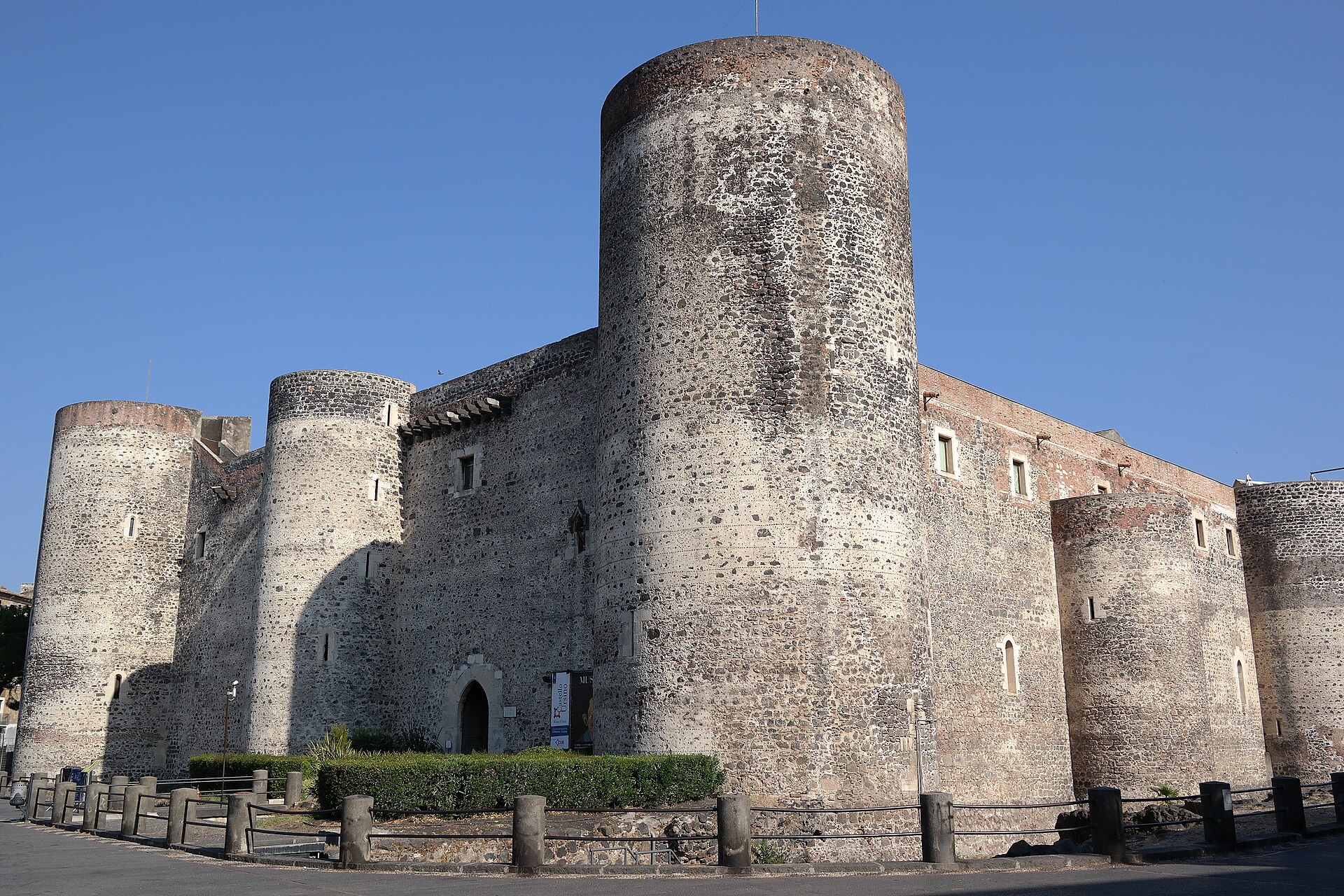
Castello Ursino is a 13th-century castle in Catania, Sicily, constructed by Emperor Frederick II of the Hohenstaufen dynasty. Originally built on a promontory overlooking the sea, the castle served as a strategic defensive fortification and a royal residence for the Sicilian monarchy, notably functioning as the seat of the Sicilian Parliament during the reign of Frederick III of Sicily.
The structure is characterized by its square plan with massive circular towers at each corner and a central courtyard. Despite the 1669 eruption of Mount Etna, which surrounded the castle with lava and pushed the coastline further out, the fortress remained largely intact. Today, it houses the Museo Civico di Catania, displaying a significant collection of archaeological artifacts and fine arts.
Key Facts
- Materials
- Lava stone, Limestone
- Civilization
- Hohenstaufen / Kingdom of Sicily
- Accessibility
- Ground floor accessible, upper levels limited
- Date(s)
- 1239-1250 CE
- Condition
- Well-preserved, repurposed as a civic museum
- Original Function
- Royal fortress and defensive citadel
- Key Figures
- Frederick II, Frederick III of Sicily
Construction under Frederick II
1239-1250The castle was commissioned by Emperor Frederick II as part of a defensive network to consolidate royal authority in Sicily. It was designed by the architect Riccardo da Lentini.
Royal Residence and Parliament
14th centuryDuring the Sicilian Vespers and the subsequent Aragonese rule, the castle served as a royal residence and the seat of the Sicilian Parliament, playing a central role in the island's political life.
The 1669 Eruption
1669A massive eruption of Mount Etna drastically altered the landscape. Lava flows surrounded the castle and filled the moat, effectively isolating the fortress from the sea and changing its strategic position.
Modern Museum Transformation
20th century - presentFollowing extensive restoration work, the castle was converted into the Museo Civico di Catania. It now serves as the primary repository for the city's historical and artistic heritage.
Cultural Significance
Castello Ursino stands as a symbol of the Hohenstaufen architectural legacy in Southern Italy. It represents the transition of Sicilian power structures from the medieval period into the early modern era, serving as a physical witness to the island's complex history of foreign rule and natural disasters.
Interpretive Notes
Scholarly debates and areas of uncertainty
There is ongoing academic discussion regarding the original maritime accessibility of the castle. While historical records suggest it was built on a cliff overlooking the sea, the exact topography of the coastline prior to the 1669 lava flow remains a subject of geological and archaeological investigation.
Visiting Information
Entry Rules
Open daily. Tickets are required for museum entry. Visitors are requested to follow standard museum conduct and refrain from touching the exhibits.
Best Times to Visit
Morning hours are recommended to avoid afternoon crowds. The site is particularly significant for those interested in the history of the Sicilian Parliament.
Photography
Personal photography is permitted without flash. Professional photography requires prior authorization from the museum administration.
Preservation Notes
The structure is subject to ongoing maintenance due to its age and the impact of the surrounding volcanic terrain. Visitors must remain within designated museum pathways.
Nearby POIs
3 shownSources & Further Reading
- [1]Frederick II: A Medieval Emperor — David Abulafia. Oxford University Press (1988)
- [2]Castelli di Sicilia — Ferdinando Maurici. Edizioni d'Arte (2001)
Key Facts
- Materials
- Lava stone, Limestone
- Civilization
- Hohenstaufen / Kingdom of Sicily
- Accessibility
- Ground floor accessible, upper levels limited
- Date(s)
- 1239-1250 CE
- Condition
- Well-preserved, repurposed as a civic museum
- Original Function
- Royal fortress and defensive citadel
- Key Figures
- Frederick II, Frederick III of Sicily